An MIT professor taught the same math course for 62 years, and the day he retired, students from every country on earth showed up online to watch him give his final lecture.
I opened the playlist at 2am and ended up watching three of them back to back.
His name is Gilbert Strang. The course is MIT 18.06 Linear Algebra.
Every machine learning engineer, every data scientist, every quant, every self-taught programmer who actually understands how AI works learned the math from this one man. Most of them never set foot on MIT's campus. They just opened a free playlist on YouTube and let him teach.
Here's the story almost nobody tells you.
Strang joined the MIT math faculty in 1962. He retired in 2023. That is 61 years of standing at the same chalkboard teaching the same subject to 18-year-olds.
The interesting part is what he did when MIT launched OpenCourseWare in 2002. Most professors were skeptical. They worried that putting their lectures online would make their classrooms irrelevant. Strang did not hesitate. He said his life's mission was to open mathematics to students everywhere. He filmed every lecture and gave it away.
The decision quietly changed how the world learns math.
For decades linear algebra was taught the wrong way. Professors started with abstract vector spaces and proofs about field axioms. Students drowned in the abstraction. Most never recovered. They walked out believing they were bad at math when they had simply been taught in an order that nobody's brain is built to absorb.
Strang inverted the entire curriculum.
He started with matrix multiplication. Something you can write down on paper. Something you can compute by hand. Something you can see. Then he showed his students that everything else in linear algebra eigenvectors, singular value decomposition, orthogonality, the four fundamental subspaces was just a different lens for understanding what the matrix was actually doing under the hood.
His rule was strict. If a student could not explain a concept using a concrete 3 by 3 example, that student did not actually understand the concept yet. The abstraction was supposed to come last, not first. The intuition was the foundation. The proofs were just confirmation that the intuition was correct.
The second thing Strang changed was the classroom itself. He said please and thank you to his students. Every single lecture. He paused mid-derivation to ask "am I OK?" to check if anyone was lost. He never used the word "obviously" or "trivially" because he knew exactly what those words do to a student who is one step behind. He treated 19-year-olds learning math for the first time the way he treated his own colleagues. With patience. With respect. With the assumption that they belonged in the room.
For 62 years.
The result is something that has never happened in the history of education. A single math professor became the default teacher of his subject for the entire planet.
Universities in India, China, Brazil, Nigeria, every country with a computer science department, started telling their own students to just watch Strang's lectures. The University of Illinois revised its linear algebra course to do almost no in-person lecturing. The reason was honest. The professor said they could not compete with the videos.
His final lecture was in May 2023.
The auditorium was packed with students who had never met him before. He walked to the chalkboard, taught for an hour, and at the end the entire room stood and applauded. He looked confused for a moment, like he genuinely did not understand why they were cheering. Then he smiled and waved them off and walked out.
His written comment under the YouTube video of that final lecture was four sentences long. He said teaching had been a wonderful life. He said he was grateful to everyone who saw the importance of linear algebra. He said the movement of teaching it well would continue because it was right.
That was it. No book promotion. No farewell speech. No legacy management.
The man whose teaching is the foundation of modern AI just thanked the audience and went home.
20 million views. Zero ego. The entire engine of the AI revolution sits on top of math that millions of people learned for free from one quiet professor in Cambridge.
The course is still on MIT OpenCourseWare. Every lecture, every problem set, every exam, every solution. Free.
The most important math course of the 21st century is sitting one click away from you. Most people will never open it.
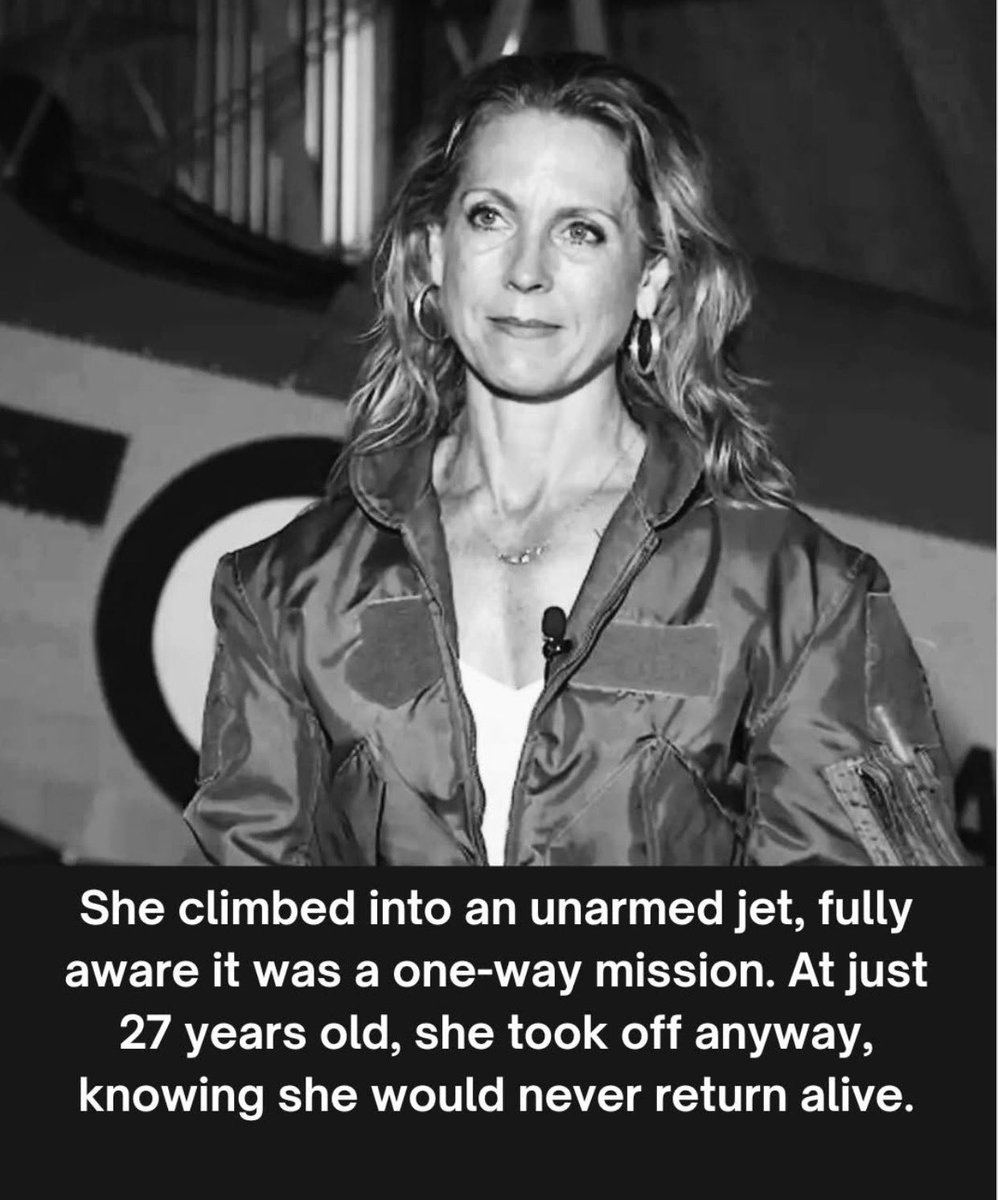
On the morning of September 11, 2001, First Lieutenant Heather “Lucky” Penney was sitting in a briefing room at Andrews Air Force Base, Maryland, planning routine training operations. She had no idea that within an hour, she would be called to risk her life in a way few could imagine.
Tuesday morning began like any other. Then someone entered the briefing room and said the words that changed everything: “Somebody just flew into the World Trade Center.”
Within minutes, confusion gave way to horror. A second plane hit, then a third struck the Pentagon, just fifteen miles away. Smoke rose on the horizon, visible from the base. America was under attack.
Reports streamed in of a fourth hijacked plane—United Airlines Flight 93—headed for Washington, D.C., likely the White House or the Capitol. Heather and her commanding officer, Lieutenant Colonel Marc Sasseville, were among the closest fighters ready to intercept.
There was one problem: their F-16s carried no missiles. No live ammunition. The jets had just returned from training in Nevada, loaded only with practice rounds.
Sasseville looked at Heather and said, “Lucky, you’re coming with me.”
They sprinted to their jets. Preflight procedures normally took thirty minutes—they had none. Ground crews hurried to remove safety pins as pilots climbed into their cockpits. The mission was clear: find Flight 93. Stop it from reaching Washington. By any means necessary.
Heather knew exactly what that meant. Without weapons capable of downing a 757, the only option was to fly her F-16 directly into the hijacked airliner. A one-way mission.
As she strapped in, Sasseville’s voice cut through her headset: “I’ll take the cockpit. You take the tail.” Heather responded, “Roger that.” No fear—only focus. Protecting her country mattered more than anything.
As they lifted off, screaming over the burning Pentagon, Heather felt the odd calm of training instincts taking over. Her father had taught her precision, focus, purpose. Now she would use every lesson to crash into a plane full of civilians. For a brief moment, she imagined her father might be at the controls of Flight 93. It wouldn’t have changed anything. The mission came first.
Heather and Sasseville never intercepted Flight 93. Because 200 miles away, ordinary Americans on that flight had already made the choice she was willing to make. Through phone calls, they learned of the attacks, knew the plane had been turned into a weapon, and decided to fight back. Todd Beamer rallied fellow passengers: “Are you ready? Okay. Let’s roll.” They stormed the cockpit, and at 10:03 AM, Flight 93 crashed into a Pennsylvania field. Forty-four people died—but the plane never reached Washington.
When Heather finally landed later that afternoon, her crew chief was waiting, tears in his eyes. “I didn’t think I’d see you again, ma’am,” he said. “Neither did I,” she replied.
For ten years, Heather rarely spoke of the day. When she did, she deflected praise to the passengers of Flight 93. “They were ordinary Americans living ordinary lives, forced to make an impossible choice,” she said. “Sasseville and I were ready to give our lives too. Anyone would have. The passengers on Flight 93 did it first.”
Heather later served two combat tours in Iraq, and flying night missions as a SCUD hunter. Today, she advocates for service members as a defense policy expert.
She remembers September 11 every day—not with trauma, but with hope. She witnessed ordinary people becoming heroes, strangers risking everything for others, a nation remembering some things are worth more than ourselves.
23 years have passed. The world has changed. But the lesson remains: courage isn’t the absence of fear—it’s strapping in anyway. Duty isn’t about destruction—it’s about protection. Sometimes being “Lucky” means being ready to give everything for something bigger than yourself.
In honor of First Lieutenant Heather “Lucky” Penney—and the forty heroes of Flight 93 who acted first.
"My name's Raymond. I'm 73. I work the parking lot at St. Joseph's Hospital. Minimum wage, orange vest, a whistle I barely use. Most people don't even look at me. I'm just the old man waving cars into spaces.
But I see everything.
Like the black sedan that circled the lot every morning at 6 a.m. for three weeks. Young man driving, grandmother in the passenger seat. Chemotherapy, I figured. He'd drop her at the entrance, then spend 20 minutes hunting for parking, missing her appointments.
One morning, I stopped him. "What time tomorrow?"
"6:15," he said, confused.
"Space A-7 will be empty. I'll save it."
He blinked. "You... you can do that?"
"I can now," I said.
Next morning, I stood in A-7, holding my ground as cars circled angrily. When his sedan pulled up, I moved. He rolled down his window, speechless. "Why?"
"Because she needs you in there with her," I said. "Not out here stressing."
He cried. Right there in the parking lot.
Word spread quietly. A father with a sick baby asked if I could help. A woman visiting her dying husband. I started arriving at 5 a.m., notebook in hand, tracking who needed what. Saved spots became sacred. People stopped honking. They waited. Because they knew someone else was fighting something bigger than traffic.
But here's what changed everything, A businessman in a Mercedes screamed at me one morning. "I'm not sick! I need that spot for a meeting!"
"Then walk," I said calmly. "That space is for someone whose hands are shaking too hard to grip a steering wheel."
He sped off, furious. But a woman behind him got out of her car and hugged me. "My son has leukemia," she sobbed. "Thank you for seeing us."
The hospital tried to stop me. "Liability issues," they said. But then families started writing letters. Dozens. "Raymond made the worst days bearable." "He gave us one less thing to break over."
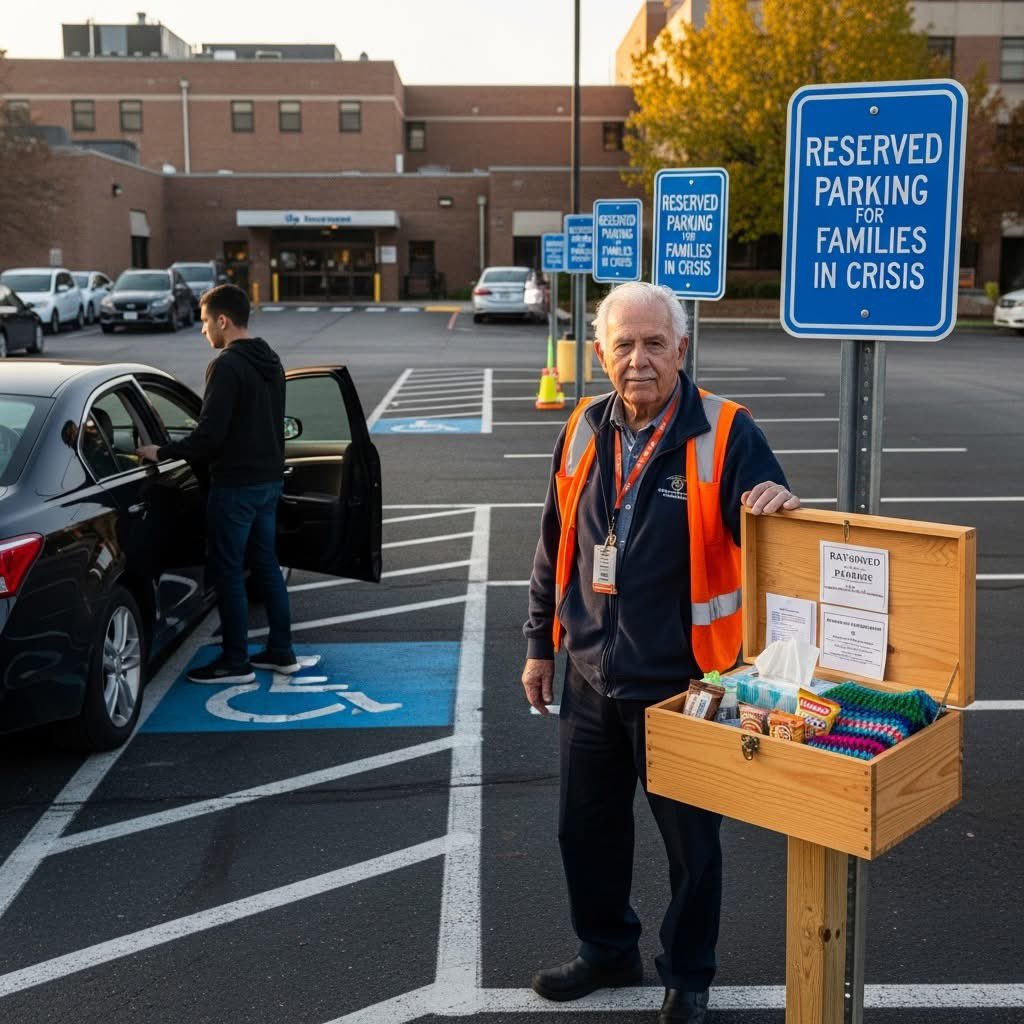
Last month, they made it official. "Reserved Parking for Families in Crisis." Ten spots, marked with blue signs. And they asked me to manage it.
But the best part? A man I'd helped two years ago, his mother survived, came back. He's a carpenter. Built a small wooden box, mounted it by the reserved spaces. Inside? Prayer cards, tissues, breath mints, and a note,
"Take what you need. You're not alone. -Raymond & Friends"
People leave things now. Granola bars. Phone chargers. Yesterday, someone left a hand-knitted blanket.
I'm 73. I direct traffic in a hospital parking lot. But I've learned this: Healing doesn't just happen in operating rooms. Sometimes it starts in a parking space. When someone says, "I see your crisis. Let me carry this one small piece."
So pay attention. At the grocery checkout, the coffee line, wherever you are. Someone's drowning in the little things while fighting the big ones.
Hold a door. Save a spot. Carry the weight no one else sees.
It's not glamorous. But it's everything."
Let this story reach more hearts....
Credit: Mary Nelson