Come share your research at @nyuniversity!
The NYU Social Psychology Program is inviting speakers for our 2026-2027 Speaker Series! If you’ll be passing through NYC next year and are interested in giving a research talk, we’d love to hear from you.
Nominate yourself using this short form by MAY 15th: https://t.co/xZV2zxSz53
PhD students in our program @ktannemason and @okst_kayley will be coordinating the speaker series. We welcome self-nominations and scholars from all career stages.
NYU Social Psychology is looking for people passing through NYC next year who want to give a research TALK in our Speaker Series.
We welcome self-nominations and scholars from all career stages (you can apply multiple time).
Apply here: https://t.co/0hcxS8D0mY
*Time Sensitive* Call for Collaboration:
We’re launching a new megastudy of interventions aimed at increasing voter registration.
Become our coauthor by submitting one of the interventions we select for testing.
Submit by Sept 1: https://t.co/esJWUStdUH
New pub!
“‘Today I Can Look in the Mirror and Like Myself’: Effects of a Trauma-Informed Mindful Recovery Program on Self-Compassion”
https://t.co/9MJUbBLClU
@EricRLouderback@CMC_CHA@JoeRosansky@NIH_NCCIH The study will be helpful to understanding the question of differences across interventions delivered via virtual modalities, but future research is needed to directly compare mindfulness-based interventions delivered in person vs. online.
@EricRLouderback@CMC_CHA@JoeRosansky We are currently running an @NIH_NCCIH funded comparative effectiveness trial comparing online, synchronous mindfulness-based cognitive therapy (for resilience in covid) to asynchronous iCBT and an enhanced version of CHAMindWell as a control. Stay tuned for those results soon!
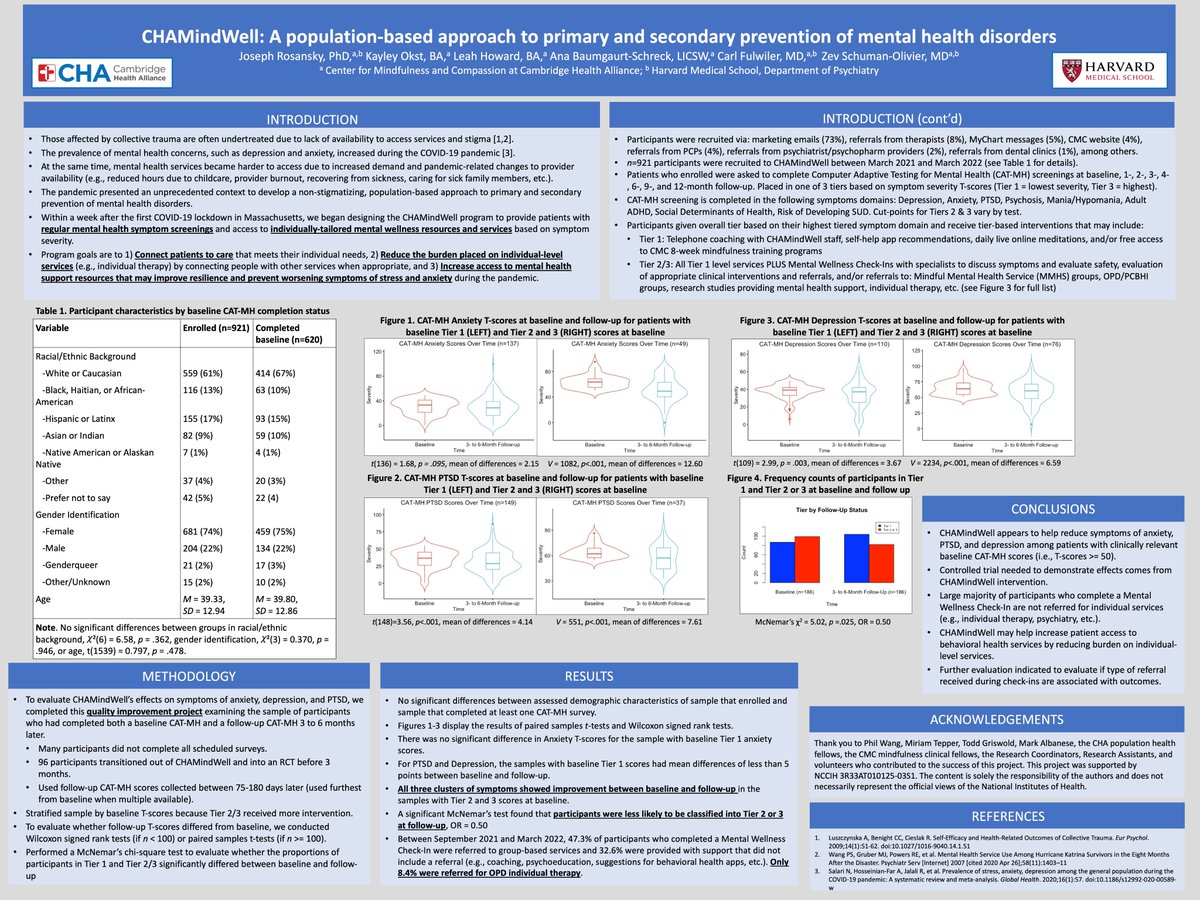
Chat with @JoeRosansky and @okst_kayley about their QI work: "CHAMindWell: A population-based approach to primary and secondary prevention of mental health disorders"! #CHAvirtualposter
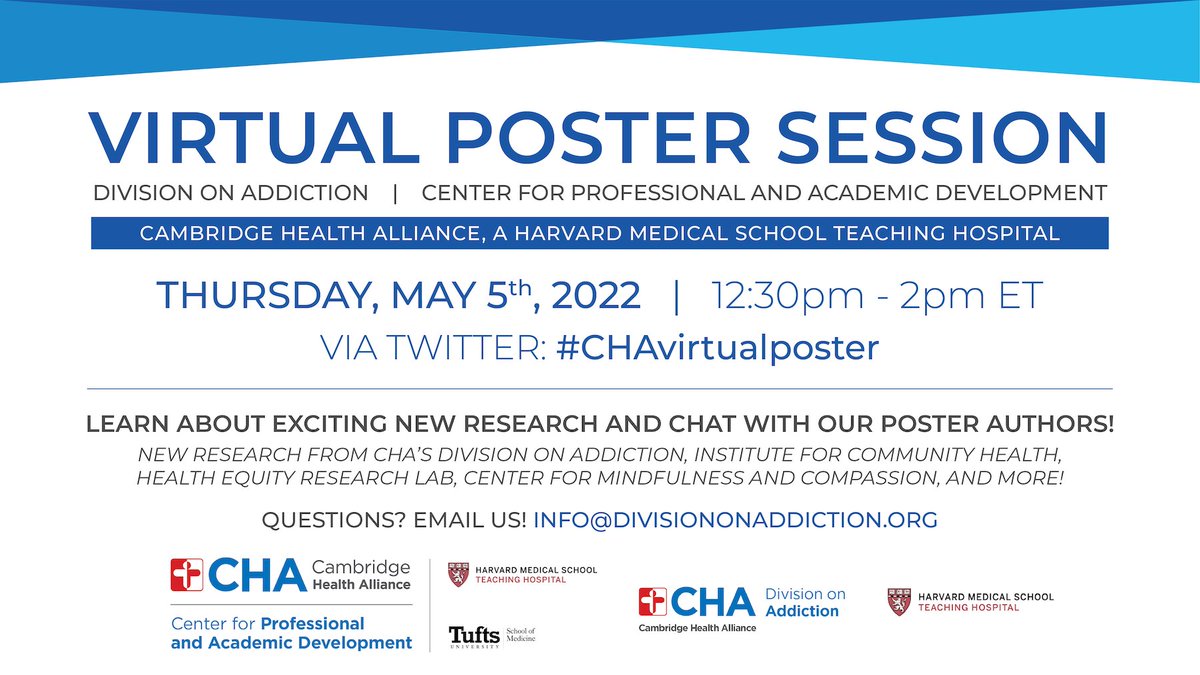
The @challiance Virtual Poster Session will take place right here on Twitter – TOMORROW, May 5! Swing by between 12:30-2pm ET for the latest research from @icommhealth, @bencook_equity, @CMC_CHA the CHA Department of Psychiatry, and more! #CHAvirtualposter
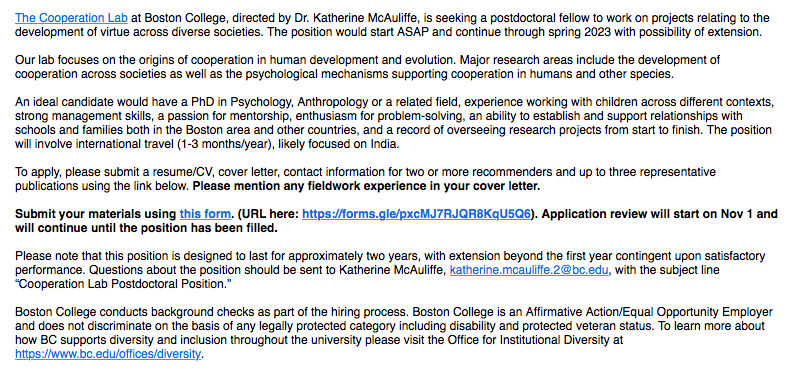
My lab is looking for a postdoc to work on virtue-related projects. Applications due Nov 1. Position would start ASAP. Ad and link below. We’re really excited to add to our team so please share widely. (My last RT request for a while, I promise!).
https://t.co/FNCynHL5HF
@DebiLaPlante@CMC_CHA In terms of ACES, we dichotomized based on number of ACES rather than type. I suspect it may be difficult to parse out the differential effects of one type of ACE over another because they are often co-occurring in this population. Thank you again for your questions!
@DebiLaPlante@CMC_CHA A few male participants also reported feeling less inclined to participate in impulsive violence. Gender effects are definitely something we are hoping to explore in the RCT we are currently running!
@DebiLaPlante@CMC_CHA Thank you Debi! Our sample size was small and predominantly male, so we were not able to explore gender effects in great detail. However, M-ROCC was found to be feasible and acceptable in this majority male population.
@heathermarygray@CMC_CHA@Div_Addiction In terms of the provider piece specifically, the M-ROCC program is trauma-informed, so I think further incorporating aspects of that approach into other areas of treatment would be beneficial
@heathermarygray@CMC_CHA@Div_Addiction Many participants specifically cited the group setting as a factor that positively impacted their experience in the program.
@heathermarygray@CMC_CHA@Div_Addiction Thank you Heather! I do believe there is a role for healthcare providers to play; however, one of the large goals of M-ROCC is to allow participants to get the support of other group members (who have had similar experiences) which may be equally if not more powerful.