. @HottieBabeGem Marketing Team Recruitment
Hey everyone! We’re looking for people who are interested in helping us source potential clients by reaching out to businesses and Web3 projects that may be interested in promoting their projects with us.
If you have experience with outreach, networking, or business development, or you’re willing to learn, we’d love to have you on the team.
If you’re interested, please fill out the application form below. We’ll review all submissions and get in touch with shortlisted applicants.
Application Form: https://t.co/lNMSa72HJD
Every generation solves one trust problem, then runs into the next
Btc answered, “can strangers exchange value without a bank?”
Eth answered, “can agreements execute without intermediaries?”
now ai forces a different question: who decides when there isn’t a single provable ans
i just secured some whitelist spot for you guys
Market Players. Each chart bar now has a character
🎭 by OG artist osmankbt
Launchpad: @opensea
Supply: 4,444
Chain: ETH
Mint Date: 04.08.2026 🗓️
MP: TBA
Musts DROP wallet address
- F0ll(0)w ME @0xmarketplayers & @osmankbt
- Like & RT - Turn notifys ON 🔔
5 GTD + 25 FCFS spots (don’t ask more GTD. Spots limited)
NFA... DYOR
Just sent out another batch of airdrops for AGNT.
Ranges from $5 USDC > $50 in solana:9cRCn9rGT8V2imeM2BaKs13yhMEais3ruM3rPvTGpump
Go check your agnt wallets.
And check out the methodology used here in this video.
@HottieBabeGem@KiiChainio One thing I’ve noticed is that KiiChain has stayed focused on the same vision from the start. It’s easier to trust a project that keeps building instead of constantly changing direction.
I’ll definitely join the public sale
People often celebrate the milestone. What usually goes unnoticed is the work that made it possible.
Over the past few months, @KiiChainio has continued to build with a clear focus on solving real financial challenges. Instead of chasing short term narratives, the ecosystem has steadily expanded through onchain FX, stablecoin powered payments, cross border settlement, and financial infrastructure designed to better serve emerging markets.
That consistent execution has now led to another important milestone.
Registration for the $KII Public Sale is officially open.
This is more than preparing for a Public Sale. It marks the next phase of an ecosystem that has grown through continuous product development, community participation, and a long term vision centered on real utility.
What stands out to me is KiiChain’s commitment to building infrastructure that addresses practical financial needs. The focus has remained on improving how value moves across borders, making payments more efficient, and expanding access to modern financial services for users and businesses alike.
Registering early is about being prepared for what’s ahead. It keeps you informed, gives you time to prepare before the Public Sale begins, and ensures you’re ready as the ecosystem enters its next stage of growth. With momentum continuing to build around the ecosystem, being early today could make all the difference tomorrow.
Now is the right time to register for the $KII Public Sale, explore the KiiChain App, and stay up to date as new announcements and milestones continue to unfold. The opportunity to prepare is available now, but it won’t always feel this early.
Once you’ve registered, share the announcement with your network and invite others who are interested in financial infrastructure, cross border payments, and the future of Web3 to join the conversation. Strong ecosystems are built by communities that grow together.
Looking forward to seeing the next chapter of @KiiChainio unfold.
Here's my link to Register: https://t.co/VqcyH658FK
The more I think about AI agents, the less I think intelligence is the hard problem.
The hard problem is judgment.
An agent can negotiate a contract, send a payment, and execute every instruction exactly as written. But what happens when both sides believe they followed the agreement and still end up in a dispute?
That isn’t a failure of automation.
It’s a failure of interpretation.
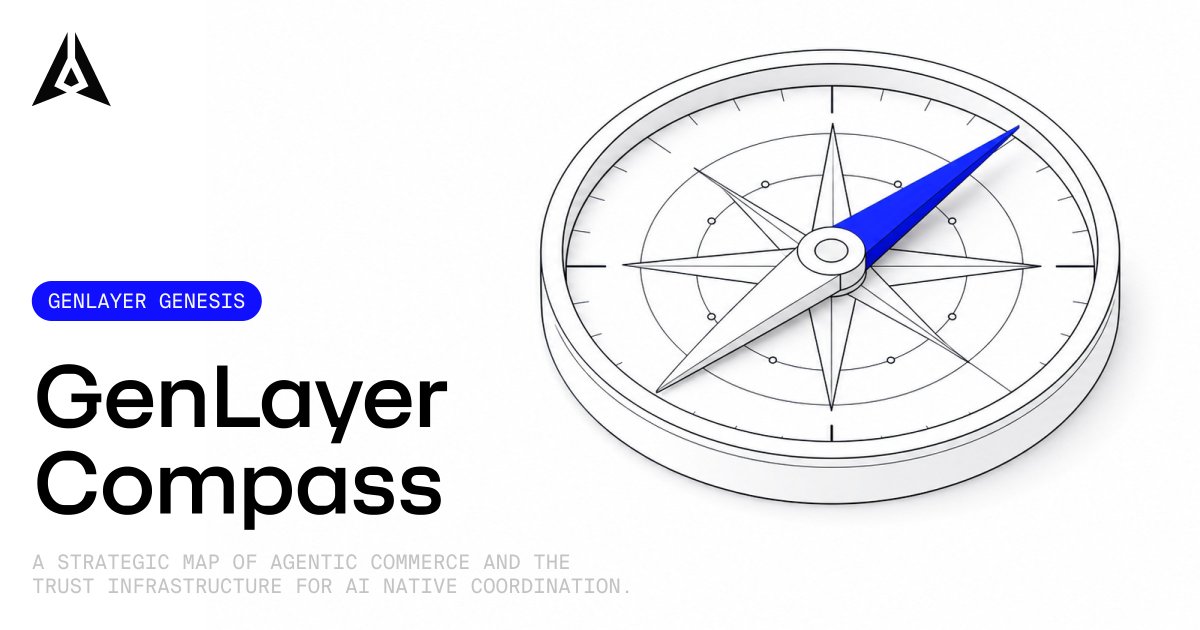
That’s why I spent time reading The Compass from @GenLayer
It isn’t a whitepaper explaining how the protocol works. It’s one of GenLayer’s founding documents, laying out the worldview, the concept, and the mission behind building an adjudication layer for the agent economy.
One idea stayed with me.
The Compass argues that trust has always evolved whenever humans needed to cooperate at a larger scale. We moved from personal trust to institutions, then to markets, reputation systems, and finally cryptography. Each layer solved a problem the previous one couldn’t.
Now we’re creating autonomous agents that will negotiate, sign agreements, and exchange value without human involvement.
Yet the infrastructure being built today still assumes the happy path.
Payments are improving.
Identity is improving.
Negotiation is improving.
But none of those layers answer the question that matters when something goes wrong:
Who decides what an agreement actually meant?
That isn’t something code alone can solve.
It’s a problem of judgment.
The Compass explains why @GenLayer believes adjudication is the next layer of trust, extending decentralization beyond execution and into interpretation itself.
If you want to understand the thinking behind GenLayer instead of only reading product updates, start here:
https://t.co/Dj5LtUuJZq
I’m curious what others think.
Will decentralized AI need better models, or will it need better systems for resolving disagreement?
The more I think about AI agents, the less I think intelligence is the hard problem.
The hard problem is judgment.
An agent can negotiate a contract, send a payment, and execute every instruction exactly as written. But what happens when both sides believe they followed the agreement and still end up in a dispute?
That isn’t a failure of automation.
It’s a failure of interpretation.
That’s why I spent time reading The Compass from @GenLayer
It isn’t a whitepaper explaining how the protocol works. It’s one of GenLayer’s founding documents, laying out the worldview, the concept, and the mission behind building an adjudication layer for the agent economy.
One idea stayed with me.
The Compass argues that trust has always evolved whenever humans needed to cooperate at a larger scale. We moved from personal trust to institutions, then to markets, reputation systems, and finally cryptography. Each layer solved a problem the previous one couldn’t.
Now we’re creating autonomous agents that will negotiate, sign agreements, and exchange value without human involvement.
Yet the infrastructure being built today still assumes the happy path.
Payments are improving.
Identity is improving.
Negotiation is improving.
But none of those layers answer the question that matters when something goes wrong:
Who decides what an agreement actually meant?
That isn’t something code alone can solve.
It’s a problem of judgment.
The Compass explains why @GenLayer believes adjudication is the next layer of trust, extending decentralization beyond execution and into interpretation itself.
If you want to understand the thinking behind GenLayer instead of only reading product updates, start here:
https://t.co/Dj5LtUuJZq
I’m curious what others think.
Will decentralized AI need better models, or will it need better systems for resolving disagreement?
People often say technology removes the need for trust.
I don’t think that’s completely true.
What technology has actually done over time is change where trust lives.
We stopped trusting banks to move money and trusted cryptography instead.
We stopped trusting servers to execute agreements and trusted code instead.
Now we’re entering a world where AI agents won’t just answer questions. They’ll negotiate contracts, purchase services, hire other agents, move assets, and make business decisions on our behalf.
That raises a different problem.
What happens when two intelligent agents read the same agreement, look at the same evidence, and honestly reach different conclusions?
The problem isn’t that one of them is lying.
The problem is that proof alone doesn’t always tell us what a transaction means.
That’s why reading The Compass from @GenLayer changed how I think about the next phase of the agent economy.
The Compass isn’t another technical specification. It’s one of GenLayer’s founding documents, explaining the worldview, the concept, and the mission behind building an adjudication layer for AI commerce.
One idea stood out to me.
Trust has always evolved in layers because every generation faced a new coordination problem. Personal trust worked for small communities. Laws, markets, reputation systems, and cryptography expanded cooperation between strangers. But none of those layers answer what happens when autonomous agents disagree over the meaning of an agreement.
That’s the gap GenLayer is trying to solve.
Not by asking everyone to produce identical answers, but by reaching decentralized consensus on equivalent meaning through AI validator consensus. That’s a very different problem from simply verifying facts or executing code.
As agents become participants in the economy rather than tools we occasionally use, disagreements won’t be rare exceptions. They’ll become part of normal commerce.
The systems that define the next decade won’t just automate transactions.
They’ll make sure those transactions can reach fair conclusions when interpretation matters.
I think that’s why The Compass is worth reading. It isn’t just explaining what @GenLayer is building. It’s asking one of the biggest questions for the AI era:
If proof isn’t enough, who should decide what is true, and why should anyone trust that decision?
People often say technology removes the need for trust.
I don’t think that’s completely true.
What technology has actually done over time is change where trust lives.
We stopped trusting banks to move money and trusted cryptography instead.
We stopped trusting servers to execute agreements and trusted code instead.
Now we’re entering a world where AI agents won’t just answer questions. They’ll negotiate contracts, purchase services, hire other agents, move assets, and make business decisions on our behalf.
That raises a different problem.
What happens when two intelligent agents read the same agreement, look at the same evidence, and honestly reach different conclusions?
The problem isn’t that one of them is lying.
The problem is that proof alone doesn’t always tell us what a transaction means.
That’s why reading The Compass from @GenLayer changed how I think about the next phase of the agent economy.
The Compass isn’t another technical specification. It’s one of GenLayer’s founding documents, explaining the worldview, the concept, and the mission behind building an adjudication layer for AI commerce.
One idea stood out to me.
Trust has always evolved in layers because every generation faced a new coordination problem. Personal trust worked for small communities. Laws, markets, reputation systems, and cryptography expanded cooperation between strangers. But none of those layers answer what happens when autonomous agents disagree over the meaning of an agreement.
That’s the gap GenLayer is trying to solve.
Not by asking everyone to produce identical answers, but by reaching decentralized consensus on equivalent meaning through AI validator consensus. That’s a very different problem from simply verifying facts or executing code.
As agents become participants in the economy rather than tools we occasionally use, disagreements won’t be rare exceptions. They’ll become part of normal commerce.
The systems that define the next decade won’t just automate transactions.
They’ll make sure those transactions can reach fair conclusions when interpretation matters.
I think that’s why The Compass is worth reading. It isn’t just explaining what @GenLayer is building. It’s asking one of the biggest questions for the AI era:
If proof isn’t enough, who should decide what is true, and why should anyone trust that decision?
The entire agent economy is being built for the moment things go right.
Payments, identity, negotiation.
Almost no one is building for the moment two agents disagree.
And they will. By 2030 ARK projects the agentic economy at $9 trillion, and no court was built to settle deals between software.
The average civil dispute in the US already takes 344 days.
That missing piece is adjudication, and it is the layer GenLayer exists to be.
We wrote the whole thinking behind it in The Compass, one of GenLayer's founding texts alongside the Manifesto and the whitepaper.
It lays out the worldview, the concept, and the mission in one place.
Read The Compass → https://t.co/EaIu3i8cz9
The entire agent economy is being built for the moment things go right.
Payments, identity, negotiation.
Almost no one is building for the moment two agents disagree.
And they will. By 2030 ARK projects the agentic economy at $9 trillion, and no court was built to settle deals between software.
The average civil dispute in the US already takes 344 days.
That missing piece is adjudication, and it is the layer GenLayer exists to be.
We wrote the whole thinking behind it in The Compass, one of GenLayer's founding texts alongside the Manifesto and the whitepaper.
It lays out the worldview, the concept, and the mission in one place.
Read The Compass → https://t.co/EaIu3i8cz9
@Tjbeauti The interesting shift here is treating disagreement as expected rather than exceptional. Real economies always generate disputes, so agent economies will too.