1. Follow @MyCoralApp@TheCoralIntern on X
2. Quote tweet the pinned post and tag 5 friends with a message.
3. Option 2, write a tweet and use the statement "Inthereef" and tag us.
4. Join the Coral Tribe (https://t.co/D19mz2GdSS) and say what you benefited from the event
Best 10 will be selected by the team.
Each person will get N10k. It will close at midnight today.
Announcement will be made latest Monday.
The Names of God and Their Meanings With Scriptures
1. Elohim – God, the Mighty Creator
📖 Genesis 1:1 – "In the beginning God created the heavens and the earth."
2. Yahweh (Jehovah) – I AM WHO I AM
📖 Exodus 3:14 – "God said to Moses, 'I AM WHO I AM.'"
3. El Shaddai – God Almighty
📖 Genesis 17:1 – "I am God Almighty; walk before me faithfully and be blameless."
4. Adonai – Lord and Master
📖 Psalm 8:1 – "O LORD, our Lord, how majestic is your name in all the earth!"
5. El Elyon – The Most High God
📖 Genesis 14:19 – "Blessed be Abram by God Most High, Creator of heaven and earth."
6. El Roi – The God Who Sees Me
📖 Genesis 16:13 – "You are the God who sees me."
7. Jehovah Jireh – The Lord Will Provide
📖 Genesis 22:14 – "So Abraham called that place The LORD Will Provide."
8. Jehovah Rapha – The Lord Who Heals
📖 Exodus 15:26 – "For I am the LORD, who heals you."
9. Jehovah Nissi – The Lord Is My Banner
📖 Exodus 17:15 – "Moses built an altar and called it The LORD is my Banner."
10. Jehovah Shalom – The Lord Is Peace
📖 Judges 6:24 – "So Gideon built an altar to the LORD there and called it The LORD Is Peace."
11. Jehovah Tsidkenu – The Lord Our Righteousness
📖 Jeremiah 23:6 – "And this is the name by which he will be called: The LORD Our Righteous Savior."
12. Jehovah Sabaoth – The Lord of Hosts
📖 1 Samuel 1:3 – "To worship and sacrifice to the LORD Almighty at Shiloh."
13. Jehovah Rohi (Raah) – The Lord My Shepherd
📖 Psalm 23:1 – "The LORD is my shepherd, I shall not want."
14. Jehovah Shammah – The Lord Is There
📖 Ezekiel 48:35 – "And the name of the city from that time on will be: THE LORD IS THERE."
15. Ancient of Days – The Eternal God
📖 Daniel 7:9 – "As I looked, thrones were set in place, and the Ancient of Days took his seat."
16. Alpha and Omega – The Beginning and the End
📖 Revelation 22:13 – "I am the Alpha and the Omega, the First and the Last, the Beginning and the End."
17. Father – The Loving Father of His Children
📖 Matthew 6:9 – "Our Father in heaven, hallowed be your name."
18. King of Kings and Lord of Lords – The Supreme Ruler Over All
📖 Revelation 19:16 – "KING OF KINGS AND LORD OF LORDS."
19. Emmanuel – God With Us
📖 Matthew 1:23 – "They will call him Immanuel (which means 'God with us')."
20. Rock – Our Strength and Refuge
📖 Psalm 18:2 – "The LORD is my rock, my fortress and my deliverer."
"Some trust in chariots and some in horses, but we trust in the name of the LORD our God." — Psalm 20:7.
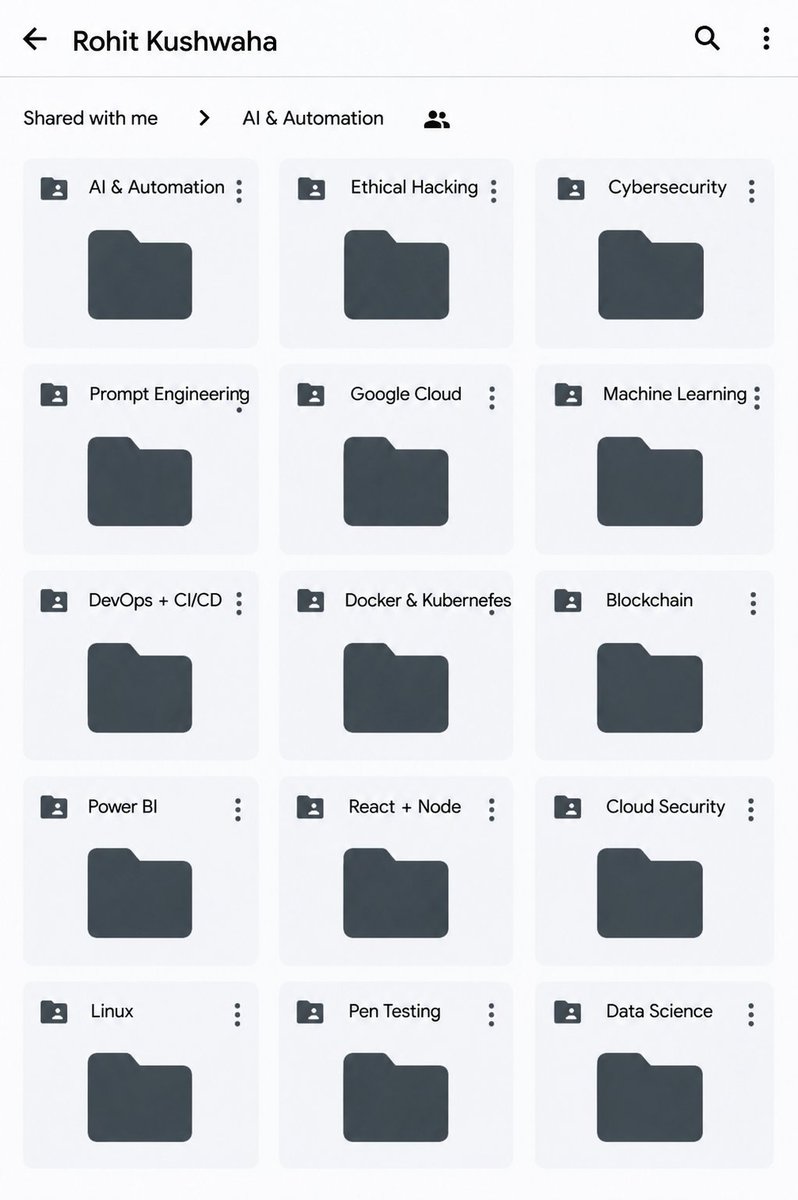
All Paid Courses (Free for First 4500 People)
𝗣𝗮𝗶𝗱 𝗖𝗼𝘂𝗿𝘀𝗲 𝗙𝗥𝗘𝗘 (PART - 1)
1. Artificial Intelligence
2. Machine Learning
3. Prompt Engineering
4. Claude,Chatgpt,Grok
5. Data Analytics
6. AWS Certified
7. Data Science
8. BIG DATA
9. Python
10. Ethical Hacking
(72 Hours only )
Like + RT + comment ' Drive '
Must Follow me so I can DM you.
the creator of C++ just explained why most developers will never become senior - and it has nothing to do with years of experience
> AI code is trained on legacy patterns - accepting it blindly is a mid move
> 90%+ of memory bugs come from old coding habits, not the language itself
> static typing isn't annoying overhead - it's what lets you design instead of debug
> if you only know one language, you're a hobbyist, not a professional
> seniors solve real problems - juniors build tools to scratch their own itch
> the same principles apply whether you're writing web apps or autonomous agents - clean architecture over clever hacks
the man whose language powers every OS, browser, and trading system alive
if you're trying to level up, save this interview
SOLID Principles Explained with Clear Examples:
𝐒 - 𝐒𝐢𝐧𝐠𝐥𝐞 𝐑𝐞𝐬𝐩𝐨𝐧𝐬𝐢𝐛𝐢𝐥𝐢𝐭𝐲 𝐏𝐫𝐢𝐧𝐜𝐢𝐩𝐥𝐞
A class should have only one reason to change.
- Example: Instead of one giant User class that handles authentication, profile updates, and sending emails, split it into UserAuth, UserProfile, and EmailService.
𝐎 - 𝐎𝐩𝐞𝐧/𝐂𝐥𝐨𝐬𝐞𝐝 𝐏𝐫𝐢𝐧𝐜𝐢𝐩𝐥𝐞
Classes should be open for extension but closed for modification.
- Example: Define a Shape interface with an area() method. When you need a new shape, just add a Circle or Triangle class that implements it.
𝐋 - 𝐋𝐢𝐬𝐤𝐨𝐯 𝐒𝐮𝐛𝐬𝐭𝐢𝐭𝐮𝐭𝐢𝐨𝐧 𝐏𝐫𝐢𝐧𝐜𝐢𝐩𝐥𝐞
Subtypes must be substitutable for their base types without breaking behavior.
- Example: If Bird has a fly() method, then Eagle and Sparrow should both work anywhere a Bird is expected.
𝐈 - 𝐈𝐧𝐭𝐞𝐫𝐟𝐚𝐜𝐞 𝐒𝐞𝐠𝐫𝐞𝐠𝐚𝐭𝐢𝐨𝐧 𝐏𝐫𝐢𝐧𝐜𝐢𝐩𝐥𝐞
Don't force classes to implement interfaces they don't use.
- Example: Instead of one fat Machine interface with print(), scan(), and fax(), break it into Printable, Scannable, and Faxable. A SimplePrinter only implements Printable.
𝐃 - 𝐃𝐞𝐩𝐞𝐧𝐝𝐞𝐧𝐜𝐲 𝐈𝐧𝐯𝐞𝐫𝐬𝐢𝐨𝐧 𝐏𝐫𝐢𝐧𝐜𝐢𝐩𝐥𝐞
High-level modules should not depend on low-level modules. Both should depend on abstractions.
- Example: Your OrderService should depend on a PaymentGateway interface, not directly on Stripe or PayPal.
The real power of SOLID is not in following each principle in isolation. It's in how they work together to make your code easier to change, test, and extend.
♻️ Repost to help others learn this
BOOKS THAT WILL DESTROY YOUR LIMITING BELIEFS AND REBUILD YOUR PSYCHOLOGY FROM SCRATCH:
1. Psycho Cybernetics – Maxwell Maltz on reprogramming your self image to change your entire life
2. Breaking the Habit of Being Yourself – Joe Dispenza on using neuroscience to become a new person
3. The Power of Your Subconscious Mind – Joseph Murphy on programming the mind below awareness
4. Mindset – Carol Dweck on fixed versus growth mindset and why it determines everything you achieve
5. Learned Optimism – Martin Seligman on training yourself to think in ways that produce better outcomes
6. The Six Pillars of Self Esteem – Nathaniel Branden on building unshakeable self worth from the inside
17. Awaken the Giant Within – Tony Robbins on taking immediate control of your mental emotional and physical destiny
8. The Power of Positive Thinking – Norman Vincent Peale the book that started the entire self help movement
9. Unlimited Power – Tony Robbins on neuro linguistic programming and modelling excellence in others
10. You Can Heal Your Life – Louise Hay on the connection between thought patterns and physical illness
11. The Success Principles – Jack Canfield on the 67 principles that transform average into exceptional
12. What to Say When You Talk to Yourself – Shad Helmstetter on the science of internal self talk
13. The Belief Code – Kimberly Meredith on identifying and clearing the subconscious blocks to success
14. Reprogram Your Mind – rewiring neural pathways to eliminate self sabotage permanently
15. The Achievement Habit – Bernard Roth on applying design thinking to every personal challenge
A Nobel Prize winner spent his entire career proving that your brain lies to you constantly, and the most unsettling part is that the smarter you are, the more convincing the lies become.
His name is Daniel Kahneman, and the research that earned him the Nobel Prize in Economics was not about markets or money.
It was about the two systems running inside every human mind at all times, and why one of them is almost always in charge when you think the other one is.
Here is what he found, and why it changes how you should think about every decision you make.
Kahneman called them System 1 and System 2.
System 1 is fast, automatic, emotional, and operates almost entirely outside your conscious awareness. It is the system that reads the mood in a room before you process a single word, that flinches before you hear the sound, that forms an impression of a stranger in milliseconds.
System 2 is slow, deliberate, effortful, and exhausting. It is the system you engage when you do long division or carefully weigh a major life decision. The critical insight is not that these two systems exist. It is that System 2 is lazy by design, and System 1 runs the show far more often than any of us want to believe.
The most dangerous finding in Kahneman's research is what he called the what-you-see-is-all-there-is problem. System 1 does not pause to ask what information might be missing. It builds the most coherent story it can from whatever data is currently available, then delivers that story to your conscious mind as a conclusion that feels like it was carefully reasoned.
You experience the output of an automatic process as if it were the result of deliberate thought. The confidence feels earned. It almost never is.
This is why cognitive biases are not character flaws. They are structural features of a brain optimized for speed. The availability heuristic makes you overestimate the probability of whatever comes to mind most easily, which is why people fear plane crashes more than car accidents and dramatic rare diseases more than the conditions that actually kill most people.
The anchoring effect makes your judgment of any number heavily influenced by whatever number you heard first, even if that number was completely arbitrary. The halo effect makes your overall impression of a person contaminate every individual judgment you make about them, so the same resume gets rated more competitively when attached to an attractive photo.
The part that Kahneman spent the most time on, and that most people resist the hardest, is what he called expert overconfidence. He studied stockbrokers, surgeons, military commanders, clinical psychologists, and financial analysts people at the absolute top of their fields with decades of experience and found systematic evidence that their confidence in their own judgments consistently exceeded the accuracy of those judgments.
Experience in a domain does not eliminate cognitive bias. In many cases it amplifies it, because experts build elaborate mental models that feel comprehensive but are often just more sophisticated versions of the same shortcuts everyone uses.
The most honest thing Kahneman ever said about his own research was that writing the book did not make him any less susceptible to the biases he spent fifty years documenting. He still felt the pull of every heuristic he described. The difference was not immunity.
The difference was recognition, and the discipline to slow down in moments when the fast answer felt suspiciously easy.
Knowing that your brain lies to you does not stop the lies. But it teaches you which moments deserve a second look before you trust the story you are already telling yourself.