Sometime in late 2025, we partnered with a premium artificial greenery brand operating across Australia and North America.
With an average order value north of $500, it was obvious this wasn’t a situation of a brand with a bunch of impulse-buy SKUs.
People don’t wake up and casually spend that kind of money on greenery, you knwo.
So naturally, we built an email and SMS strategy that respected a long purchase consideration cycle. Education. Reassurance. Repetition without pressure. That part worked.
Where we slipped was more subtle.
In focusing so heavily on how long it takes customers to buy, we overlooked why different customers were buying in the first place.
The content and copy we rolled out reflected the motivations of the Australian audience — almost exclusively. And we didn’t catch early enough that the US audience was buying for different reasons and motivations.
To put this simply in Australia, it turns out that buyers were primarily looking to transform dry, sun-exposed outdoor spaces into long-lasting, low-maintenance green havens. So our Australian campaigns leaned into drought resistance, year-round greenery, outdoor entertaining, and weather durability. and other core UVPs custom to the AU region. And that resonated.
But the US buyer wasn’t the same. Not entirely. We would find out later that in the US, customers leaned far more toward indoor aesthetics — home offices, modern interiors, calming living spaces, visual balance etc.
Those US customer aspirations however barely showed up in our copy. And that gap showed up in the numbers.
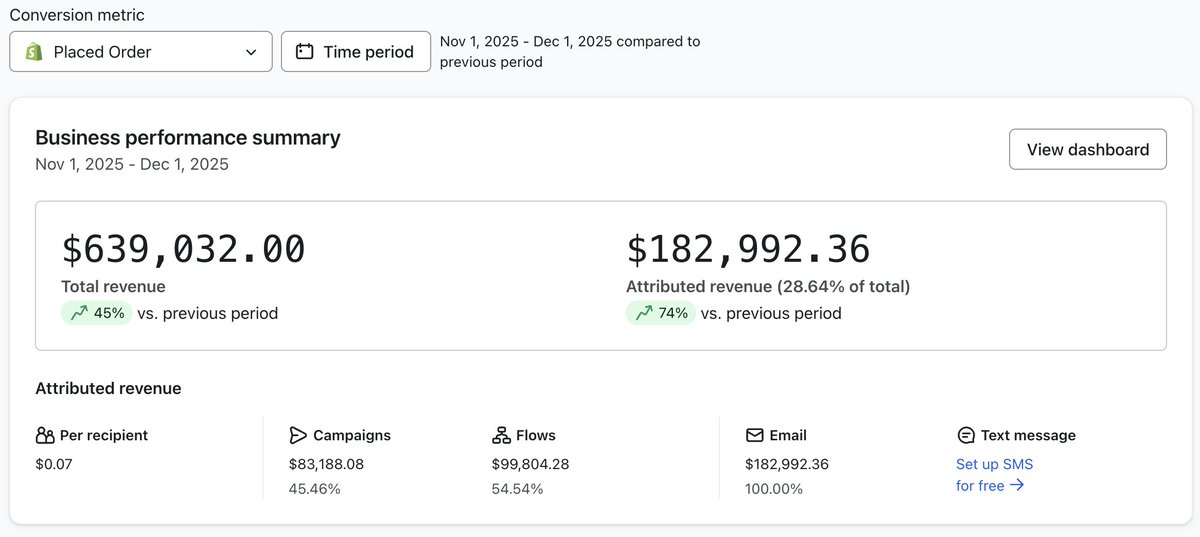
In December 2025 alone, Australia generated over $81,000 from email. The US audience, for the same brand, generated about $26,000.
Going back further, November’s difference was even starker: $124,000 in Australia versus $21,000 in the US.
Now to be clear, there were other factors at play and this wasn’t just about content.
It turns out that the US audience was smaller in number — about 1,000 email profiles compared to 10,000+ in Australia.
But even with that in mind, there was a clear gap that revealed a deeper issue: mainly that we didn’t align with what motivates a US customer to invest in greenery.
Same product. Same pricing. Same retention framework.
But different reasons for buying.
That was the lesson.
This goes to show that no matter how solid your overall strategy is, messaging cannot be copy-pasted across regions. Different markets will respond to different emotional triggers. Especially when it’s a high AOV brand.
Hope this helps someone!
Your post-purchase flows are failing to drive customer retention because you’re treating every buyer the same after checkout. (let that sink in)
Do you see how that makes no sense?
Because a first-time buyer, a repeat buyer, and a VIP buyer are in completely different mental states after a purchase.
So the rule is simple, you should never have just one generic post-purchase flow for all customers rather they should be segmented.
At minimum, it should be split into three paths:
First-time buyers (1× buyers)
Repeat buyers (2×+ buyers)
VIP buyers (high frequency + high CLTV)
But before we even talk about content, there’s a technical distinction that most brands miss.
I like to split post-purchase into two very different moments in the buyer journey:
Placed Order - being the metric that triggers IMMEDIATELY after a customer completes checkout and initiates the purchase process.
Fulfilled Order - being the metric that occurs a bit later triggering only AFTER the order is packed, shipped, or marked complete. This is where delivery expectations, product usage, and long-term trust actually begin.
I almost always recommend building your segmented post-purchase flows under the Fulfilled Order metric and not Placed Order.
Now let’s talk segmentation.
You want to first, define your buyers clearly.
A first-time buyer is straightforward:
Someone who has triggered Fulfilled Order only once over all time.
A repeat buyer varies by brand and AOV, but for simplicity:
If your AOV is under $100, a repeat buyer is usually someone who has purchased at least 2–3 times.
Where most brands mess up is in defining VIPs.
VIP status should never be based on purchase count alone.
You also need to factor in AOV and CLTV.
For sub-$100 AOV brands, I like defining a VIP as:
At least 4 purchases, and
A CLTV that’s 3–5× the brand’s AOV
Now that keeps the segments genuinely exclusive.
Once your definitions are locked in, the mistake you don’t want to make now is to build out the segments… …and then send the same “thank you” emails anyway.
That defeats the entire point. Each segment needs a different post-purchase strategy.
But don’t worry it’s not hard.
First-time buyers are the most fragile.
They’re dealing with uncertainty, buyer’s remorse, and lack of product familiarity.
So their post-purchase flow should be the most intensive:
Product education
Social proof
Community signals
Reassurance
Clear order updates
And carefully chosen complementary upsells
Your job here is to remove doubt and build confidence.
Repeat buyers are calmer.
They already trust the product, but they still need direction.
For them, the strategy shifts to:
Tips and advanced usage
Loyalty program induction
Community invites
Brand transparency
Thoughtful cross-sells
You’re strengthening habit, not convincing them from scratch.
VIP buyers are the calmest of all.
At this point, trust is already baked in.
They don’t need long post-purchase sequences.
In fact, over-communicating here often does more harm than good.
For VIPs, I usually keep it tight:
A VIP welcome
Perks, bonuses, or affiliate access
Behind-the-scenes or early access
Two or three emails at most.
Premium tone. No noise. That’s it!
Your post-purchase strategy works to improve your customer retention when the structure reflects where the buyer actually is — not where the brand hopes they are.
A wildly successful razor company spent over a century telling men:
“You deserve the best a man can get.”
And it worked.
For 118 years, they dominated over 70% of their market.
That’s unheard of.
But in 2018, something changed.
A new marketing director stepped in… and decided it was time for a bold pivot.
Instead of continuing to reflect the values their customers already resonated with…
They tried to redefine them.
They ran a 2-minute Ad telling those same loyal customers that they needed to be “better men.”
The intention might have been noble but the execution wasn’t rooted in customer insight.
The company lost over $8 billion in value the very next year.
And more than $1.8 billion in the years that followed.
Your customers are not clay to be molded.
They’re not waiting to be told who to be.
They're already someone.
And great marketing at least the kind that works consistently, doesn’t need to create new desires or motivations.
It listens first.
It reflects.
Then it gently guides.
If you’re trying to shift perception, reposition a product, or spark loyalty...
Start by understanding who your customer already is.
And when thou prayest, thou shalt not be as the hypocrites are: for they love to pray standing in the synagogues and in the corners of the streets, that they may be seen of men. Verily I say unto you, They have their reward.
Dear Heavenly Father, as I stand at the doorway of 2026, I come before You in the name of Jesus Christ. Before this new year fully unfolds, I place my life, my family, my work, and my future into Your hands. Go before me, and destroy every plan of darkness set against my life.
By the authority of Jesus, every curse that tried to follow me from previous years is stopped here. Every negative word, every repeated pattern, every hidden plan meant to delay my progress or steal my peace is cancelled now. What was sent to weaken me will not enter 2026 with me.
Cover my home with Your presence.
Guard my steps with Your wisdom.
Order my days with Your peace.
I declare that 2026 will not be marked by struggle, but by direction; not by heaviness, but by freedom; not by curses, but by the blessing of God.
Lord, I will not keep this prayer to myself. I promise to share this prayer with at least one person today. In the victorious name of Jesus Christ, Amen.
Type “God is great” to disappoint the enemy!