BREAKING: Israel was not formally part of the Iran negotiations and is unhappy that it "got word" that the deal was finalized at a late stage, per WSJ.
Details include:
1. Israel was not consulted regarding the ceasefire agreement, mediators tell WSJ
2. The extent of the consultation was President Trump calling Israeli Prime Minister Netanyahu "shortly before" the ceasefire was announced
3. Mediators said Israeli officials were unhappy with the terms, including the planned inclusion of Lebanon in the agreement
4. Netanyahu said Wednesday morning that the deal does not include Lebanon, contradicting an earlier statement by Pakistan
The ceasefire situation remains fluid.
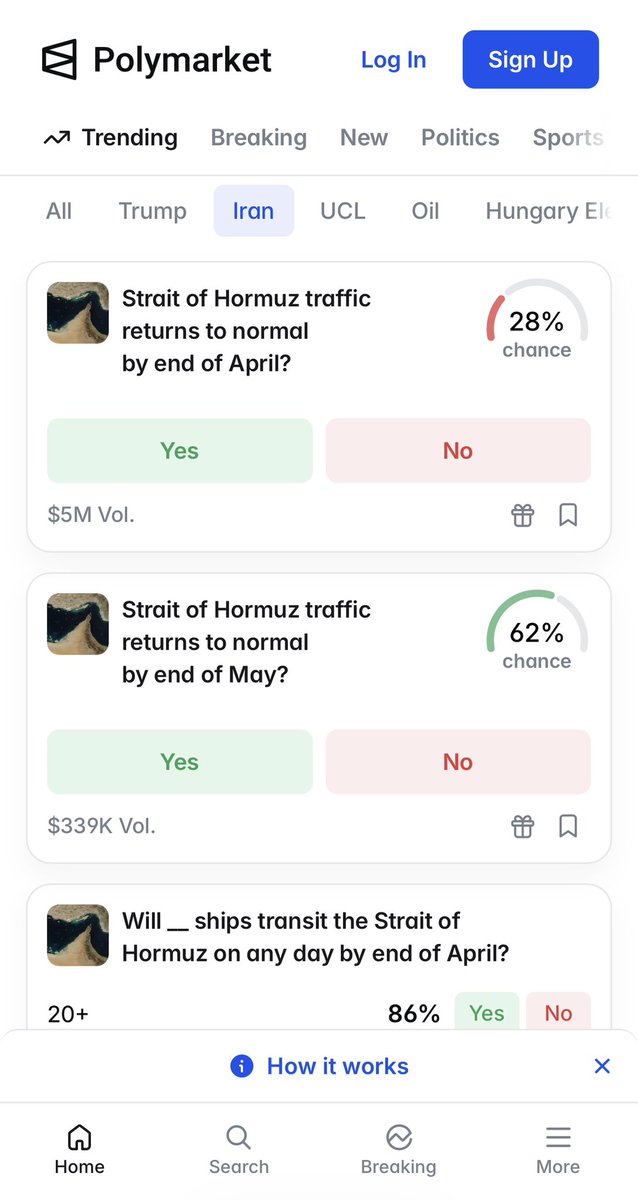
#Polymarket on #Hormuz is pricing in a very specific scenario: Partial transit returns first, full recovery takes longer.
Current market structure suggests:
By end of April, normal traffic returning is still viewed as unlikely at 28%.
By end of May, it becomes more plausible at 62%.
At the same time, the market is pricing high odds that ships will still transit the Strait before end of April, meaning passage is expected, just not a full return to normal conditions.
The April normalization market has far higher volume, which suggests the main disagreement is not whether recovery happens at all, but whether it can happen fast.
So the real #signal here is:
the market believes the worst-case scenario may have passed, but shipping risk has not been fully cleared.
Found an interesting q on #polymarket 's discord server:
“I started with $71, all my positions were closed successfully… but now I only have $53.9. Where did my money go?”
People may ask, why my balance decreased even after winning trades when they are new here.
1⃣ “Winning trade” ≠ Made money
Instead, the won money is determined by your entry price vs exit price. For example:
👍 Buy YES at 0.72
✌️ Sell at 0.70
Even if the market later resolves to YES, you already exited at a loss.
👉 PnL = Exit Price – Entry Price
2⃣ #Spread & #liquidity matter
When trading, not trading against “the market” — also against other users in the #orderbook.
That means u might buy high (market order), but sell lower (due to thin liquidity). This difference is called spread.
If repeat this multiple times, small losses accumulate.
3⃣ How Polymarket calculates #PnL
PnL = (Sell Price – Buy Price) × Shares – Fees
Buy 100 shares at 0.60 → cost = $60
Sell 100 shares at 0.55 → receive = $55
PnL = -$5 (before fees)
Important distinction
◽️Realized PnL → when you close positions
◽️Unrealized PnL → when positions are still open
#Infrastructure is the key to industry maturity. By reducing repetitive work, establishing standards, and improving efficiency, it enables ecosystems to scale and sustain long-term growth. Whether in #Web3, #AI, or the traditional #internet, infrastructure remains the foundation of durable industry development.
https://t.co/K4Hth2D0zF
I know that some of you guys may want to give birth to ur personal #openclaw on #Discord server. While when the #clawdbot ask for #discordbot token, you may feel confused. Lucy shows you A Simple Guide to Creating a Discord Bot
https://t.co/0qD8HokLMs
These days I’ve been spending a lot of my time on AI. I studied sociology — not CS — but somehow these tools have genuinely pulled me into building.
The one that’s impressed me most so far is #Cursor. It’s the first time I’ve felt confident enough to edit code, dig through GitHub, and turn small ideas into something that actually runs.
I’ve also been playing with AI prototyping tools like #Stitch, which feel surprisingly friendly for non-designers/non-engineers: you can prototype the structure and interactions first, then decide whether it’s worth real dev time. In parallel, I’ve been brushing up on UI fundamentals (mostly via https://t.co/qpwHvWTuCj). The more I read, the more I realize product differences often aren’t about feature count — they’re about the invisible stuff: information architecture, flows, and good defaults.
While I’m tracking new projects across agents, tools, infra, and apps, I’ve been building a few small experiments of my own:
each day I pull in my info feeds → score/filter with my own weights → generate a short highlight summary → tag by theme → push a scheduled digest to #Lark/#Discord, while saving everything to a table for easy lookup.
The change is real: I used to bounce between apps and wade through noise. Now I mostly read one digest — and only go deeper when something’s truly worth it.
My bar for whether an AI product has a shot is pretty simple: will I open it daily — and more directly, would I pay for it? Model gaps are shrinking, but the gap in product experience, workflow ownership, and reliable delivery is getting bigger. Whoever turns AI into a dependable daily tool will capture most of the value.
One thing worth being cautious about: AI is widening the digital divide. It’s a productivity lever — and leverage tends to favor the people who know how to use it.
If you’re also building in the agent/workflow/product space, I’d love to hear what you’re working on in the comments.
The wait is over. Veilcraft is officially available on Google Play.
Download now and begin your adventure.
Apple Testflight will join the force in couple of hours!
https://t.co/MJlYR8ztUI
Just tried #ChatGPT#atlas seems it is still on the beginning stage🤔
It's pity that haven't seen any truly revolutionary change; instead, it feels like opening another GPT and a less-than-perfect #browser.
Hope to see in AI is a true transformation where 1+1>2. A whole #AI Ecosystem 🪐