Math isn't just about numbers - it's about finding complex patterns in our world.
And there are many ways that you can apply mathematical concepts in programming, beyond what you might've learned in school.
In this guide, Tiago discusses the architecture of math – and how you can use it in your code.
https://t.co/mH2DFQBGXy
agents → tools → loops → graphs → autonomous systems
Google just put all five in one free course. most people stop after the first one.
2 hours 17 minutes, taught by a Developer Relations Engineer at Google Cloud. no signup, no paywall.
39:45 - build your first agent
56:10 - connect MCP tools
1:14:34 - four loop patterns for running it
1:23:01 - turn those loops into a graph
2:05:00 - wire the whole thing into one autonomous system
the progression is the point. one agent is a demo, an agent with tools does work.
loops let it keep going. graphs let several of them coordinate.
only the last step runs without you in the room.
most people are still tuning the prompt inside step one.
worth more than most paid agent bootcamps.
bookmark and watch it today, then read the full graph engineering breakdown below
Google just released free 2-hour course on full Graph engineering: 1 prompt → 100 agents → loops → graphs from 0% to 100%:
10% → 17:44 - build your first agent
30% → 39:30 - Loop engineering: iterate, check, break
60% → 1:12:38 - Graph engineering
75% → 1:34:26 - agents that throttle themselves
100% → 1:55:05 - full graph for multi-agentic systems
everyone builds one agent and calls it done - this is the full system where agents wire themselves into a graph
watch the course, build the graph - then read the full architecture below ↓
This paper is f*cking brilliant
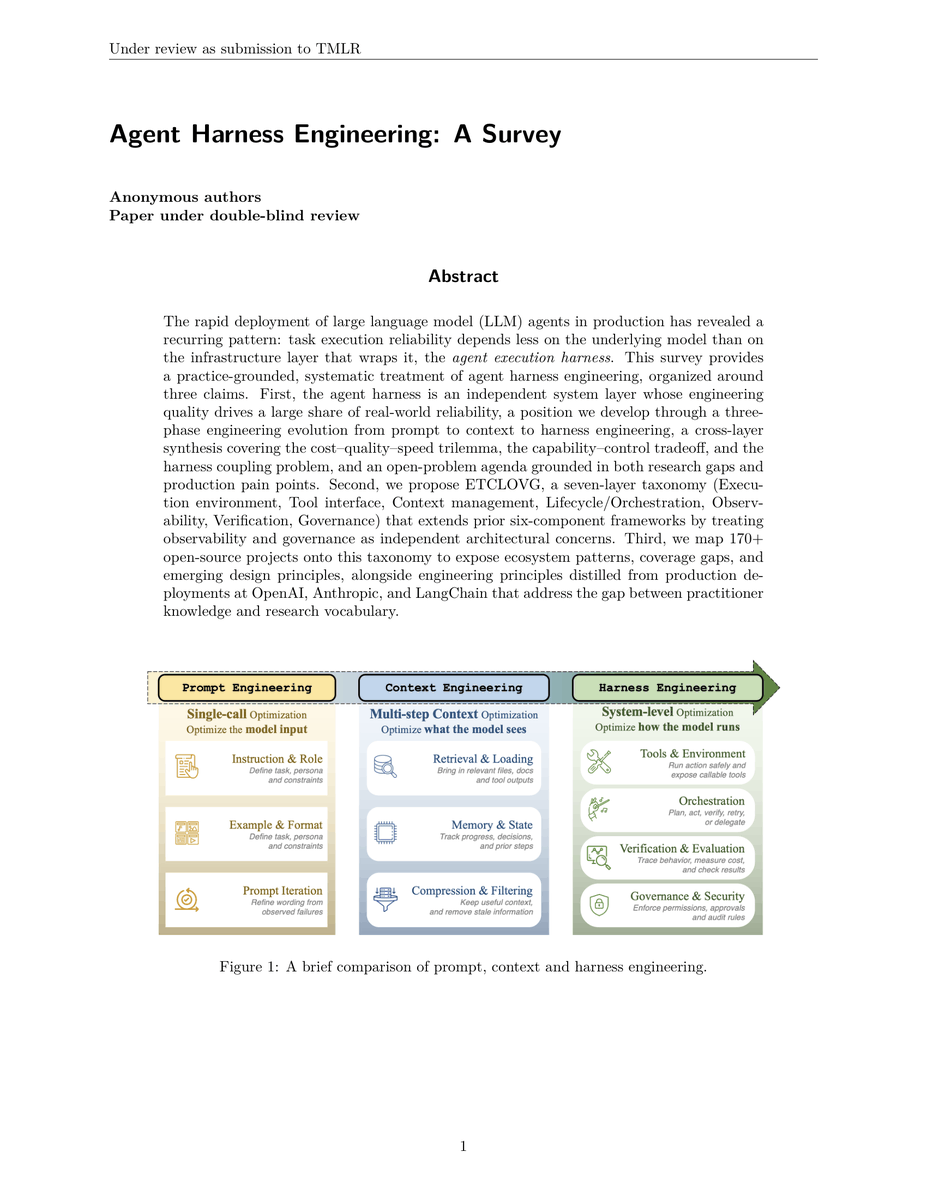
A computer science paper establishes harness engineering as the primary determinant of AI agent reliability
The result: the ETCLOVG seven-layer architecture unifies execution sandboxes, tool protocols, context state, lifecycle graphs, observability, verifiers, and governance
The crazy part is how harness engineering boosts performance without changing the underlying model
Optimizing the execution harness alone increased SWE-bench coding benchmarks from 6.7% to 68.3%
Most developers try to fix agent failures by upgrading to larger LLMs
This framework shifts system reliability from model weights to deterministic harness architecture
Read the complete paper + article below
Bookmark it for future reference
A good prompt works for a single AI task. But multi-step workflows often need something more.
In this guide, Oyedele discusses prompt engineering vs loop engineering and when to use each approach.
You'll learn how to design AI loops with tools, guardrails, and human review, then build a practical PR review loop in Python.
https://t.co/D5xpzIe0sF
ATTENTION
The bible for running LLMs locally is now available online to read for FREE
Covers what to use on
- Laptop / edge / odd hardware
- Mac-first workflows
- Single RTX GPUs
- 2-4+ NVIDIA / CUDA GPUs
- General production serving
- Long-context / MoE / routing
- NVIDIA max performance
- Cluster orchestration
Software
- llama.cpp
- MLX / MLX-LM
- ExLlamaV2
- ExLlamaV3
- vLLM
- SGLang
- TensorRT-LLM
- NVIDIA Dynamo
You should read this, and if you cannot now then you most definitely wanna bookmark it for later
Local & Opensource AI FTW
I created a playbook to help you learn AI engineering.
It'll give you:
• Core concepts behind AI systems.
• Condensed notes to understand full-stack AI engineering.
• Must know techniques to build, deploy & scale AI apps.
(24 HOURS ONLY!!!)
1 Follow @systemdesignone [MUST]
2 Like & Retweet to get DM
3 Reply "Playbook"
Then I'll DM you the details.
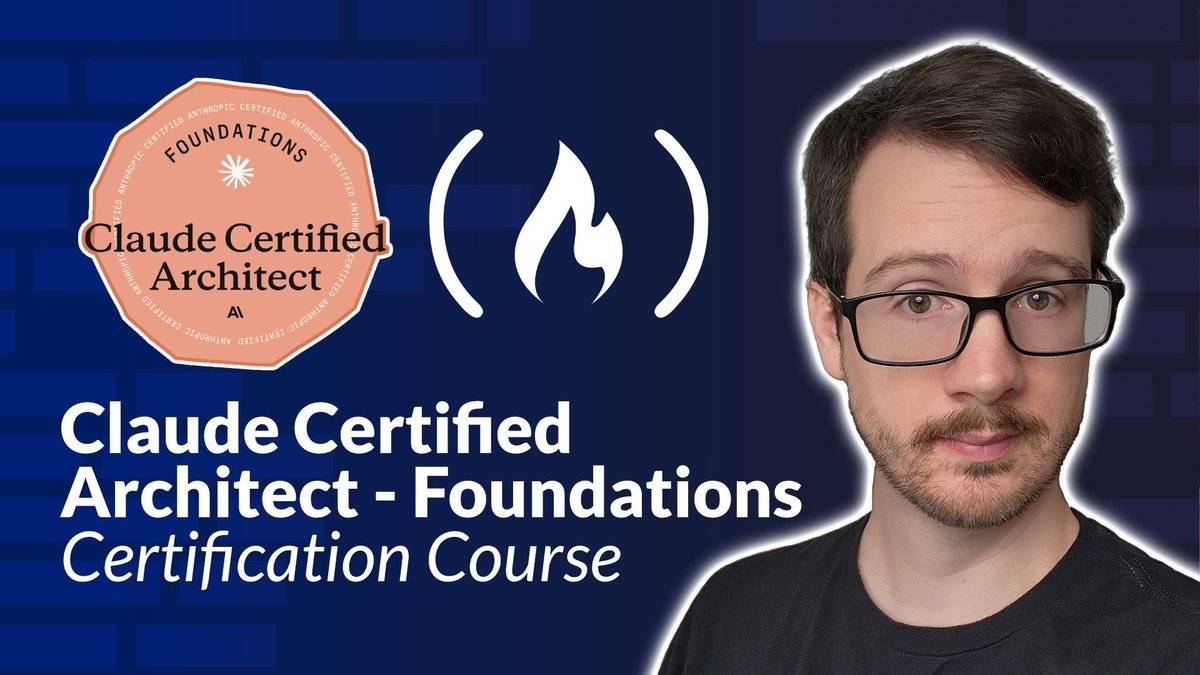
Anthropic's Claude Certified Architect exam focuses on practical AI engineering, not just theory.
In this course, Andrew helps you prepare by building real-world agent workflows with Claude, MCP, and the Claude Agent SDK.
You'll learn about agent orchestration, tool design, prompt engineering, context management, and multi-agent architecture.
https://t.co/zA9wWu6puu
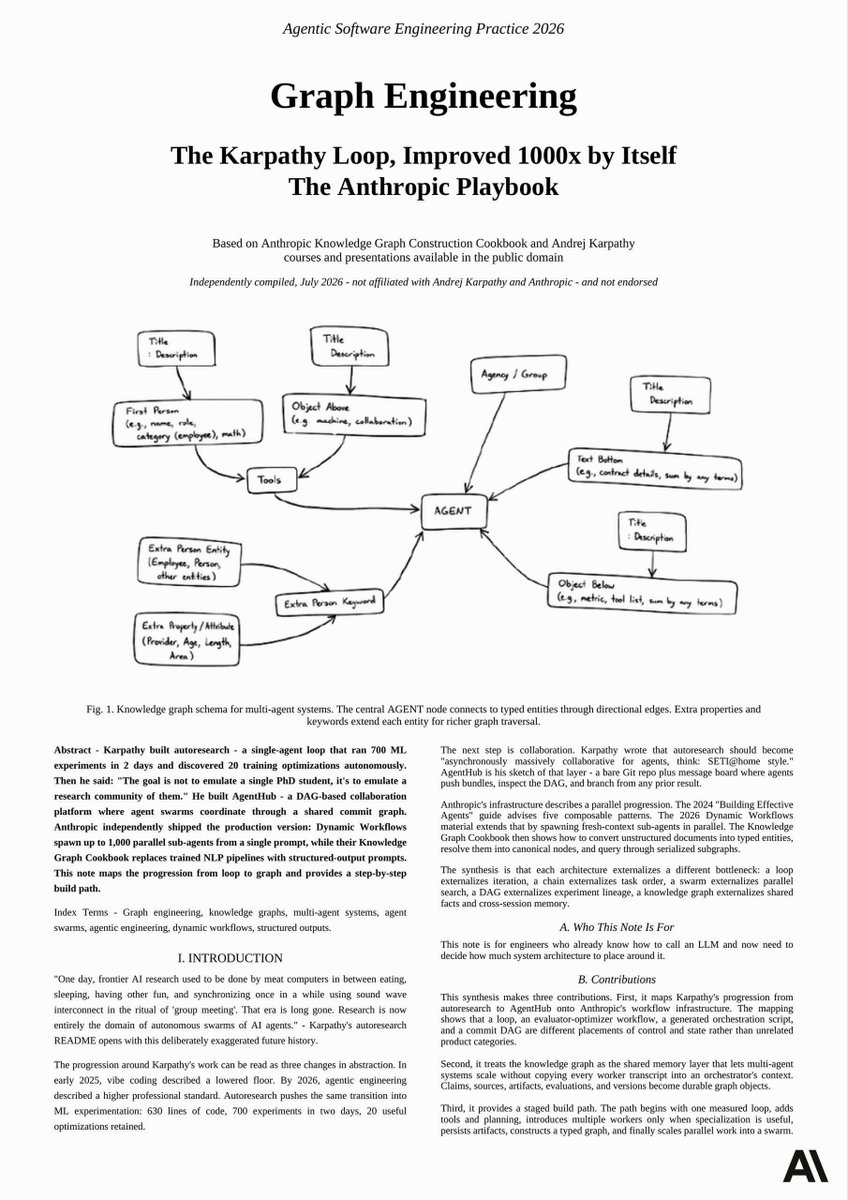
Two Anthropic seniors just made Karpathy's loop 1000x better with "Graph Engineering" - dropped 11-page PDF
the shift: the agentic systems got 1000x better the moment you wired agents into a graph
here's the playbook in 6 steps:
step 1 → build one loop: generate, critique, revise - one self-review cycle beats a smarter model with none
step 2 → add tools: search, code execution, database - thinking without tools is hallucinating
step 3 → go parallel: spin up agents in separate worktrees - same repo, different branches, no conflicts
step 4 → add a graph: agents write findings as typed nodes and edges - not transcripts - every claim keeps its source
step 5 → ground your evaluator: it checks claims against graph edges, not vibes - "Triple not found" beats "seems off"
step 6 → the graph survives every session - your agents stop rebuilding context from scratch
the result: Karpathy ran 1 agent in 1 direction - this system runs 1,000 with shared memory - same model, it's the architecture
read this 11-page PDF and paste it into your Claude - you won't regret it
bookmark - then read the article on building graphs from scratch ↓
Anthropic and Andrew Ng built an agent that uses 90% fewer tokens from scratch:
they dropped the entire book of Frankenstein into a prompt - 108,000 tokens asked one question
the input dropped from 108,000 tokens to 11
here's how:
step 1 → put everything that never changes at the top - tools, then system, then docs
step 2 → mark where the static part ends. everything above it gets cached
step 3 → one stray space breaks it - and you pay full price again
step 4 → the cache dies in 5 min - every read resets the clock
step 5 → cached tokens don't count against your rate limits. free headroom
most people never touch this - it pays for itself on day one
watch & bookmark - this 1-hour brilliant course ↓
@AiOs_public The reasoning is mostly useful to me as a debugging trace; finding the right balance between useful thinking and response time is still something I’m tuning.
@AiOs_public Good question. The post was mainly about separating and testing the output, rather than solving latency completely. I keep a token cap so it cannot think forever or use the whole budget before answering.
The ultimate Full-stack AI Engineering roadmap to go from 0 to 100.
Bookmark this.
This is the exact mapped-out path on what it actually takes to go from Beginner → full-stack AI engineer.
> Start with coding fundamentals.
> Learn Python, Bash, Git, and testing.
> Every strong AI engineer starts with fundamentals.
> Learn how to interact with models by understanding LLM APIs.
> This will teach you structured outputs, caching, system prompts, etc.
> APIs are great, but raw LLMs still need the latest info to be effective.
> Learn how LLMs are usually augmented with more info/patterns.
> This will teach you the basics of fine-tuning, RAG, prompt/context engineering, etc.
> Strong LLMs are useless without context. That’s where Retrieval techniques help.
> Learn about vector DBs, hybrid retrieval, indexing strategies, etc.
> Once retrieval is solid, move into RAG.
> Learn to build retrieval + generation pipelines, reranking, and multi-step retrieval using popular orchestration frameworks.
> Now, step into AI Agents, where AI moves from answering to acting.
> Learn memory, multi-agent systems, human-in-the-loop design, Agentic patterns, etc.
> Learn how to ship in production with Infrastructure.
> This will teach you CI/CD, containers, model routing, Kubernetes, and deployment at scale.
> Focus on observability & evaluation.
> Learn how to create eval datasets, LLM-as-a-judge, tracing, instrumentation, and continuous evaluation pipelines.
> Security is crucial.
> Learn how to implement guardrails, sandboxing, prompt injection defenses, and ethical guidelines.
> Finally, explore advanced workflows.
> This covers voice & vision agents, CLI agents, robotics, agent swarms, and self-refining AI systems.
This is the actual journey to becoming a full-stack AI Engineer and not just "use” AI, but designing full-stack AI systems that can survive in production.
If you need specific resources, I wrote a detailed article that provides a structured learning roadmap for AI engineers in 2026.
It covers prompting, RAG, fine-tuning, agents, MCP, evals, and inference, with guidance on what to prioritize and in what order.
Read it below.






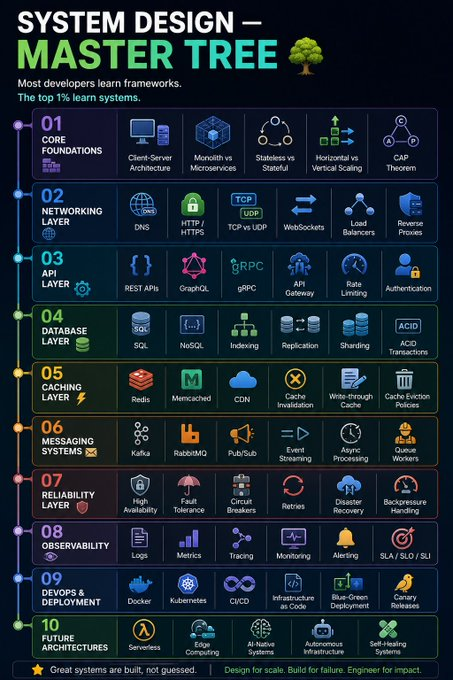
![systemdesignone's tweet photo. I created a playbook to help you learn AI engineering.
It'll give you:
• Core concepts behind AI systems.
• Condensed notes to understand full-stack AI engineering.
• Must know techniques to build, deploy & scale AI apps.
(24 HOURS ONLY!!!)
1 Follow @systemdesignone [MUST]
2 Like & Retweet to get DM
3 Reply "Playbook"
Then I'll DM you the details.](https://pbs.twimg.com/media/HOUJkGuW0AAS9CY.jpg)