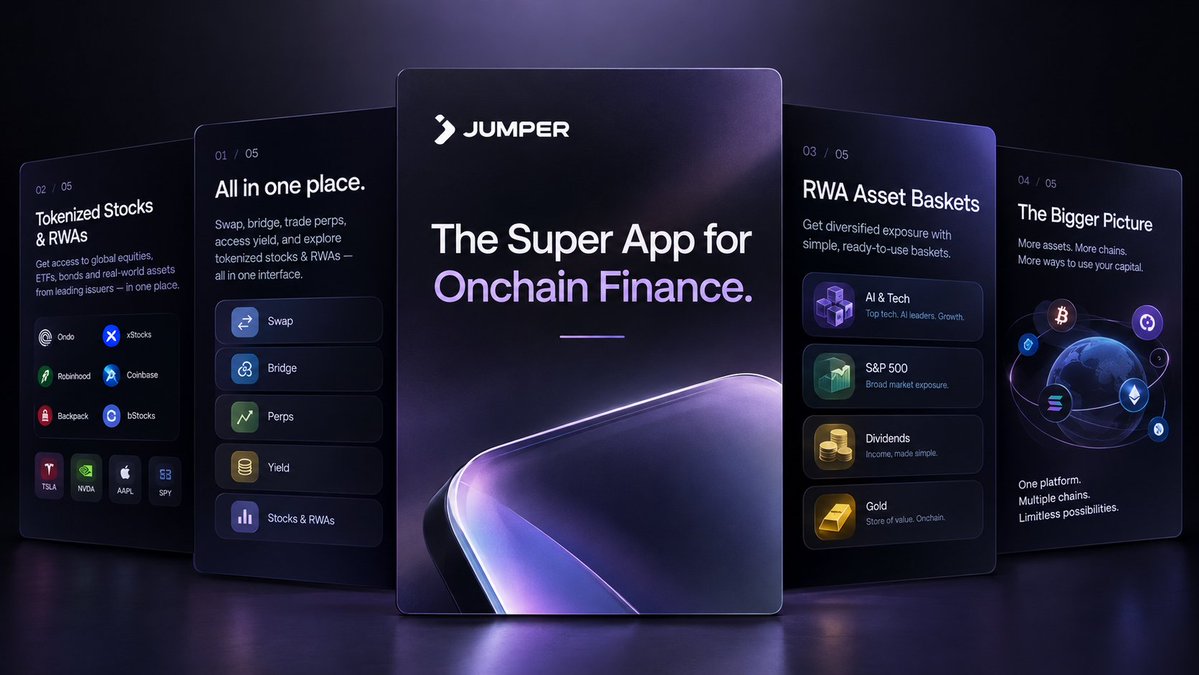
Stocks and RWAs are moving onchain.
But I don't think enough people are paying attention to what that actually means.
For years, stocks, ETFs and bonds were basically out of reach for a lot of people outside traditional financial markets.
I remember thinking Tesla was a great buy years ago, but I couldn't actually buy it.
Not because I didn't know what Tesla was.
I simply didn't have access to the market.
That access problem is slowly changing.
We've spent years watching companies build the infrastructure to bring traditional assets onchain.
Ondo has built a large catalogue of tokenized stocks and ETFs across multiple chains.
Backed/xStocks has brought hundreds of equities and ETFs onchain.
Coinbase is bringing tokenized stocks onto Base.
Robinhood has its own tokenized stock infrastructure.
Binance has bStocks.
Backpack is bringing actual securities exposure onto Solana.
The important part isn't that every issuer is doing the exact same thing. They aren't.
The legal structure, rights, custody and jurisdictions can differ significantly between products.
But the direction is clear:
traditional financial assets are becoming programmable, transferable digital assets.
And that's where I think Jumper gets interesting.
Because once you have all these issuers creating assets, you still have a distribution problem.
You don't want to visit five different platforms to find five different versions of the same asset.
You don't want to think about which chain an asset lives on.
You don't want to manually bridge, swap and route capital every time you want exposure to something.
Jumper is increasingly becoming the layer that brings that fragmented market together.
Their RWA interface already lets users explore tokenized assets from issuers including Ondo, xStocks, Robinhood, Backpack Securities, Coinbase and bStocks in one place.
And you can already see the direction:
$TSLA
$NVDA
$AAPL
$MSFT
$SPY
$QQQ
$Gold
and dozens of other assets.
One interface. Multiple issuers. Multiple chains.
That gets even more interesting when you move from individual assets to portfolios.
I find the idea of RWA asset baskets particularly interesting.
Instead of someone having to decide:
"Should I buy Nvidia?"
"Should I buy Tesla?"
"Should I buy the S&P 500?"
You can start thinking in terms of exposure.
AI.
Technology.
The S&P 500.
Dividends.
Gold.
Growth.
A basket can package multiple assets into one portfolio exposure, making diversification much simpler.
And because these assets live onchain, the portfolio doesn't have to stop at simply holding them.
Eventually you can imagine the same assets being used across lending, collateral, trading, yield and other onchain financial applications.
That's the bigger opportunity.
Tokenization is only the first step.
Issuers bring the assets onchain.
Jumper brings the assets together.
DeFi gives those assets utility.
And users get a financial system that starts looking much more open and composable.
This is also why Jumper's September 22 announcement is important.
Jumper isn't positioning itself as just a bridge anymore.
The stated direction is to become a super-app for onchain finance one place where users can swap, bridge, access yield, trade perps and access tokenized stocks and other RWAs.
They already have the distribution.
$40B+ lifetime volume.
100K+ monthly active users.
15%+ share of bridging volume, according to Jumper.
Now they're trying to turn that distribution into a much broader financial application.
That's the thesis I'm watching.
The future may not be about bringing every asset to one chain.
It may be about making every asset accessible from one interface.
And Jumper is clearly trying to build that interface.
The next step is the JUMP launch on Legion.
The sales goes live today September 29.
If you're interested in what @jumperapp is building and want to participate in the sale, start from the links in the comment:
What the next chapter of Jumper looks like - interview with @zord4n, CEO of Jumper.
0:00 - Intro
2:13 - $JUMP Token Sale Goes Live Tomorrow
3:10 - Why $JUMP Matters
11:22 - Jumper Spinning out of LI.FI
15:45 - Building the Super-App for Onchain Finance
21:45 - The Jumper Product Stack
34:40 - Jumper Perps
40:40 - What Comes Next
I got to use @SorsaApp Premium for two weeks, and I can say it gives you an edge when it comes to spotting opportunities early.
You can track things like:
Trending narratives
Early-stage projects
VC interest
What people are searching for
But what I found even more interesting is the ability to track relationships and account activity.
You can see who's following an account, detect name changes, identify suspicious bot followers, and monitor other activity that might reveal useful signals.
It's more than just tracking what's trending. It's about understanding who is behind the attention, where that attention is coming from, and what might be worth looking into before everyone else catches on.
If you're actively hunting for opportunities in Web3, tools like this are worth exploring.
Let’s look at it this way.
Would you want your salary, company treasury movements, business settlements, or entire investment positions exposed for everyone to see?
i believe not.
And whether we all agrees or disagrees, not every financial transaction is meant for public consumption.
So why should transparency mean exposing everything?
A better privacy system proves what needs to be proven without revealing everything behind it.
Your data stays private by default. The necessary facts can be verified when required, without exposing the underlying details.
Transparency proves. Privacy protects.
The goal isn’t to choose one over the other. It’s to build a system that does both.
Proof without exposure.
Control without sacrifice.
Private when it matters. Verifiable when required.
That’s the @primus_labs balance