👹 The Biggest Scandals in English Football History
🔴 Manchester City Financial Breaches (2026/Ongoing): An independent panel found Manchester City guilty of 114 out of 115 Premier League charges relating to financial rules, sham contracts, and hidden payments spanning from 2009 to 2018. The case involves over £820–£900 million in disguised funding and sponsorship figures, making it the largest financial cheating verdict in the history of the Premier League. The club has appealed the decision.
🔴 The 1915 Betting and Match-Fixing Scandal: A First Division match between Manchester United and Liverpool was fixed by players from both sides to manipulate bets. Several players were banned for life by the Football Association (FA) after investigators uncovered proof of collusion, though some bans were later lifted due to service in World War I.
🔴 The 1964 British Betting Scandal: A widespread match-fixing ring involving several high-profile players (including Jimmy Gauld, David Layne, Peter Swan, and Tony Kay) conspired to fix lower- and top-division matches for illegal financial payouts. Multiple players received prison sentences and lifetime bans from football.
🔴 The 1905 Bribery Scandal (Billy Meredith): Manchester City captain Billy Meredith was suspended and fined after trying to bribe Aston Villa players £10 to throw a match. The investigation exposed widespread illegal wage-payments over the club's maximum salary cap, leading to the suspension of City's entire board and manager.
🔴 The 2006 English Football Corruption Investigation (Quest Inquiry): Lord Stevens led a high-profile inquiry into "bungs" (illegal secret payments) tied to Premier League transfers, manager fees, and agent kickbacks, resulting in stricter governance and transparency rules for transfers.
🔴 "Spygate" (2019 / Ongoing discussions): Leeds United manager Marcelo Bielsa admitted to sending a staff member to covertly spy on Derby County's training ground, sparking a national debate over sporting integrity and fair play, with subsequent modern iterations (such as EFL disciplinary actions).
👹 Spanish Media
Interest in La Liga Stars: Spanish media outlets have covered United’s persistent monitoring of high-profile Spanish-based stars, including ongoing links or past interest surrounding Real Madrid's Aurélien Tchouaméni and Eduardo Camavinga, as well as Barcelona defender Jules Koundé.
👹 Ronald Burke 1946
Position: forward
Ronald Burke made his Manchester United debut on 26 October 1946, when United were beaten 3–0 by Sunderland at Maine Road, the temporary home being used by the club while Old Trafford underwent repairs following wartime bomb damage. He soon found his scoring touch and netted twice against Charlton Athletic in a 4–1 victory on 4 January 1947. Further goals followed against Aston Villa, Derby County, Everton and Leeds United as Burke became a useful attacking option in Busby’s developing side.
His first season proved particularly productive. Burke scored nine goals from 13 league appearances during 1946/47, an excellent return in a Manchester United team that finished runners-up in the First Division. His opportunities became more limited during 1947/48, when he made six league appearances and scored once.
Burke returned to prominence during 1948/49, producing the most prolific spell of his United career. He scored 13 goals in 16 appearances in all competitions, including six goals from nine league matches and six from six FA Cup appearances. He also scored against Arsenal in the 1948 Charity Shield.
His FA Cup form was particularly impressive. Burke scored twice as United defeated Bournemouth 6–0 in the third round, added another two in the 5–0 replay victory over Bradford Park Avenue and struck twice more as United overwhelmed Yeovil Town 8–0. United eventually reached the semi-final, where their defence of the FA Cup ended with a 1–0 defeat against Wolverhampton Wanderers.
Burke's final Manchester United appearance came on 30 April 1949 where he scored a late winner away to Newcastle United, and he finished his career at Old Trafford with 35 competitive appearances and 23 goals. His record comprised 16 goals in 28 First Division appearances, six goals in six FA Cup matches and one goal in his single Charity Shield appearance.
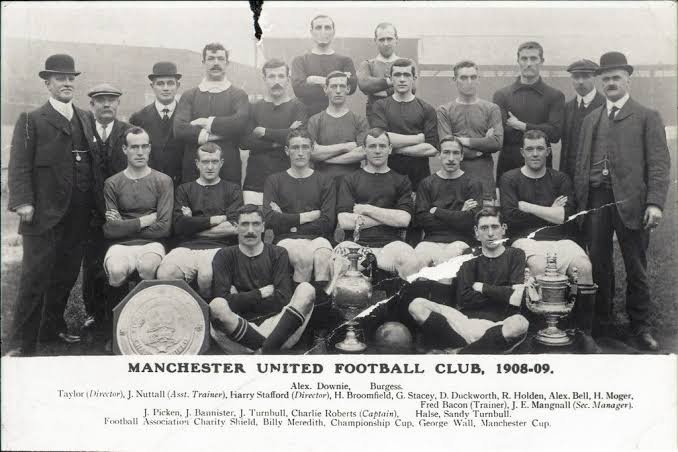
👹 The 1908–09 season was a historic landmark for Manchester United Football Club, securing their first-ever FA Cup triumph. Under the management of Ernest Mangnall, the club entered the season as reigning First Division champions. While their league form dipped—resulting in a fifth-place finish—their cup run cemented their status as an emerging English powerhouse.
The defining moment came on 24 April 1909 at Crystal Palace, where United faced Bristol City in the FA Cup Final. Sandy Turnbull scored the only goal of the match, securing a 1–0 victory. This triumph was heavily aided by the prowess of Billy Meredith on the wing and the clinical finishing of Turnbull, who finished the season as the club's top goalscorer.
Playing their home games at Bank Street before their move to Old Trafford, the 1908–09 squad proved that Manchester United possessed the grit and elite talent to conquer English football.
⚽ The top goalscorer for Manchester United during the 1908–09 season was Jimmy Turnbull.
Manchester United's biggest win of the 1975–76 season by margin of goals was their 5–1 thrashing of Sheffield United at Old Trafford on 23 August 1975.
Having just won promotion back to the First Division, Docherty’s exciting, young side showed they belonged in the top flight immediately. In only their third game of the league season, they dismantled Sheffield United at home, signaling the high-octane, attacking brand of football that would eventually carry them to a 3rd-place finish.
⚽ Lou Macari was Manchester United's top goalscorer in all competitions during the 1975–76 season, netting 15 goals in total.
⚽ However, if you are looking strictly at league play, the honour goes to forward Stuart Pearson, who was the top scorer in the Football League First Division with 13 goals.
⚽ Lou Macari was named the Manchester United Supporters' Club Player of the Year for the 1975–76 season.
👹 Nicky Wood (Forward, 1985–1987): Highly rated in the youth setup, his progress was severely disrupted by serious injury, limiting his first-team impact to just three appearances under Ron Atkinson and Sir Alex Ferguson.
👹 Jack Crompton was a former Manchester United goalkeeper, most famous for helping the club win the 1948 FA Cup and later serving as a coach during the development of the Busby Babes. His contributions to Manchester United spanned from his playing days in the 1940s to his coaching career, where he helped shape one of the most iconic teams in the club's history. Crompton's legacy is deeply intertwined with Manchester United's rise to greatness under Matt Busby.
👹 Mark Higgins (Defender, 1985–1986): After a long career with Everton, the veteran defender had a very brief four-match spell at Old Trafford in the mid-1980s before moving on to Bury.
👹 Medina named Player of the Month
Andrea Medina has deservedly won the Manchester United Women Player of the Month award for September.
The Spaniard has enjoyed a superb start to life with the Reds, starting all four of our league outings – twice in a relatively unfamiliar left-wing role.
Andrea scored her first United goal from that very position, against West Ham, as she won a second successive Player of the Match award, after also being voted our star performer at Arsenal
👹 John Powell
The story goes that Jack Powell turned up to watch a match at Ruabon one day having never played the game before and, he was so impressed by what he saw, he decided to take up football right then and there. It was an inspired decision - he would go on to become one of the greatest defenders in the early history of Welsh football, winning 15 caps for the Principality from March 1878 to March 1888 at a time when they played two or three internationals per year.
Powell duly became the captain of Druids - Wales' elite team of the time - and he helped them win the Welsh Cup in three consecutive years (from 1880 to 1882) and finish runners-up twice. A mountain of a man, the full-back was 6 feet tall in shorter times and weighed a colossal 14 stone.
His idea of defending was to charge opposition strikers with full force, the location of the ball rather irrelevant. One time Jack simply fell on top of a Sheffield Wednesday forward and knocked him unconscious. It is said that Powell could head the ball farther than many players could kick it and, just how far he himself could kick it is best illustrated by the time at Turf Moor when, on three separate occasions, he took a goal-kick and sent the ball across the pitch and over the opposition goal!
With such a pedigree, Jack soon became the earliest known Welshman to turn professional with a club in England, joining Bolton Wanderers for wages of £2 10s a week. Being a first rate engineer, he was also handed a job at Galloway's Brass Works.
He played for Bolton from October 1883 till January 1886 and would have stayed longer but for an acrimonious FA Cup tie in December 1885. Bolton lost to Preston but protested that two of their players were ineligible. Preston in turn accused Powell of the same and, following an investigation, both clubs were ejected from the competition and he was suspended for a month. Apparently, Jack had snuck back to live in Ruabon after taking a job there. Upset because he had lied to them, the Wanderers promptly terminated his contract.
This lie, however, was to breathe life into Newton Heath, for it was they who pounced to sign Jack in March 1886 and offer him a job as a fitter at the L&YR. It was a masterstroke on two fronts. Firstly, his solid displays soon made Heath's defence "about equal to any in the country"; and, secondly, his name attracted other Welsh stars to North Road to make Heath "the best team in Cottonopolis".
The fans certainly showed their appreciation as, within the first year of his arrival, lithographed portraits of Jack, bearing the injunction "Play Up, Newton", were printed and taken to games by the spectators.
Appearing in either full-back slot (and sometimes as goalie), Jack captained the Heathens as they won three successive Manchester Cups (1888 to 1890) and the Football Combination (1888-89), and as they became founder members of the Football Alliance in 1889-90.
He was also skipper when the club contested their first ever FA Cup tie in October 1886... but perhaps he should not have. The same residential qualifications of his Bolton days came into question before the meeting with Fleetwood Rangers, forcing Heath to scratch before a ball had been kicked and participate in a friendly match instead. The history books erroneously state that Heath played an official cup tie but forfeited for refusing to stay on for extra-time after a 2-2 draw.
Manchester United's very first professional (along with Tom Hay) played his last match for the club in December 1890, by which time "he was very slow, having long since seen his best day". Powell worked for the railway for a while then ran a pub in Manchester before doing likewise back home in Wrexham. When he celebrated his 80th birthday in March 1939, he was reputed to be the oldest living Welsh international, eventually passing away after World War Two.
👹 Speculation on His Club Future.
The French media is currently focused heavily on Leny Yoro, the 20-year-old Manchester United center-back. He just made his highly anticipated senior international debut for France in a 4–1 victory against Belgium.
Because he was a surprise call-up by new manager Zinedine Zidane to replace the injured Ibrahima Konatè, major French outlets are closely analyzing his breakthrough performance:
⚽ The Verdict on His Debut.
The media response has been broadly encouraged and positive:
• Foot Mercato gave him a 6/10 rating, noting that he firmly "seized his opportunity." They praised him for being strong in one-on-one duels, incisive with his tackles, and highly precise with his distribution from the back.
• RMC Sport also assigned a 6/10 rating, highlighting his tactical awareness and vigilance against star striker Romelu Lukaku. They particularly appreciated his willingness to push forward and drive play along the right flank.
• Get Football News France echoed the 6/10 rating, summarizing it as a "very decent start to international life" where the defender hardly put a foot wrong
⚽ Speculation on His Club Future
Beyond his performance on the pitch, French and European media are reporting heavily on his situation at Manchester United. Media outlets point out that Yoro has seen limited playing time under manager Michael Carrick. As a result, reports are circulating that French giants Paris Saint-Germain (PSG) are keeping a very close eye on Yoro and may consider a €50 million move depending on how his situation develops
👹 The 1970–71 season was a defining period of turbulent transition for Manchester United F.C., signalling the painful decline of a once-dominant empire. Struggling to step out of the shadow of past European glories, the team suffered from inconsistent form and tactical drift.
Following a string of poor results, young manager Wilf McGuinness was dismissed in December 1970. This prompted the legendary Sir Matt Busby to briefly come out of retirement to steer the club as temporary manager for the remainder of the campaign.
Despite boasting the iconic "Holy Trinity" of George Best, Denis Law, and Bobby Charlton, an ageing squad found trophies elusive. United reached the League Cup semi-finals but fell to Aston Villa, ultimately finishing a disappointing eighth in the First Division. George Best finished as the top scorer with 21 goals across all competitions, yet his brilliant individual displays could not mask a collective regression, setting the stage for a difficult decade ahead.
👹 Jimmy Murphy was a Welsh football player and manager who became the defining modern custodian of Manchester United's spirit.
As the assistant manager to Sir Matt Busby from 1946 to 1971, he was the master scout and coach who discovered and nurtured the legendary "Busby Babes," including Bobby Charlton and Duncan Edwards.
Following the tragic 1958 Munich air disaster, which left Busby critically injured, Murphy heroically stepped up as caretaker manager. Despite overwhelming grief, he rebuilt the shattered squad and somehow guided Manchester United to the 1958 FA Cup Final. He also managed the Wales national team simultaneously, leading them to their historic 1958 World Cup quarter-final. Murphy remains a legendary figure in football history.
⚽ Additionally, as the director of youth development, Murphy personally coached the junior sides to six FA Youth Cup victories (including five consecutive titles between 1953 and 1957), creating the foundation for all of the club's subsequent senior success.
👹 On 26 August 1961, Manchester United hosted Blackburn Rovers at Old Trafford in an exhilarating Football League Division One clash. Managed by the legendary Matt Busby, United put on a masterclass of attacking football before a passionate crowd of 45,302. Bobby Charlton opened the scoring early in the third minute. Although Blackburn’s John Bray equalised shortly after halftime, United responded with a relentless offensive onslaught. Albert Quixall restored the lead with a quick-fire brace, including a penalty, before David Herd added two more to deflate the visitors. Maurice Setters sealed the emphatic 6–1 victory with a spectacular forty-yard strike in the final minutes. This commanding performance beautifully showcased the emerging brilliance of Busby's rebuilt squad on their historic home turf.
⚽ Manchester United's top goalscorer for the 1961–62 season was Scottish forward David Herd.
⚽ Manchester United finished 15th in the First Division and reached the semi-finals of the FA Cup during the 1961–62 season.
👹 Ballon d'Or trophy.
Denis Law became the first Scottish footballer to win the prestigious European Player of the Year award in 1964.
Playing as a prolific forward for Manchester United, Law enjoyed an extraordinary season, scoring an astonishing 46 goals across all competitions. His lethal finishing, exceptional aerial ability, and relentless work rate made him the ultimate attacker in world football. Law outpolled legendary figures like Luis Suárez and Amancio to claim the Ballon d'Or trophy.
This historic achievement cemented his status as a true football icon and a cornerstone of Sir Matt Busby’s famous "Holy Trinity" alongside Bobby Charlton and George Best. Law’s triumph remains a defining moment of pride for both Manchester United and Scottish sports history.