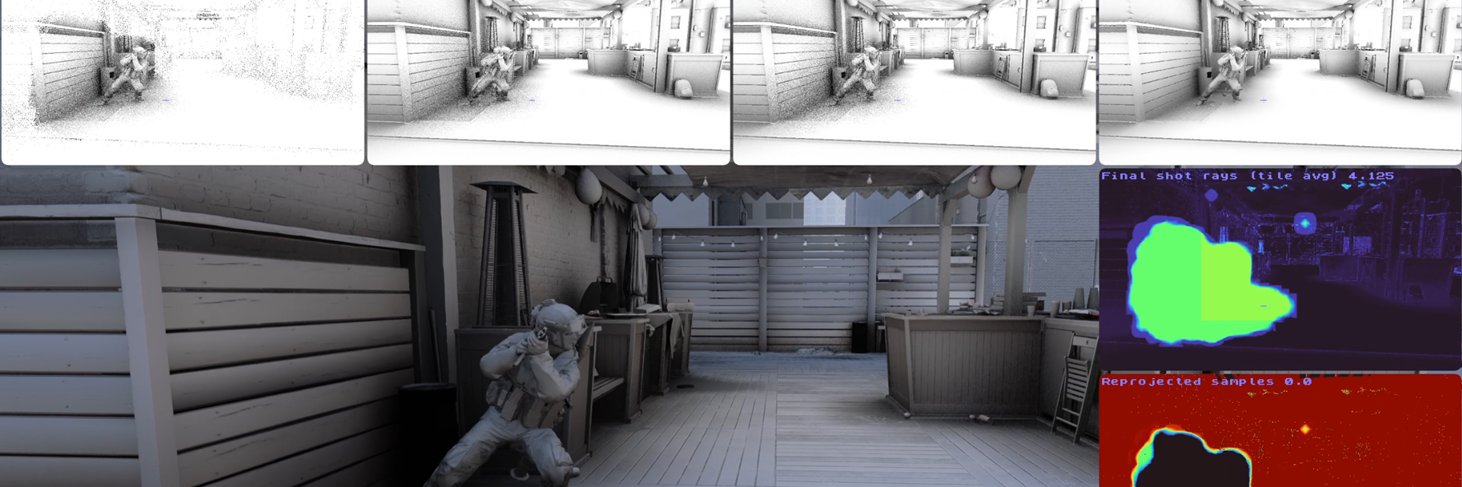
Happy to announce that I’ll be presenting my work on Variable Rate Ray Tracing in Call of Duty: Modern Warfare 4 as part of Advances in Real-Time Rendering at SIGGRAPH 2026.
Ever since ray-tracing hardware debuted, I’ve been obsessed with trying to fix common screen-space denoising artifacts to make ray tracing viable for competitive multiplayer gameplay.
VRRT is my solution: through smart on-screen ray reallocation and load balancing, we achieve a fixed frame time with no disocclusion or lag-on-movement issues. See the course page for the full abstract.
https://t.co/Smum3bEYpo
After this year's ZTGK (https://t.co/MfaenSo6QX) I started a little blog documenting the rendering of our game, Guiding Light. If you want to check it out, the link is here: https://t.co/vVDjG86AJS
"Raytraced shadows in Call of Duty: MW" Digital Dragons 2020 presentation recording is now available: https://t.co/XMHtip4Pvd, slides: https://t.co/WGs16W3GJ2, great advice for raytracing high quality shadows for local lights. #graphicslinkoftheday
@TooMuchVoltage@nholzschuch@pointinpolygon@c_schied There is nice overview on official q2rtx github (screen space only though): https://t.co/W8cTrkFhu8 "Indirect diffuse lighting channel uses spherical harmonics. Incoming radiance is converted to YCoCg color space, and the Y component is decomposed into 4 SH coefficients."
@SebAaltonen LG also added low frame rate compensation in one of the software patches (frame doubling below 40hz so VRR keeps working), though I haven't seen any tests on how well this works in practice.
@SebAaltonen I wish this could be said about next-gen console games, which will still probably be mostly 30Hz, and occasionaly 60Hz. Outside of that, C9/CX seem like ideal next-gen TVs.
@AliBeeGfx@PawPawDH We do that on GCN with TAA, but we didn't want to make assumptions about PC hw. I tried the same trick on PC, but it broke with odd dynamic res scales (4k/1440p/1080p were ok), which suggests that interpolator res on Turing is different (IIRC our notes said it is 1/256.0 on GCN).
@CasualEffects UE4 has a nice educational uber-shader (uber-header?) and VRWorks has an optimized compute implementation (algorithmically similar to MJP's)
@SebAaltonen@BrianKaris I did have a big boost after switching to 5-tap Catmull-Rom (like in
@iryoku1's Filmic SMAA) but I see UE4 did that too some time ago.