I know every generation has their class struggles, but let me tell you about the summer of 1990 when Supersoakers hit the market and only a few kids could afford them and the rest of us were hunted for sport.
Shopify CEO Tobi Lutke explains Goodhart’s law and why he doesn’t like KPIs or OKRs
“Goodhart’s law is real. The moment a metric becomes a goal, it’s no longer a useful metric… No metric by itself is a complete heuristic for a complex business. There’s a million different tensions in a company, and you can’t keep all of them in harmony by optimizing for one thing.”
For this reason, Shopify doesn’t use KPIs or OKRs. But as Tobi explains, this doesn’t mean they don’t value data and metrics.
“We are extremely data informed. We have invested enormous amounts of money and time into systems that give us basically everything at our fingertips… But what Shopify attempts to do is just not over-fit for what’s quantifiable.”
People love optimizing for highly-quantifiable things because there’s immediate gratification that comes from seeing a number go up. But Tobi thinks that the most important aspects of a product are rarely quantifiable:
“The overlap of the most valuable things you can do with a product and the things that happen to be fully quantifiable are like maybe 20%. Which leaves 80% of a value space unaddressable by the people who only look at quantifiable things.”
He continues:
“Shopify is comfortable with unquantifiable things like taste, quality, passion, love, hate… The sort of deep satisfaction that a craftsperson feels when they’ve done a job well is actually a better proxy if you allow it to be.”
They then have robust analytics systems that tell the company if something’s wrong or a new rollout breaks something.
“We think about it as a cockpit for a pilot. The decisions are still made by pilots, and we think this leads to better results… I think there needs to be more acceptance in business of unquantifiable things… And then metrics take a support function.”
Source: @lennysan (Feb 2025)
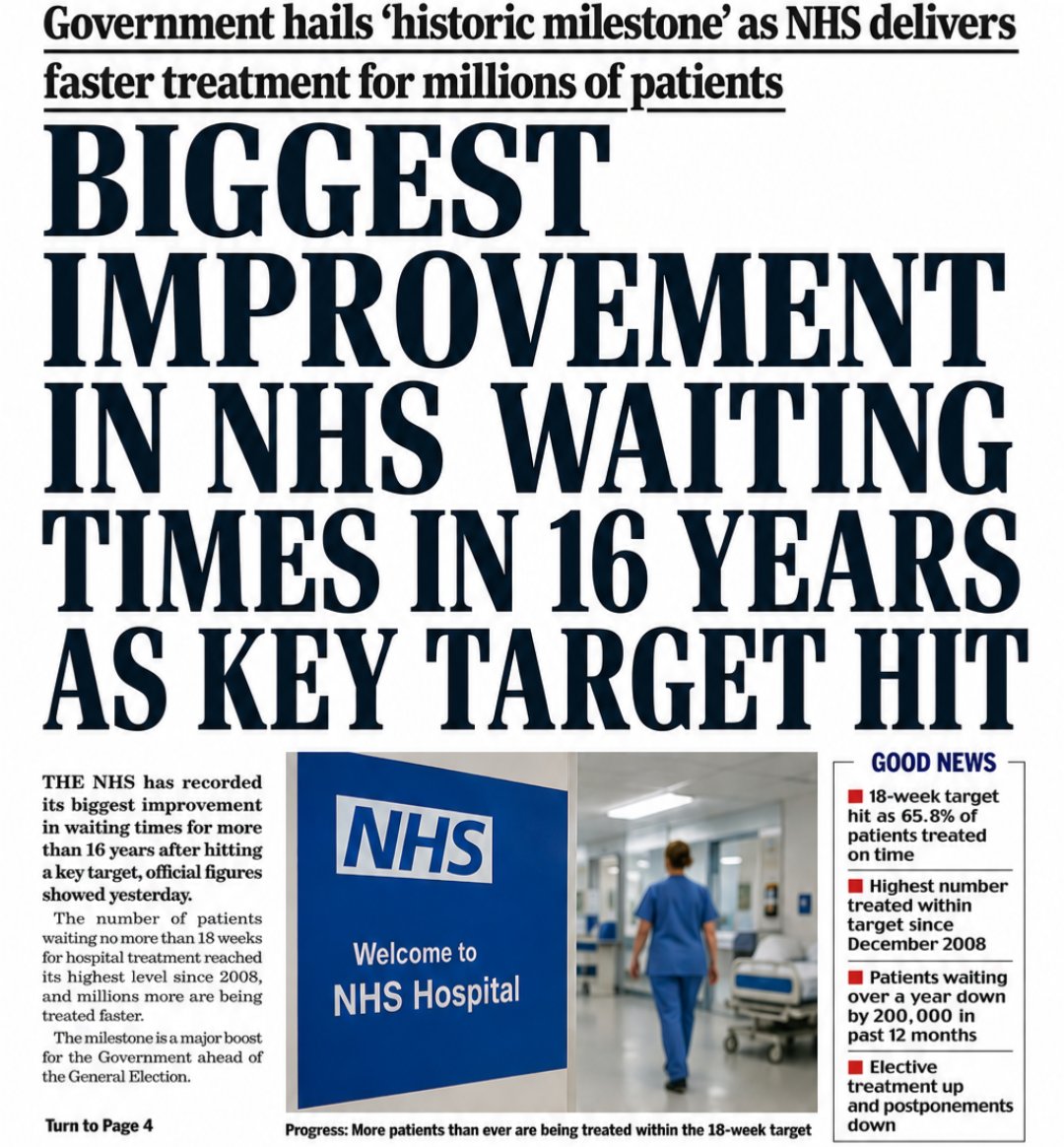
The government has hit one of its key NHS targets on waiting times, with 65% of patients being treated within 18 weeks, government reported!
This is the biggest improvement in NHS waiting times in 16 years, and the first time since November 2021 that more than 65% of patients were seen within 18 weeks.
Source: The London Economic
The vibes in SF feel pretty frenetic right now. The divide in outcomes is the worst I've ever seen.
Over the last 5yrs, a group of ~10k people - employees at Anthropic, OpenAI, xAI, Nvidia, Meta TBD, founders - have hit retirement wealth of well above $20M (back of the envelope AI estimation).
Everyone outside that group feels like they can work their well-paying (but <$500k) job for their whole life and never get there.
Worse yet, layoffs are in full swing. Many software engineers feel like their life's skill is no longer useful. The day to day role of most jobs has changed overnight with AI.
As a result,
1. The corporate ladder looks like the wrong building to climb.
Everyone's trying to align with a new set of career "paths": should I be a founder? Is it too late to join Anthropic / OpenAI? should I get into AI? what company stock will 10x next? People are demanding higher salaries and switching jobs more and more.
2. There’s a deep malaise about work (and its future).
Why even work at all for “peanuts”? Will my job even exist in a few years? Many feel helpless. You hear the “permanent underclass” conversation a lot, esp from young people. It's hard to focus on doing good work when you think "man, if I joined Anthropic 2yrs ago, I could retire"
3. The mid to late middle managers feel paralyzed.
Many have families and don't feel like they have the energy or network to just "start a company". They don't particularly have any AI skills. They see the writing on the wall: middle management is being hollowed out in many companies.
4. The rich aren’t particularly happy either.
No one is shedding tears for them (and rightfully so). But those who have "made it" experience a profound lack of purpose too. Some have gone from <$150k to >$50M in a few years with no ramp. It flips your life plans upside down. For some, comparison is the thief of joy. For some, they escape to NYC to "live life". For others still, they start companies "just cuz", often to win status points. They never imagined that by age 30, they'd be set. I once asked a post-economic founder friend why they didn't just sell the co and they said "and do what? right now, everyone wants to talk to me. if i sell, I will only have money."
I understand that many reading this scoff at the champagne problems of the valley. Society is warped in this tech bubble. What is often well-off anywhere else in the world is bang average here.
Unlike many other places, tenure, intelligence and hard work can be loosely correlated with outcomes in the Bay. Living through a societally transformative gold rush in that environment can be paralyzing. "Am I in the right place? Should I move? Is there time still left? Am I gonna make it?" It psychologically torments many who have moved here in search of "success".
Ironically, a frequent side effect of this torment is to spin up the very products making everyone rich in hopes that you too can vibecode your path to economic enlightenment.
UK tech is back.
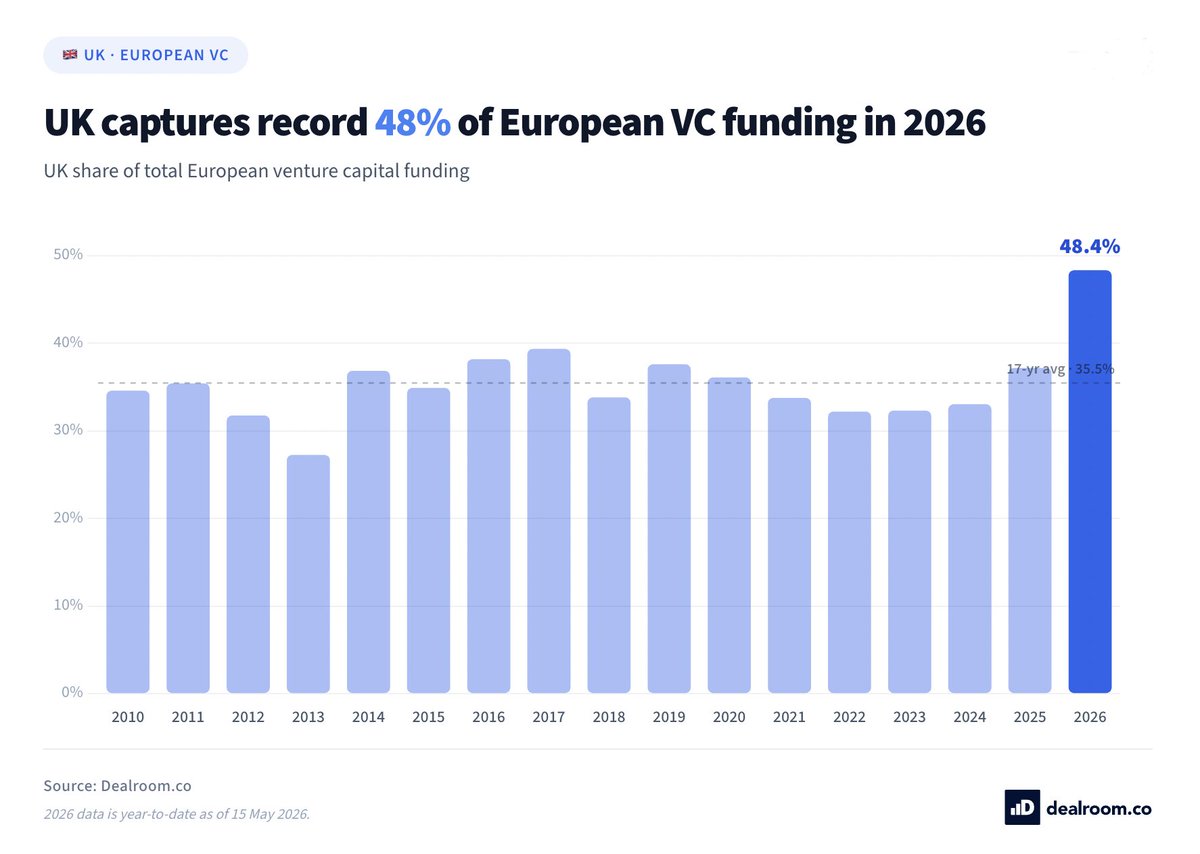
The UK's share of European venture capital is at an all-time high: 48% so far in 2026, compared to long-run average of 35.5%.
The driver is a run of mega-rounds, with AI doing the heavy lifting:
🧬 @IsomorphicLabs — $2.1B Series B
☁️ @nscale — $2B Series C
🚙 @wayve_ai — $1.2B Series D
💡 Ineffable Intelligence — $1.1B Seed
♻️ Recursive Superintelligence — $650M Seed
🎤 @ElevenLabs — $500M Series D
London is once again Europe's standout VC market.
📊: Dealroom
‘You have done a better job than any cabinet minister of telling us the story of Keir Starmer’s successes.’
As Wes Streeting resigns, Caller Martin reminds @TomSwarbrick1 of what the PM has delivered.
🔺Excl: Reform UK leader Nigel Farage bought a £1.4 million property in cash shortly after receiving a £5 million personal gift from billionaire donor Christopher Harborne, according to property records seen by Sky News. Reform spox: "The offer and process for purchase of this property commenced before the gift".
Full story 👇
https://t.co/A4l77ayimL
Leave the infighting to the Tories.
Keir Starmer has taken Labour from its worst defeat since 1935 to a place where we can win the next general election. He doesn’t get nearly enough credit for it.
This is a team effort. I’m proud to support candidates who want Labour to win.