12th May 1975:
A three minute clip from Nationwide on BBC One showing a segment on the traditional East End of London foods and their decline.
Taken from the BBC Archive.
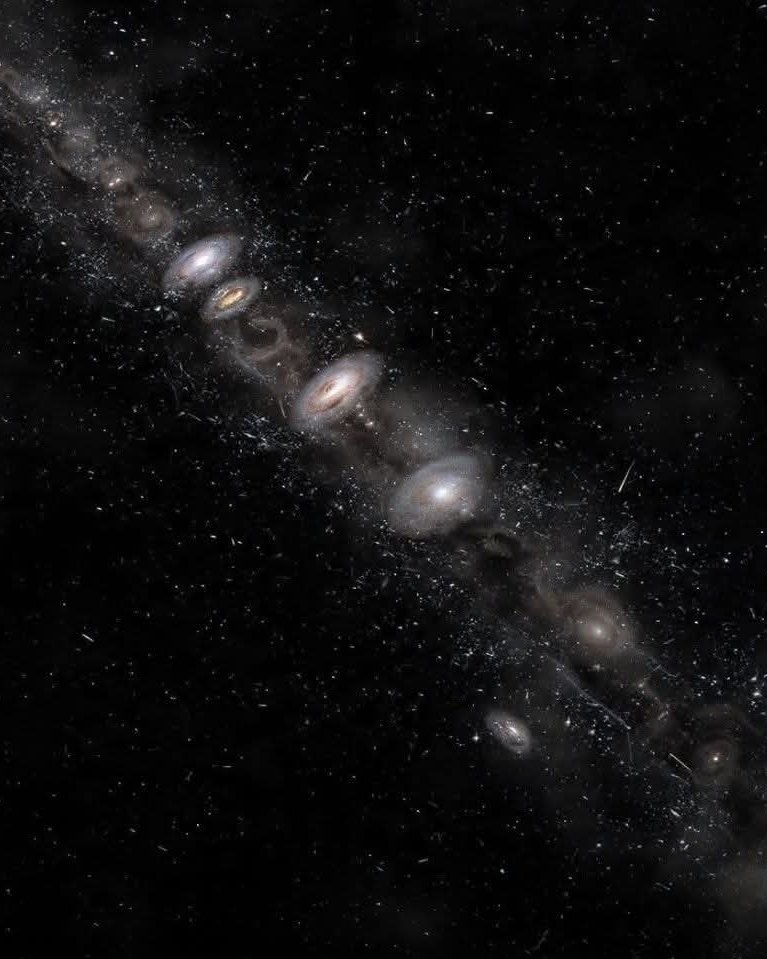
James Webb Just Found a Giant Cosmic Highway of 20 Galaxies Stretching 13 Million Light-Years Across the Infant Universe!
In one of its deepest infrared stares, the James Webb Space Telescope has uncovered something extraordinary: a massive, perfectly aligned chain of roughly 20 galaxies spanning nearly 13 million light-years — a colossal structure that existed when the universe was less than 1 billion years old.This isn’t just a random grouping. Scientists believe they’re looking at a cosmic filament — a thread-like superhighway where gravity, guided by invisible dark matter scaffolding, pulled these young galaxies into a long, connected chain. Individual galaxies in this structure are separated by hundreds of thousands of light-years, yet they all move together as part of the same enormous cosmic web.Webb’s powerful infrared vision pierced through the haze that once hid these ancient systems from Hubble, revealing how the very first large structures in the universe took shape. Instead of being scattered randomly, early galaxies preferred to form along these massive, invisible threads — dark matter acting like cosmic blueprint lines directing where stars and galaxies would be born.The light we’re seeing today left those galaxies over 13 billion years ago and has been racing toward us ever since. What you’re witnessing is a living fossil of the early cosmos, when the universe was still weaving the grand architecture we see today.A breathtaking reminder that the universe wasn’t born chaotic — it was organizing itself into vast, beautiful patterns from the very beginning. How mind-blowing is it that we can now see the cosmic “skeleton” that built everything?
It's recycled 2019 footage from a Kroger gas station in Houston, Texas—not the UK or any current shortage. The woman really did fill orange plastic bags with petrol (dangerous and dumb), but it's been repurposed for every panic-buying scare since. No link to today's price spikes or supply worries.
You’re literally aging at different speeds!
According to Einstein's theory of general relativity, your feet are younger than your head because time passes more slowly in stronger gravitational fields. Since your feet are closer to the Earth's center of mass, gravity is slightly stronger, causing them to age at a slower rate than your head.
This principle states that clocks in stronger gravity tick slower than those in weaker gravity.
Experiments using high-precision atomic clocks have confirmed this, with measurements showing that even a few centimeters in height can make a difference in time.
Over a lifetime, your head ages a few nanoseconds (around 90 nanoseconds) faster than your feet.
This effect implies that living on the top floor of a building makes you age slightly faster than living on the ground floor.
GPS satellites, located far from Earth's center, have clocks that run
faster per day than clocks on the ground; they must be adjusted to work accurately.
( 📷Marcopolo9442/GettyImages)
@AldiUK I have just opened a new tub of your Grandessa smooth peanut butter & it is half empty. Don't expect to pay for a product & only receive half a tub
'POTHOLE WATCH' LATEST: Greenhill, Buckhurst Hill.
A resident has told @eefnews Greenhill has 42 "mature and baby" potholes "the biggest is about ten inches deep and the width of nearly half a car".
'Pothole Watch' page link via https://t.co/fm2PnWDHdx
🚨 Why Are Geniuses Like Einstein So Rare Today?
Imagine this: today there are 8 billion people on Earth — four times more than a century ago. By chance alone, we should have more Einsteins than ever. Yet, where are the discoveries that change everything?
Physics used to be full of revolutions: Special Relativity, Quantum Mechanics… today? Mostly confirmations of what we already know.
It’s not because there are no mysteries left. We still don’t know what 95% of the Universe is made of. We don’t know what came before the Big Bang, or what’s inside a black hole. Mind-blowing puzzles are everywhere.
🤔 So why are breakthroughs so rare?
Part of the reason may be psychological. As the scientific community grows, groupthink grows too. Most scientists stick to safe, accepted ideas because stepping outside the norm can hurt careers. Funding, fame, and reputation often reward following the herd, not breaking it.
💡The solution? Reward risk-takers. Small teams, wild ideas, and thinking differently should get prestige and funding, not just the herd-followers.
And the craziest thought? Over 13.8 billion years, how many Einstein-level minds might have lived on other planets — and what could they know that we don’t even dream of?
The next universe-shaking discovery might not come from Earth… yet. 🌌
The Mother’s Hospital, Lower Clapton Road, where many of the children from Hackney were born.
The hospital, built in 1913, served the mothers of Hackney, until it was demolished in 1986.
Imagine a star so obscenely large that the phrase “larger than life” feels insulting.Stephenson 2-18 isn’t just big; it’s cosmic hubris made plasma.Our Sun, the unquestioned ruler of our sky, is a mere speck next to it: a glowing marble beside a weather balloon the size of a small country. The Sun’s diameter is 1.39 million kilometers. Stephenson 2-18 laughs at that number. Its diameter is estimated at roughly 3 billion kilometers (2,150 solar radii, give or take the usual red-supergiant mood swings).If you dropped this crimson titan into the center of our solar system, its surface would reach somewhere between the orbits of Saturn and Uranus on a good day. Mercury, Venus, Earth, Mars, Jupiter, and Saturn wouldn’t be planets anymore; they’d be crumbs toasted inside a star.Picture it: Earth, the entire orbit of Jupiter (all 5.9 billion kilometers of it), just a shallow layer beneath the star’s roiling, semi-transparent outer atmosphere. You could fit more than 10 billion Suns inside its volume. Ten. Billion.Yet this monster is dying. It’s a red supergiant in the absolute final chapters of its life, burning through the last of its fuel in a desperate, bloated spectacle. One day (astronomically soon, maybe in a few tens of thousands of years), it will detonate as one of the most violent hypernovae the Milky Way has ever seen, briefly outshining entire galaxies before collapsing into a black hole that will weigh dozens of times more than the Sun.Stephenson 2-18 is 7,500 parsecs away in the constellation Scutum, hidden behind thick curtains of dust, so we’ll never see it with the naked eye. But it’s there, right now: a swollen, crimson ember the size of a planetary system, quietly reminding us that in the universe’s ledger of extremes, our Sun doesn’t even register as https://t.co/rTvkYttA5d’s not just a star. It’s a warning label on the cosmos: “Objects in telescope may be more terrifying than they appear.”
Vangelis’ Blade Runner (1982) score feels like neon dreaming. Synths that mourn the future before it even arrives, melodies that make rain feel lonely. It is the sound of sci-fi becoming poetry.