We wanted to wish a happy birthday to one of our #OlnickSpanuArtProgram artists #GiorgioVigna! His work, 'Corallo,' a necklace composed of 13 coral like branches of #Muranoglass, copper and silver, from the Olnick Spanu Collection is currently on view at #PalazzoDucale, #Urbino.
This is Fulvio Bianconi’s ‘A spicchi’ (1950) from the Olnick Spanu Collection of #MuranoGlass. The name of the work refers to the six “spicchi,” triangular segments of aubergine, straw, and blue colored glass, that decorate on side of the flask. #Glass#FulvioBianconi
Carlo Scarpa’s ‘A fili’ (1942) is a clear glass vase that is decorated with horizontal “fili,” or threads, of colored glass. There is a light “battuto,” or etching, in a horizontal direction covering the entire surface.
#Glass#OlnickSpanuCollection#CarloScarpa#MuranoGlass
These two vases in red glass ‘Cinesi’ were made by Carlo Scarpa in 1940 at Venini & C. and are distinctive for their color and shape. Chinese porcelains influenced the shapes in this series and oriental lacquers inspired the finish.
#Glass#CarloScarpa#MuranoGlass
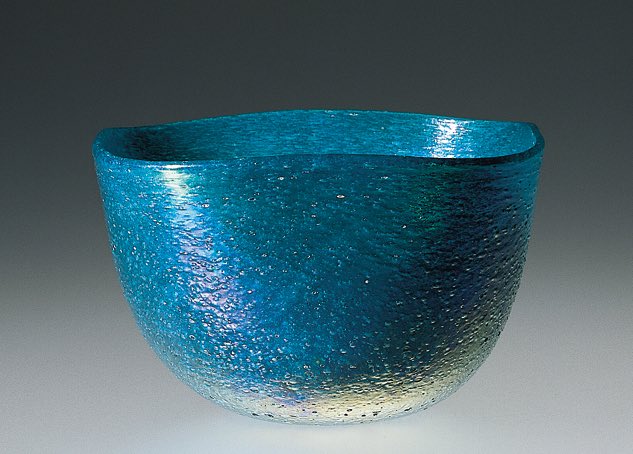
#CarloScarpa created this beautiful bowl, ‘A bollicine,’ in 1932-34 using iridized green #glass. The texture is achieved through densely bubbled “a bollicine” glass. The name, which translates to bubbles in Italian, derives from the numerous small air bubbles that cover the form.
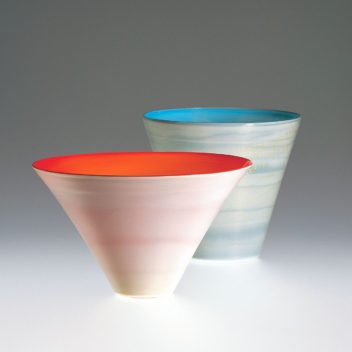
These two vessels, ‘Incamiciati’ were made with Venini & C. in 1936-1940. They are composed of “tramonto” and “alba” glass cased in several layers of colored #glass. The colors are characteristic of #TomasoBuzzi’s production, whereas the shapes are designed by #CarloScarpa.
This is Carlo Scarpa’s ‘Iridato’ (1929-1930) from the Olnick Spanu Collection of Murano Glass. The iridescent look is achieved by exposing the object during the annealing process to the vapors of tin, titanium, or other metals.
#Glass#OlnickSpanuCollection#CarloScarpa
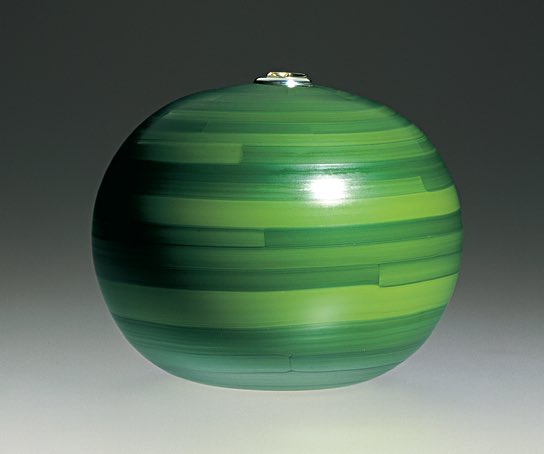
This is Thomas Stearns’ ‘Il vase per le lacrime del Doge’ (1961) stunning green orb composed of horizontal green canes with an inlay of silver and gold at the aperture. This “Vessel for The Doges Tears” was only a prototype and never actually produced: #Glass#ThomasStearns
The gold leaf application over the entire surface characterizes these footed vases by Tomaso Buzzi from the #OlnickSpanuCollection of #Muranoglass. ‘Laguna’ (1933) is a footed vase in pink laguna glass with a foot in “lattimo” glass. ‘Lattimo’ (1933) is a white vase in “lattimo.”
Fashioned in “trasparente” glass, ‘A macie’ (ca. 1950) is a product of Dino Martens. The vase receives its alluring and dazzling color from inclusions of ruby glass grit.
#Glass#OlnickSpanuCollection#DinoMartens#MuranoGlass
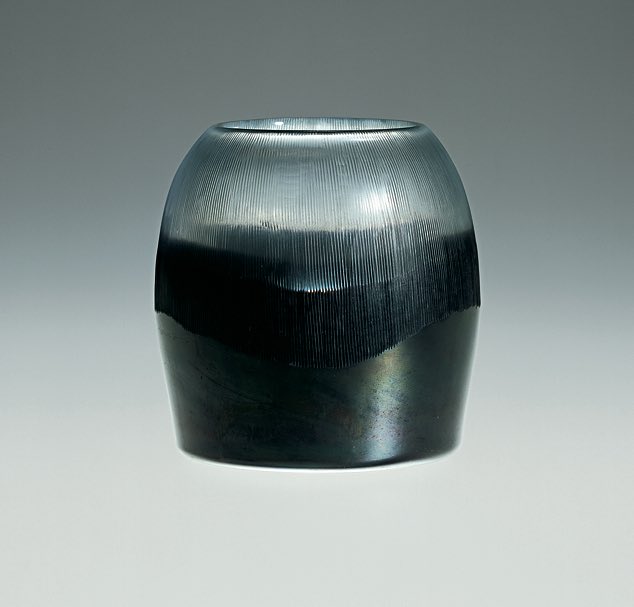
Thomas Stearns created this beautiful vessel, ‘Nebbia lunare,’ in 1962 using heavily iridized black blue glass for the lower portion and clear glass with fine vertical cuts in the top portion. The two portions are separated by an “inciso” asymmetrical band. #ThomasStearns#Glass
These 3 black glass rectangular sculptures are part of the Olnick Spanu Collection of Murano Glass. “S3,” “S4,” and “S2” were made by Laura Diaz de Santillana in 1999. The sculpture on the left and center have a turquoise blue edge whereas the one on the right has an amber edge.
As the name “Boats” indicates, there are two elegantly shaped pieces of glass that resemble boats. Lino Tagliapietra crafted this design in 1998 and finished both pieces with a dense and regular wheel-carved “battitura.”
#MuranoGlass#LinoTagliapietra#Glass
This is Yoichi Ohira’s ‘Metamorfosi’ (1999) from the Olnick Spanu Collection of Murano Glass. The beautiful vessel is composed of “lattimo” glass canes with inlays of “cristallo murrine.” The “lattimo” technique allows the white glass to resemble porcelain. #YoichiOhira#Glass
Carlo Scarpa created this stunning tall cylindrical vessel, ‘Inciso,’ in 1940 using transparent light blue glass cased in amethyst. If you look closely, you can see undulating vertical lines from wheel-cut incisions.
#MuranoGlass#OlnickSpanuCollection#CarloScarpa#Glass
This sculptural vase, ‘Valva,’ is part of the Olnick Spanu Collection of Murano Glass and was made by Flavio Poli in 1954. The combination of glass of significant weight and thickness with clear glass creates the unique color. #MuranoGlass#OlnickSpanuCollection#FlavioPoli
Fashioned in turquoise glass, ‘Turchese e nero’ (1932) was designed by Tomaso Buzzi. The fish décor and trim in black glass stand out against the vibrant colored bowl.
#MuranoGlass#OlnickSpanuCollection#TomasoBuzzi#Glass
This is Carlo Scarpa’s ‘Incamiciato’ (1930) from the Olnick Spanu Collection of Murano Glass. The large footed vase is cased in amethyst-colored glass with trim and a shell decoration in red “pasta vitrea” and “lattimo” glass.
#MuranoGlass#CarloScarpa#Glass
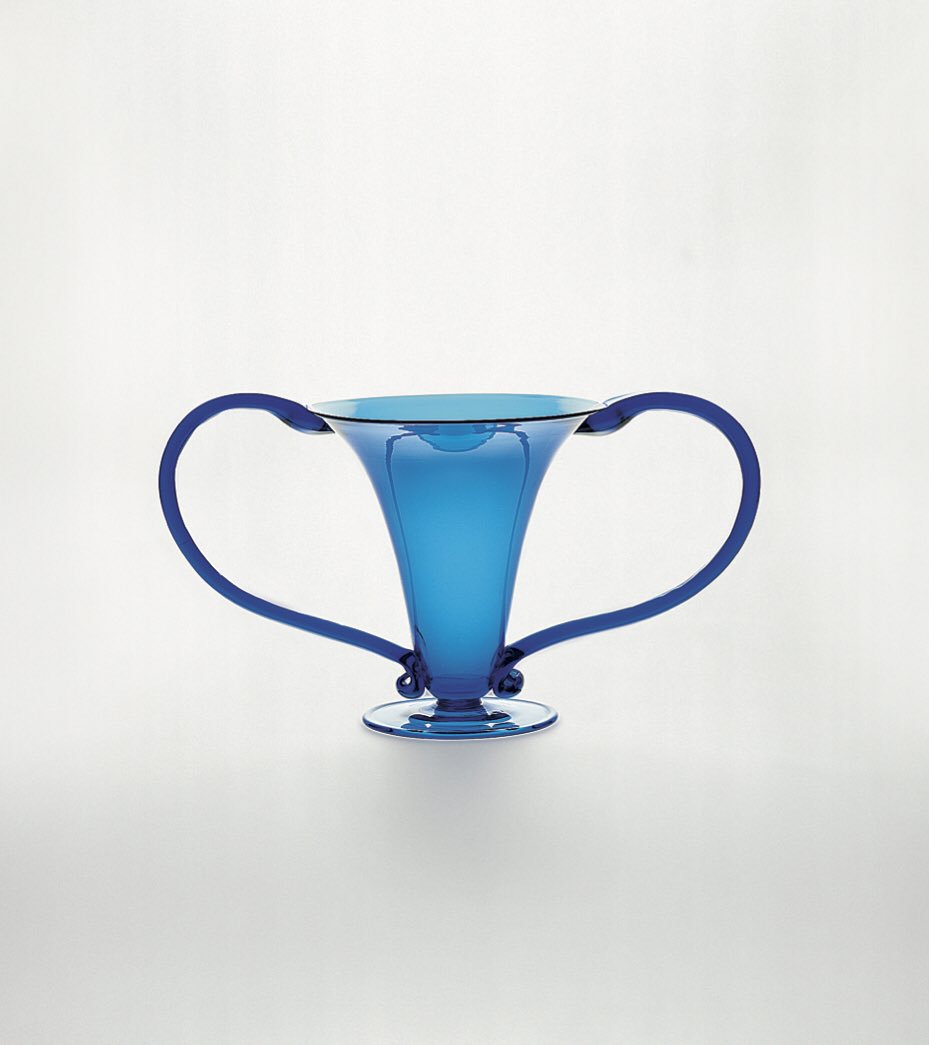
‘Libellula’ (1921-25), a thin blue transparent glass vase by Vittorio Zecchin is distinguished by its two large handles and its name comes from its resemblance to a dragonfly.
#MuranoGlass#OlnickSpanuCollection#VittorioZecchin#Glass