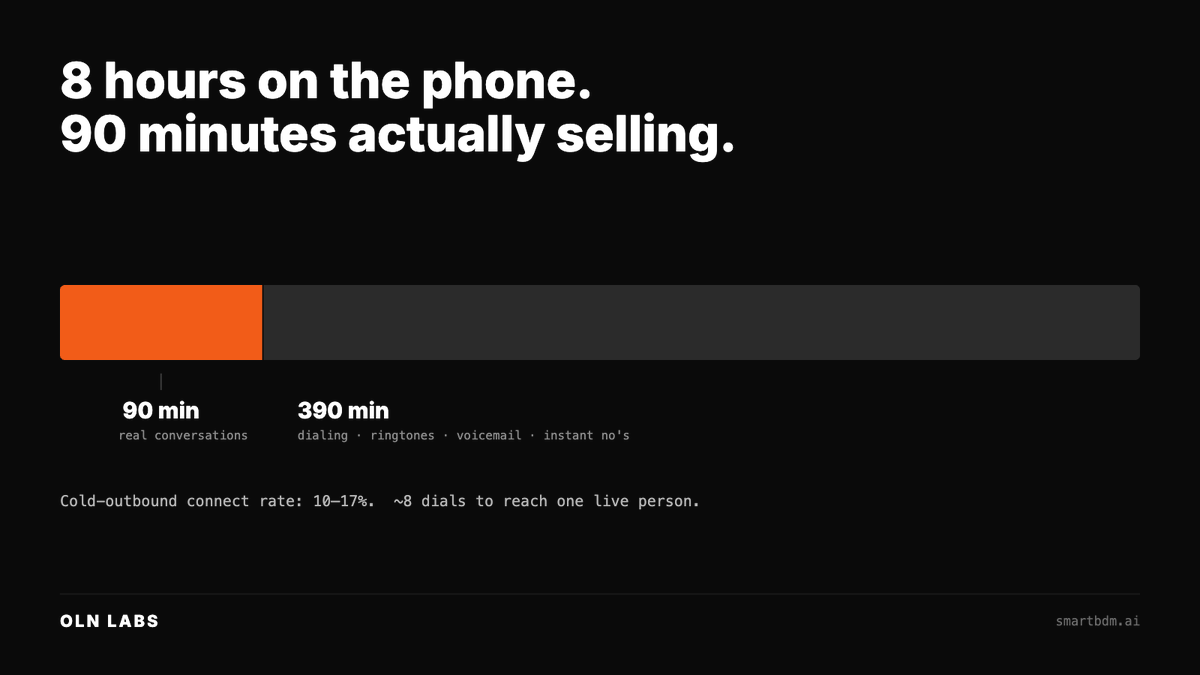
A Bengaluru sales floor: eight BDEs, ₹25,000 a month each. The best closer spends about 90 minutes of an 8-hour day actually talking to a customer.
The rest is ringtones.
Sixty to seventy dials a day off old lead lists. Most ring out. A good chunk hit "not interested" inside ten seconds. That's eight skilled people paid to mostly listen to a phone ring.
Here's what that setup misses. The expensive thing a good BDE brings isn't the dialing — it's the judgment. Hearing the hesitation in someone's voice. Knowing when to push and when to back off. Turning a maybe into a meeting.
None of that matters against a number that never picks up.
Cold-outbound connect rates sit around 10 to 17%. A rep burns roughly eight dials to reach one live person, and spends the other seven on ringtones and voicemail. That's skilled-human pay for work that's mostly waiting.
The dialing was never the job. It's the part everyone hates and everyone is bad at by call number 40.
So hand it to something that doesn't mind. A machine makes the thousands of dials, weeds out the dead numbers and the instant no's, and hands the rep a short list of people who actually answered and actually qualified. The rep opens the day with four real conversations instead of dialing seventy numbers to find them.
We built the AI Voice Caller inside SmartBDM to run exactly this play — dial your consented lists at scale, qualify in the customer's language, and hand each rep a ranked list of warm leads with the whole conversation attached.
Your most expensive people should never be the ones listening to ringtones.
Pull one rep's call log this week. Count the minutes in a real conversation against the minutes spent dialing. That gap is what you're paying for.
Your sales team isn't losing deals because of WhatsApp.
They're losing them because of the Excel sheet sitting next to it.
Here's the thing nobody wants to admit:
WhatsApp is doing its job. It's where your customers actually talk to you. Instantly. In the channel they already live in. The conversation, the tone, the voice note where they said the budget moved — it's all there. That's the real record of the deal.
Then someone has to turn that into a row in a spreadsheet. And that's where it dies. Because Excel was never built to be your memory.
It can't remind anyone to follow up. A cell that says "call back Tuesday" just sits there. Tuesday comes. Nobody's nudged. The lead goes cold.
It has no timeline. You see the current state of a row — never the sequence of what actually happened. Was this deal hot for three weeks, or did a rep flip it to "hot" yesterday to pad his numbers? You can't tell.
It has no history. Anyone can change any cell at any time, and the change leaves no trace. A deal gets overwritten, downgraded, deleted — and there's no way to see who did it or what it said before.
It's quietly wrong even when nobody's touching it. Decades of audits found ~88% of real-world spreadsheets contain at least one error.
A forecast built on a sheet nobody trusts isn't a forecast. It's a wish with formatting.
And the most expensive part?
When a rep quits, the relationship walks out with them — because the chat lived on their phone and the spreadsheet only ever held "interested, budget moved." Not the 18 messages of context behind it. The new rep inherits a row and zero relationship.
You didn't lose a person. You lost the memory of every deal they were carrying.
The instinct is to blame the messaging app. Add more discipline. Make people update the sheet.
But you can't out-discipline a missing feature.
The channel is fine. The filing cabinet is broken.
If you're running sales on WhatsApp + Excel right now — where do YOU see the deals leaking?
Curious if it's the follow-ups or the rep-quitting one that hurts most.
A ₹60L deal died last week. The CRM said "lost on price."
I pulled the timeline. The price was never the problem.
Here's what actually happened, day by day.
January 14 - The growth team at a B2B SaaS company runs a discount campaign. 5,000 contacts, 20% off annual plans, the usual new-year push. Three of those 5,000 contacts have acmecorpdotcom email addresses.
Acme is already an open deal worth ₹60L. Nobody knows the discount went to them, because the tool that sent the campaign doesn't talk to the tool that holds the deal. Two systems, one customer, zero awareness.
February 22 - The account executive gets on a call with Acme's VP of Engineering. Pitches the platform. Quotes list price — ₹60L, no discount. He has no idea his own company offered Acme 20% off six weeks earlier.
The VP doesn't say anything. But he's done the math. The number he was shown in his inbox and the number the AE just quoted don't match. He goes quiet. The AE logs the call as "positive, needs follow-up."
March 9- Someone on Acme's team starts a free trial to test the product before the contract. They hit a bug — a known one, already sitting in the backlog with a "won't fix this sprint" label. Support takes the ticket. The ticket never reaches the AE. The AE never calls Acme to say "I saw you ran into that, here's the workaround." From Acme's side, they reported a problem into a void.
April 3 - The email comes in. Four lines.
"Thanks for your time. We've decided to go in a different direction. Wishing you the best."
The AE logs it: Closed · Lost. Reason: pricing.
Here's the thing. It was never pricing.
Acme talked to one company three times. They got a discount they were never told applied to them, a quote that contradicted it, and a bug report that disappeared. From the inside, that's three teams using three tools. From Acme's side, it's one vendor that couldn't remember a conversation it had two weeks ago.
The competitor who won didn't have a better product. They had one that felt like it remembered who Acme was across every touchpoint. No seams.
That's the actual gap. Not pricing. Not the product. Memory. Most companies have a growth tool, a sales tool, and a support tool that each hold a third of the customer and never compare notes. The customer feels every seam — and picks the vendor who doesn't have any.
The next time a deal gets filed as "lost on price," pull the timeline. Count how many of your teams touched that customer, and how many of them knew what the others had said.
we'd bet the real reason wasn't on the form.
Your best sales reps aren't slow.
They've quietly become the integration your software was supposed to be.
Here's the math no vendor will ever put in front of you. Take a 10-person sales team. Each rep loses roughly 40% of every working day moving data by hand — pulling a number out of the CRM into WhatsApp, pasting a WhatsApp reply into email, updating a sheet so the manager's dashboard isn't quietly lying.
Across 250 working days, that's:
→ 1,000 person-days a year → The equivalent of 4 full-time people → ₹40L+ in cost that never lands on a single invoice
Never a line item. Always on the P&L.
And it isn't a people problem. It's structural:
Your CRM tracks deals. It doesn't send WhatsApp. Your WhatsApp tool sends WhatsApp. It doesn't update the CRM. Your email tool sends email. It has no idea what the WhatsApp said.
None of these tools talk to each other — so a human becomes the wiring between them. 5 tabs, copy, paste, switch, repeat, ~70 times a day. Quiet enough that it never shows up in a budget review.
That's the real platform tax. And here's the trap: it scales with every head you add. So the instinct to hire your way out of flat output usually just buys more of the same problem.
One question worth sitting with before the next "why is productivity flat?" meeting:
How much of my team's day is spent being the integration?
If you've watched this happen on your own team, we'd like to hear how you're thinking about it.
Marketing hit its KPI.
Sales called the leads trash.
Support is drowning.
Ops is firefighting.
Nobody's lying. Nobody's lazy.
The problem isn't your team — it's that your company's information lives in 6 different tools.
Here's how you actually lose revenue ↓
Shweta fills your form at 11:03 AM. Auto-email fires. WhatsApp pings her: "we'll call shortly."
The rep is stuck on another escalation. The CRM has no clue that WhatsApp promise even exists.
By 5 PM, she's bought from a competitor.
Dashboard next week: "Not interested."
A lie.
And misalignment never announces itself. It sneaks in through the ordinary:
• Two reps call the same customer
• "Cost per lead dropped!" — so did quality
• Support promises a fix Ops hasn't heard about
• "Wait, that happened? Nobody told me"
No dramatic failures. Just small cracks. Compounding. Every day.
Here's the ironic part.
When misalignment grows, people don't get lazy. They sprint harder.
More calls. More campaigns. More SOPs. More standups. More review meetings.
A football team where every player is talented — but no one knows the score.
You don't fix this with more dashboards. Or more tools. Or more meetings.
You fix it when every call, every message, every follow-up, every promise — lives in ONE place, on ONE timeline, visible to every team.
That's when stress drops. Trust rises. Customers feel consistency.
That's exactly why we built SmartBDM.
Why is your WhatsApp marketing suddenly dead?
It’s not your copy.
It’s not your offer.
The rules changed — and most businesses are still stuck in 2023.
A couple years ago you could upload contacts, blast a broadcast, and watch 80%+ open rates roll in. Replies flooding your inbox by evening.
WhatsApp felt like printing money.
That cheat code is gone.
Meta quietly tightened policies throughout 2024–2025. Bulk broadcasting got dismantled.
Delivery dropped. Flags increased. Costs per result climbed.If your campaigns feel throttled now, you’re not alone.
The businesses still winning on WhatsApp in 2026 shifted completely — different setup, different messaging, different compliance flow.
So want to know what changed recently, reply to this thread and we will DM you
What’s been your experience lately with WhatsApp campaigns?
Hit reply and tell me
We are hiring. come work with us and build the growth super app from India. Following roles are open
1. SDR intership - https://t.co/b1K1tqVqTw
2. Social media manager - https://t.co/nWBxU6psqB
7 tools to run one sales team is insane.
We replaced all of them.
CRM + WhatsApp + AI coaching + lead nurturing — one app, fully automated.
Your rep speaks. AI updates everything. Zero busywork.
30-day free trial. No per-seat fees.
https://t.co/5zFIlKPdOd
WhatsApp is not dead as a sales channel.
It's actually getting better — because your competitors are burning their lists with blasts, leaving more attention for the people doing it right.
The channel rewards patience and precision now.
Hot take: your WhatsApp marketing isn't failing because of bad copy or weak offers.
It's failing because you're still running a 2021 playbook on a 2025 platform.
Meta changed the rules. Nobody told you. Thread 🧵
The businesses still winning on WhatsApp in 2025 share one thing:
They stopped trying to reach everyone.
They reach the right person, at the right moment, with a message that feels like it was written for them.
Smaller list. Smarter timing. Real personalisation.
CRM stops being admin work. Starts behaving like a revenue engine.
Unlimited users. Fixed pricing. No per-seat tax on growth.
Bad leads are rare. Bad execution isn’t.
Let AI drive your next revenue jump.
Most founders think:
“Leads are bad.”
Truth?
Your sales execution is broken.
Sales teams hate CRMs.
So data doesn’t get updated.
No data → no insights → lost deals.
Then we blame marketing.
Classic mistake.
We fixed this by flipping the model.
At https://t.co/0TIOBIvy4x, AI does the CRM work for the sales team.
• Calls → auto-updated lead stages • Notes → automatic follow-ups • Zero lead leakage • Sales reps improve with every call