Breaking down NGX news and teaching the market, one thread at a time | Dividends, listings, results season — what they actually mean for retail | Benin City 🇳🇬
New here? This account breaks down NGX news and teaches the market — no jargon, no hype.
𝗧𝘄𝗼 𝘁𝗵𝗶𝗻𝗴𝘀 𝗜 𝗽𝗼𝘀𝘁:
📊 News, translated — dividends, listings, results season, explained for retail
📚 Education threads — P/E, dividend yield, rights issues, and the traps that catch new investors
Start with these:
🧵 What a dividend really means — using Zenith Bank as a live example https://t.co/sSea7fNVSR
🧵What a Money Market Fund actually is (and why it's a parking spot, not a strategy) https://t.co/3297QBft5G
New threads weekly. Follow along 🇳🇬
Warren Buffett once said: "Risk comes from not knowing what you're doing."
Before you touch NGX stocks, you need somewhere safe to park cash while you learn. That's what a Money Market Mutual Fund (MMF) is for.
A thread on the most misunderstood "safe" investment in Nigeria 🧵
Investing is paying for future convenience with present sacrifice.
The money you invest could have been spent now, but you choose to put it toward your future instead.
See every investment as a sacrifice that can help make tomorrow financially easier.
Be honest: do you actually know what happens to your money between clicking "buy" and the shares showing up in your account?
A) Yes, I understand settlement + CSCS
B) No idea, just trust the app
If B — that's exactly what I post here. No hype, no "buy this now" calls. Just how the NGX actually works, so you can think for yourself. 👇
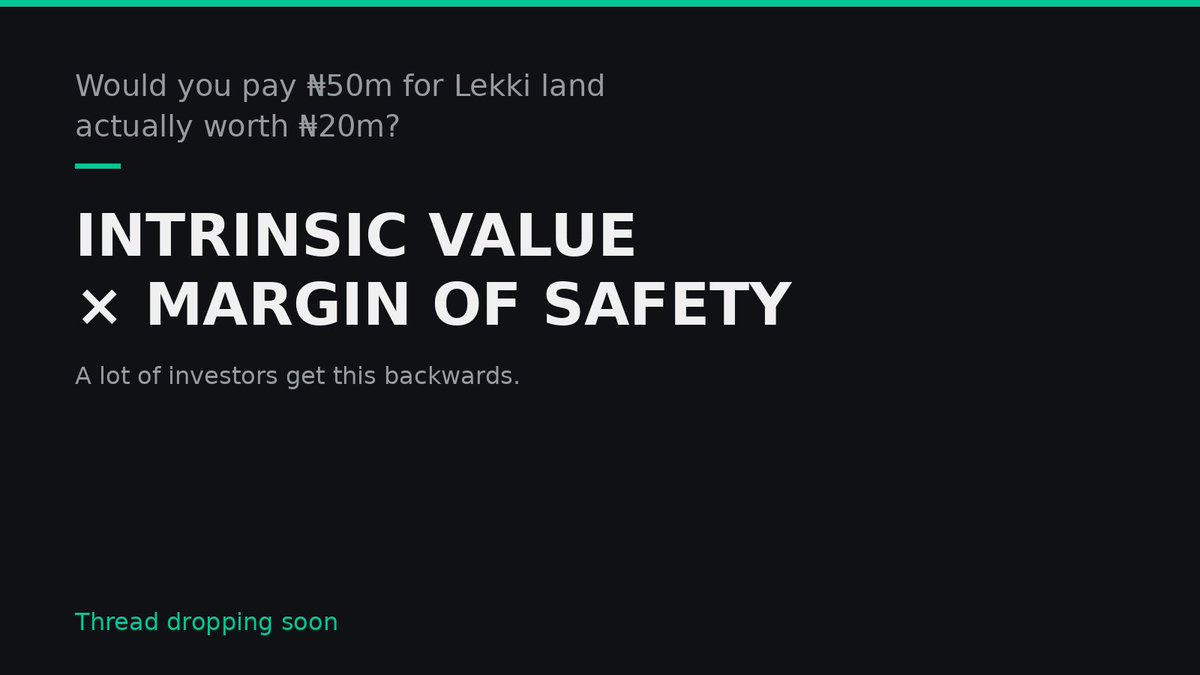
You wouldn't buy a plot of land in Lekki for ₦50m if it's actually worth ₦20m — no matter how "hot" the area is.
A lot of investors do exactly that with stocks, without realizing it.
Dropping a thread this week on intrinsic value + margin of safety — the 2 concepts that separate investors from gamblers. 🧵👀
Nigeria is returning to FTSE Russell’s Frontier Market status on September 21. 🇳🇬
But what does that actually mean?
It gives Nigerian equities greater visibility among global investors and could create opportunities for more participation and liquidity.
But the real question is:
Can Nigeria turn increased visibility into actual capital inflows?
That’s what investors should watch.
Follow me for simple, practical NGX education. 📈
Price is what you pay. Value is what you get." — Warren Buffett
FCMB trades at a Price-to-Earnings ratio of around 3.
Access Holdings, even lower. Cheap on paper — but cheap isn't automatically value.
Before you buy the price, ask why the market is pricing it that way.
NGX closed Monday, 31 August on a strong note.
ASI: 244,199.39
+1.20% | +2,900 points
Market cap: ₦157.74 trillion (+₦1.91 trillion)44 stocks up, 19 down.OMATEK, IKEJAHOTEL and SOVRENINS led the gainers.
ACCESSCORP led volume. MTNN led value.
A green close is not the same as “the market is cheap” or “buy everything.”
It means buyers showed up today. Your plan still decides whether you add, hold, or do nothing.
August ends. What stage are you buying from — tips, fundamentals, or a written strategy?
@AngelaNewton_ I'm telling you that's the best, there are stocks I'm holding currently and to be frank I'm praying they should not go up yet because I haven't accumulate enough. If those stock went up, I'm not happy because I know I'll be buying at higher price. 😂
I've been seeing people post about Money Market Mutual Funds describing how good they are in the long term — 20 to 40 years. Let's talk about why that's misleading.
The math problem:
An 18% Money Market Mutual Fund yield against ~16% inflation nets you roughly 1.7% real return per year. Compound that over 15-20 years and you get modest real growth — nowhere close to what the nominal naira figure suggests.
₦10 million at 18% becomes ₦52.3 million nominal in 10 years. Adjusted for inflation, that's closer to ₦11.9 million in today's purchasing power. The huge numbers you see in those posts are real in naira — not real in what you can actually buy.
Why it's structurally a short-term tool:
Money Market Mutual Funds are built for parking money — emergency funds, cash needed within 6-12 months, money sitting idle between decisions. They're not designed to compound meaningfully over long horizons because their yield is mechanically tied to interest rates, which move with inflation. You're not really growing wealth over 20+ years. You're mostly just keeping pace with the naira losing value, plus a thin margin on top.
What makes the case even weaker over 15-20+ years:
1. You give up decades of equity compounding, dividend growth, and reinvestment — the tools that can meaningfully outpace inflation over a long horizon, even with volatility along the way.
2. Interest rates won't stay elevated forever. The Central Bank of Nigeria's policy rate is unusually high right now. If it eases over the next two decades (near certain across that horizon), Money Market Mutual Fund yields will likely drift toward the historical 7-10% range, making real returns even thinner or negative for stretches.
3. You're paying for safety on a horizon that doesn't need it. 15-20+ years is long enough to ride out equity volatility entirely.
The honest take: a Money Market Mutual Fund is the wrong tool for a 20-40 year horizon. It's optimized for capital preservation and liquidity, not long-term growth.
So the real question: if you're not touching this money for 20+ years, why choose a "growth" that's really just inflation with extra steps?
@nazzaokonkwo@AlfaAdam001@THAT_NGX_GUY@AngelaNewton_@stockyvest@TomolaGroup
Why do some people stay broke investing while others build real wealth off the same NGX?
It's not the stocks. It's the stage they're at.
Stage 1: You buy on tips.
A friend, a WhatsApp group, or a headline tells you what to buy — you don't know why you're holding it.
Stage 2: You buy on fundamentals.
You check earnings, dividend history, and P/E before you commit. You know why you own what you own.
Stage 3: You buy on strategy.
You have a plan — target allocation, entry/exit rules, a horizon. The stock doesn't control your emotions; your plan does.
Most investors stay stuck in Stage 1 forever, because Stage 2 takes patience and Stage 3 takes discipline no tip or hype cycle can teach you.
Which stage are you at?
Be honest: have you ever bought a stock because of a WhatsApp group tip, without checking the fundamentals?
No judgment. Just curious how common this is 😅