this girl on TikTok said, “if I tell you all the trauma I endured from my mom and you look me dead in my face and tell me ‘that’s still your mom’ I’m going to beat you how she beat me.” and she’s so real. stop undermining people’s trauma.
If you’re gonna use the “Christianity was happening in Ethiopia before colonialism” argument then you better be practicing Ethiopian orthodox Christianity because I don’t want to hear it!!!
I have a theory that people’s inability to have fun in the club is a direct correlation to people’s inability to revolt & start a revolution. If they’re too scared to dance and leet loose, then they’ll be too scared to do anything meaningful about the future of this country...
Nashville, Tennessee, 1930.
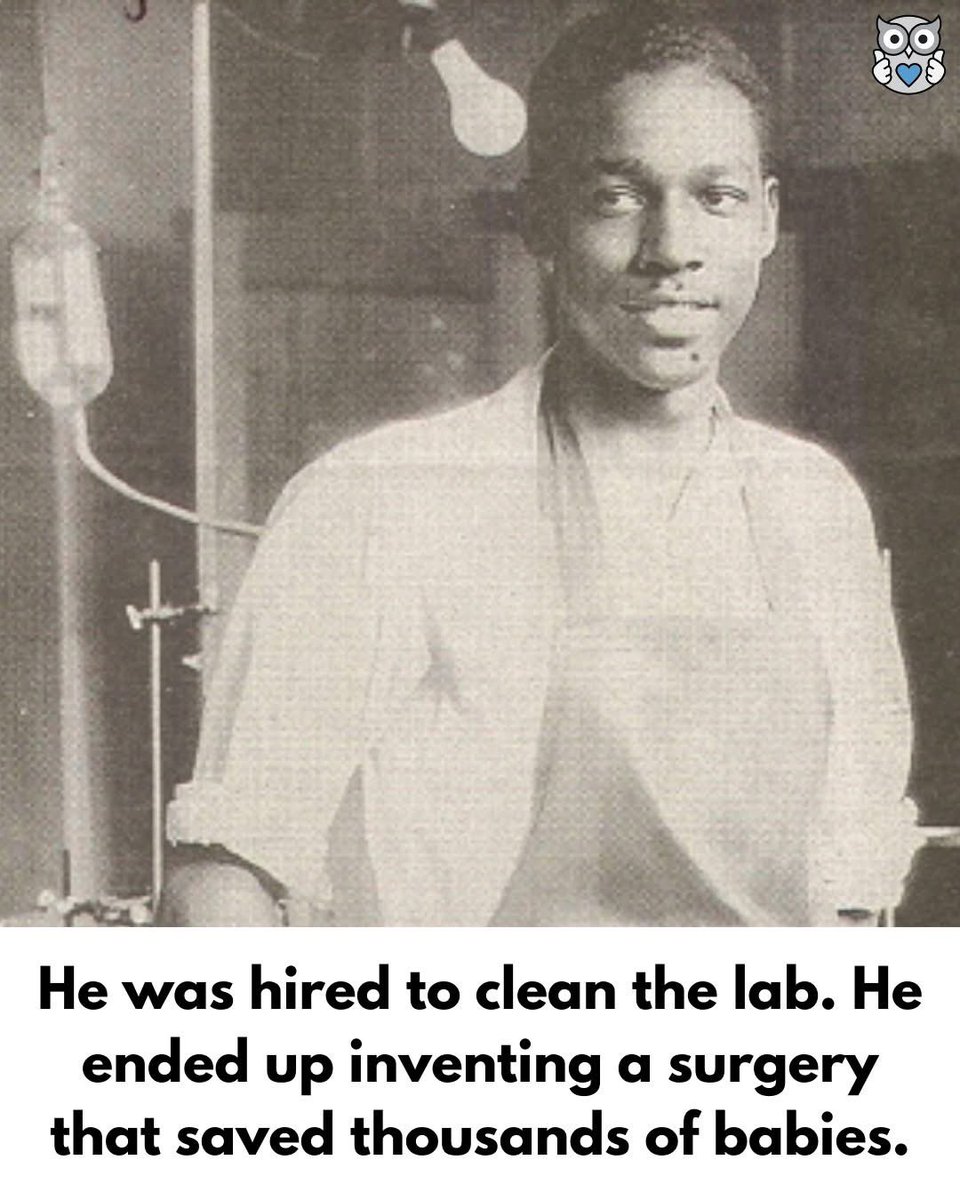
Vivien Thomas was born into the Jim Crow South. He was Black in a world that told him what he could and could not become.
He wanted to be a doctor.
He worked as a carpenter and saved every dollar to attend the Tennessee Agricultural and Industrial College. He planned to go to medical school.
Then the Great Depression hit.
The bank where he kept his savings collapsed. His money was gone. So were his plans.
At 19, Vivien took a job at Vanderbilt University Hospital. He earned 12 dollars a week as a laboratory assistant. He worked in the lab of Dr. Alfred Blalock.
He was expected to clean, care for animals, and stay quiet.
Instead, he watched.
He listened.
He asked smart questions.
He understood what the experiments were trying to do.
Dr. Blalock noticed. He began teaching Vivien surgical skills.
Vivien had never been to medical school. He had no degree. But he had sharp eyes, a strong memory, and steady hands. Soon, he was performing complex surgeries on lab animals. His stitching was careful and exact. His knowledge of anatomy was deep.
By 1933, he was no longer just an assistant in practice. He was Blalock’s research partner. But officially, he was still paid and treated far below his real role.
In 1941, Dr. Blalock moved to Johns Hopkins Hospital to become Chief of Surgery. He agreed to go only if Vivien came with him. The hospital allowed it. But they gave Vivien a lower-status technical title.
Then came their biggest challenge.
Babies were dying from a heart defect called ‘tetralogy of Fallot’. People called it ‘Blue Baby Syndrome’. The babies’ skin turned blue because their bodies were not getting enough oxygen. Most did not live long.
Dr. Helen Taussig asked if a surgery could increase blood flow to the lungs.
Blalock turned to Vivien.
“Can you figure this out?”
Vivien went to work.
For months, he practiced on dogs. He tried again and again. He had to create new methods. He had to design tools. No one had ever done this before.
Finally, he developed a way to connect the subclavian artery to the pulmonary artery. The new path lets more blood reach the lungs.
It was bold.
It was risky.
It had never been tried on a human.
On November 29, 1944, they operated on a baby girl named Eileen Saxon. She was 15 months old and weighed only nine pounds. She was dying.
Dr. Blalock performed the surgery. Vivien stood behind him on a step stool. He quietly guided every move.
“Deeper.”
“A little to the left.”
“Use smaller sutures there.”
Blalock held the tools. Vivien directed the operation.
After four and a half hours, it was over. Eileen’s blue lips turned pink. Her fingers turned pink. Oxygen was finally reaching her body.
The surgery worked.
The procedure became known as the Blalock-Taussig Shunt. It changed medicine. It saved thousands of children. It helped create the field of pediatric heart surgery.
Dr. Blalock became famous.
Vivien did not.
For 22 years, Vivien trained surgical residents at Johns Hopkins. Many of them became leaders in heart surgery. They learned their skills from him.
But he was not called Doctor. He was not listed as faculty. He ate with the maintenance staff.
His name appeared on no papers.
In 1971, after four decades of work, Johns Hopkins promoted him to Instructor of Surgery. Not Professor. Instructor.
By then, the surgeons he had trained knew the truth.
In 1976, the hospital honored him with a portrait. It was placed beside Blalock’s. At the ceremony, former students stood and applauded. Some cried.
They knew who had taught them. They knew who had built the foundation.
That same year, Johns Hopkins awarded him an honorary doctorate. At last, he was officially Dr. Vivien Thomas.
He was 66 years old.
He had been doing the work of a surgeon for 46 years.
Dr. Vivien Thomas died in 1985 at age 75.
In 2004, HBO released a film about his life called Something the Lord Made.
My mom got my father beat up every Friday after work. He cheated. So she paid a different guy $50 to spot him outside of work and he got his ass beat every Friday at 6pm. He had to be escorted with security to his car. She did this for months. 😭😭
me when i remember that i am all that i am and that there’s nothing to even worry about because it’s already done and i literally always get what i want bc im a master manifestor that has everything working out in my favor