La #UNAL lamenta profundamente el fallecimiento del profesor Víctor Manuel Moncayo, profesor emérito, ex rector y una de las personalidades más destacadas de la institución. QEPD
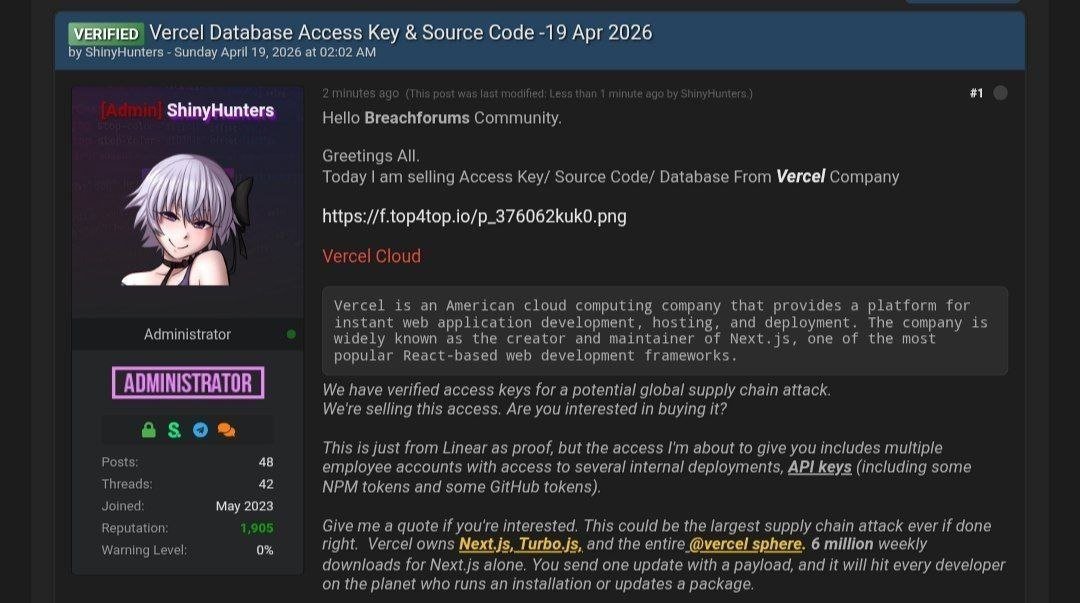
🚨 BREAKING: Vercel has been breached. A threat actor has listed their customers' data, source code, databases, and keys up for sale.
Vercel has also publicly disclosed they've identified a security incident involving unauthorized access to their internal systems.
As AI agents accelerate coding, what is the future of software engineering? Some trends are clear, such as the Product Management Bottleneck, referring to the idea that we are more constrained by deciding what to build rather than the actual building. But many implications, like AI’s impact on the job market, how software teams will be organized, and more, are still being sorted out.
The theme of our AI Developer Conference on April 28-29 in San Francisco is The Future of Software Engineering. I look forward to speaking about this topic there, hearing from other speakers on this theme, and chatting with attendees about it. We’re shaping the future, and I hope you will join me there!
It is currently trendy in some technology and policy circles to forecast massive job losses due to AI. Even if they have not yet materialized, these losses certainly must be just over the horizon! I have a contrarian view that the AI jobpocalypse — the notion that AI will lead to massive unemployment, perhaps even rioting in the streets — won’t be nearly as bad as dire forecasts by pundits, especially pundits who are trying to paint a picture of how powerful their AI technology is.
Among professions, AI is accelerating software engineering most, given the rise of coding agents. According to a new report by Citadel Research, software engineering job postings are rising rapidly. So if software engineering is a harbinger of the impact AI will have on other professions, this expansion of software engineering jobs is encouraging.
Yes, fresh college graduates are having a hard time finding jobs. And yes, there have been layoffs that CEOs have attributed to AI, even if a large fraction of this was “AI washing,” where businesses choose to attribute layoffs to AI, even though AI has not changed their internal operations much yet. And yes, there is a subset of job roles, such as call center operator, that are more heavily impacted. Many people are feeling significant job insecurity, and I feel for everyone struggling with employment, whether or not the cause is AI-related. And many other factors, such as over-hiring during the pandemic and high interest rates, have contributed to the slowdown in the labor market, and the notion that AI is leading to unemployment is oversimplified.
In software engineering, I see a lot of exciting work ahead to adapt our workflows. It is already clear that: (i) As AI makes coding easier, a lot more people will be doing it. (ii) Writing code by hand and even reading (generated) code is not that important, because we can ask an LLM about the code and operate at a higher level than the raw syntax (although how high we can or should go is rapidly changing). (iii) There will be a lot more custom applications, because now it’s economical to write software for smaller and smaller audiences. (iv) Deciding what to build, more than the actual building, is becoming a bottleneck. (v) The cost of paying down technical debt is decreasing (since AI can refactor for you).
At the same time, there are also a lot of open questions for our profession, such as:
- In the future, what will be the key skills of a senior software engineer? And for junior levels, what should be the new Computer Science curriculum?
- If everyone can build features, what skills, strategies, or resources create competitive advantage for individuals and for businesses?
- What are the new building blocks (libraries, SDKs, etc.) of software? How do we organize coding agents to create software?
- What should a software team look like? For example, how many engineers, product managers, designers, and so on. What tooling do we need to manage their workflow?
- How do AI agents change the workflow of machine learning engineers and data scientists? For example, how can we use agents to accelerate exploring data, identifying hypotheses, and testing them?
I’m excited to explore these and other questions about the future of software engineering at AI Dev. I expect this to be an exciting event. Please join us!
[Original text: The Batch newsletter.]
https://t.co/i4bQevDG4i
New record🥇
The Artemis II astronauts are now farther from Earth than humans have ever been! At 1:57 p.m. EDT, they broke the record set by Apollo 13 in 1970.
Their journey around the far side of the Moon today will take them a maximum distance of 252,752 miles from Earth.
Job seekers in the U.S. and many other nations face a tough environment. At the same time, fears of AI-caused job loss have — so far — been overblown. However, the demand for AI skills is starting to cause shifts in the job market. I’d like to share what I’m seeing on the ground.
First, many tech companies have laid off workers over the past year. While some CEOs cited AI as the reason — that AI is doing the work, so people are no longer needed — the reality is AI just doesn’t work that well yet. Many of the layoffs have been corrections for overhiring during the pandemic or general cost-cutting and reorganization that occasionally happened even before modern AI. Outside of a handful of roles, few layoffs have resulted from jobs being automated by AI.
Granted, this may grow in the future. People who are currently in some professions that are highly exposed to AI automation, such as call-center operators, translators, and voice actors, are likely to struggle to find jobs and/or see declining salaries. But widespread job losses have been overhyped.
Instead, a common refrain applies: AI won’t replace workers, but workers who use AI will replace workers who don’t. For instance, because AI coding tools make developers much more efficient, developers who know how to use them are increasingly in-demand. (If you want to be one of these people, please take our short courses on Claude Code, Gemini CLI, and Agentic Skills!)
So AI is leading to job losses, but in a subtle way. Some businesses are letting go of employees who are not adapting to AI and replacing them with people who are. This trend is already obvious in software development. Further, in many startups’ hiring patterns, I am seeing early signs of this type of personnel replacement in roles that traditionally are considered non-technical. Marketers, recruiters, and analysts who know how to code with AI are more productive than those who don’t, so some businesses are slowly parting ways with employees that aren’t able to adapt. I expect this will accelerate.
At the same time, when companies build new teams that are AI native, sometimes the new teams are smaller than the ones they replace. AI makes individuals more effective, and this makes it possible to shrink team sizes. For example, as AI has made building software easier, the bottleneck is shifting to deciding what to build — this is the Product Management (PM) bottleneck. A project that used to be assigned to 8 engineers and 1 PM might now be assigned to 2 engineers and 1 PM, or perhaps even to a single person with a mix of engineering and product skills.
The good news for employees is that most businesses have a lot of work to do and not enough people to do it. People with the right AI skills are often given opportunities to step up and do more, and maybe tackle the long backlog of ideas that couldn’t be executed before AI made the work go more quickly. I’m seeing many employees in many businesses step up to build new things that help their business. Opportunities abound!
I know these changes are stressful. My heart goes out to every family that has been affected by a layoff, to every job seeker struggling to find the role they want, and to the far larger number of people who are worried about their future job prospects. Fortunately, there’s still time to learn and position yourself well for where the job market is going. When it comes to AI, the vast majority of people, technical or nontechnical, are at the starting line, or they were recently. So this remains a great time to keep learning and keep building, and the opportunities for those who do are numerous!
[Original text; https://t.co/zbIhZHfCC0 ]
Another year of rapid AI advances has created more opportunities than ever for anyone — including those just entering the field — to build software. In fact, many companies just can’t find enough skilled AI talent. Every winter holiday, I spend some time learning and building, and I hope you will too. This helps me sharpen old skills and learn new ones, and it can help you grow your career in tech.
To be skilled at building AI systems, I recommend that you:
- Take AI courses
- Practice building AI systems
- (Optionally) read research papers
Let me share why each of these is important.
I’ve heard some developers advise others to just plunge into building things without worrying about learning. This is bad advice! Unless you’re already surrounded by a community of experienced AI developers, plunging into building without understanding the foundations of AI means you’ll risk reinventing the wheel or — more likely — reinventing the wheel badly!
For example, during interviews with job candidates, I have spoken with developers who reinvented standard RAG document chunking strategies, duplicated existing evaluation techniques for Agentic AI, or ended up with messy LLM context management code. If they had taken a couple of relevant courses, they would have better understood the building blocks that already exist. They could still rebuild these blocks from scratch if they wished, or perhaps even invent something superior to existing solutions, but they would have avoided weeks of unnecessary work. So structured learning is important. Moreover, I find taking courses really fun. Rather than watching Netflix, I prefer watching a course by a knowledgeable AI instructor any day!
At the same time, taking courses alone isn’t enough. There are many lessons that you’ll gain only from hands-on practice. Learning the theory behind how an airplane works is very important to becoming a pilot, but no one has ever learned to be a pilot just by taking courses. At some point, jumping into the pilot's seat is critical! The good news is that by learning to use highly agentic coders, the process of building is the easiest it has ever been. And learning about AI building blocks might inspire you with new ideas for things to build. If I’m not feeling inspired about what projects to work on, I will usually either take courses or read research papers, and after doing this for a while, I always end up with many new ideas. Moreover, I find building really fun, and I hope you will too.
Finally, not everyone has to do this, but I find that many of the strongest candidates on the job market today at least occasionally read research papers. While I find research papers much harder to digest than courses, they contain a lot of knowledge that has not yet been translated to easier-to-understand formats. I put this much lower priority than either taking courses or practicing building, but if you have an opportunity to strengthen your ability to read papers, I urge you to do so too. I find taking courses and building to be fun, and reading papers can be more of a grind, but the flashes of insight I get from reading papers are delightful.
Have a wonderful winter holiday and a Happy New Year. In addition to learning and building, I hope you'll spend time with loved ones — that, too, is important!
[Original text: https://t.co/MaWDs0AbzG ]
🚨 WATCH: Ex-Google CEO's BANNED Interview LEAKED: "You Have No Idea What's Coming"
Ex-Google CEO Eric Schmidt recently made headlines with some controversial comments about AI during an interview conduced at Stanford University. This interview was taken down at his request
@ykiriki No conozco el ecosistema de integradores de Go con otras tecnologías que se puedan necesitar.
Desde ese punto de vista si no existen interfaces con la mayoría de productos de Data, vas en desventaja porque te toca crearlos y mantenerlos. Siendo así, sería un No.
@ykiriki Pero qué es esta dirección de egolatría? Si necesita reconocimiento de su gestión revise sus indicadores. Si no tiene indicadores, pues trabaje en ello, en lugar de hacer relaciones públicas.
No pido referencia bibliográfica pa no contaminarme.