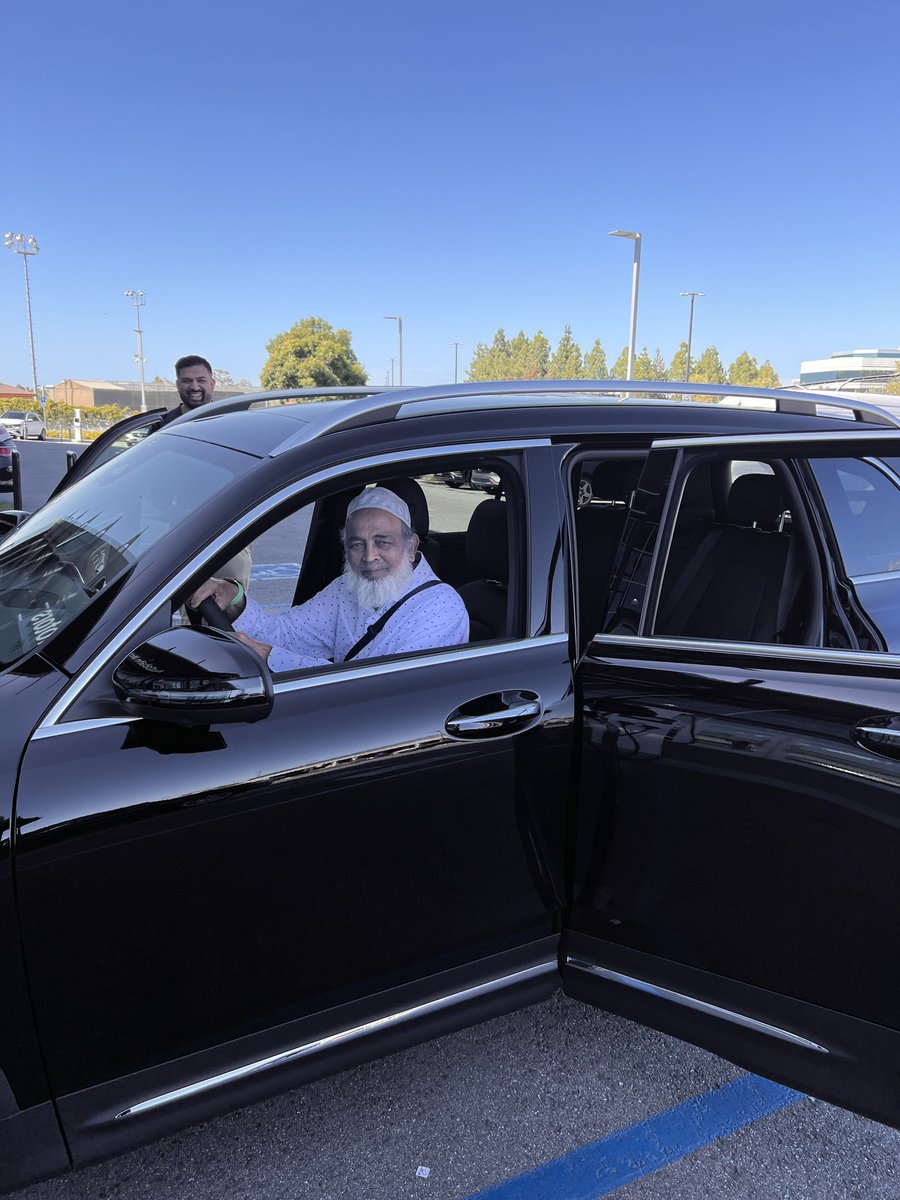
Someone (not smart) recently stole my dad's old junk car.
Even when we had nothing, my dad never got upset about financial losses. He always believed something better was coming.
Today I surprised him with a new Mercedes.
You can just do things.
I'm going to say something that might piss off a lot of AI founders.
If your product starts with a prompt box, you're cooked.
Maybe not today. Maybe not next quarter. But you're cooked.
I don't care how good the output is. Because the second someone sits down and types a question into your product, you're competing with Claude. You're competing with ChatGPT.
You're competing with companies that have more money than a country and are getting better every single month.
The gravitational pull of the horizontal platforms is just too strong. If it looks like a chat and acts like a chat, eventually everyone's going to use the chat they already have.
So what does survive?
Intelligence that doesn't wait for you to ask.
A product that already knows what you need because it's been learning how your business works. No prompt at all.
That's the difference between a company that lasts and a company that gets absorbed.
Every vertical AI founder needs to sit with this.
Anthropic just stacked another $50 billion in capital.
And what are they building? Better models. Faster inference. More capabilities behind the same prompt box.
Meanwhile, their own internal experiment told a more interesting story.
They ran something called Project Deal. They turned their SF office into an internal marketplace where employees built agents to negotiate and trade with each other.
Opus agents systematically out-negotiated Haiku agents on price and selection. What a wild time to be alive.
In a world where AI agents interact with each other (negotiating, buying, selling, making decisions) the quality of your AI is critical.
Is your company running its decisions through the best possible AI for your specific use case? Or are you just using whatever ChatGPT or Claude gives you out of the box and hoping for the best?
I’ve long said driving for @uber is a complex actuarial equation that most drivers are incapable of solving on their own.
This is the key thing that the ride-sharing companies prey on for their existence. https://t.co/hC3heo542l
A survey of 1,100 Uber and Lyft drivers in the US has found that, when expenses are taken into account, 74 percent of people earn below minimum wage salaries. https://t.co/czvPFcAT8t