#MLOps interest is at an all time high. So is confusion about the topic. Is it #DevOps for AI? A process? A bunch of tools?
Read this 1-pager by @omega_ml founder Patrick Senti to learn about the key MLOps concepts, features and criteria.
https://t.co/ieWTVnBKKD
A key feature for AI deployment in air-gapped enterprise environments, where arbitrary multi-GB downloads from ollama, huggingface et al. is not permissible: model deployment via OCI registries.
For this @omega_ml is about to get native OCI registry support, including autosync across distributed cloud runtimes and GPUs, and loading into a GPU-local model server like ollama, vllm.
No container runtime is required, it will work out of the box. Users won't even need to know what OCI registries are, nor have to deal with them directly. The platform handles the complexity, staying true to its promise: #MLOps simplified
Gen AI MLOps in omega-ml works in the same effective way as for classic ML. Just a single line of code is all you need to deploy a production-grade RAG pipeline.
The pipeline comes complete with an OpenAI-compatible REST API, conversation history, production tracking, and RAG.
⚡#release omega-ml integrates Generative AI & Classic ML
#MLOps simplified - Deploy #GenerativeAI and #ClassicML on a single and independent platform. Significant for all companies in Swiss 🇨🇭 and EU 🇪🇺 that want to keep in full control of their data and algorithms.
Just about to publish a #GenAI extension to my MLOps platform @omega_ml.
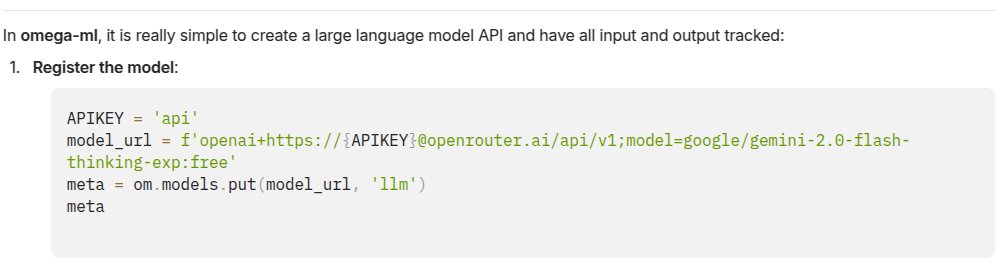
It's just 3 steps to register models, serve and track every call. Ultimately, that's required in any company use case.
Step 1: Register the model
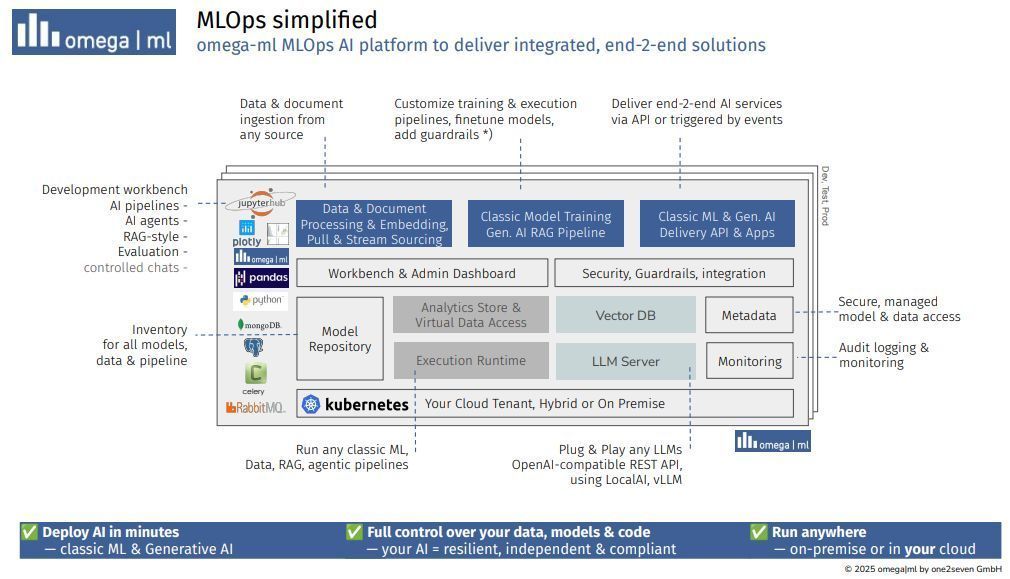
omega-ml uses Flask or Django for the service API, RabbitMQ as a request router, Python Celery for the runtime and MongoDB for the repository. The control plane is integrated into standard IT components such as Kubernetes and Keycloak.
Read more at https://t.co/pG6U4248VJ
AI solutions must be quick, efficient and technically straightforward to integrate into operational (IT) processes. #MLOps is the platform approach to achieve exactly that.
Why is this important?
A modern MLOps platform, like omega-ml, consists of the following elements.
Implemented using standard technology, enabling flexibility and cost-efficiency. Deployment is straightforward and with flexible dependencies.
#MLOps Monitoring is a key requirement in any production ML or AI system.
omega-ml now provides model monitoring and drift detection out of the box. No further tools are required (latest build, new release incoming)
https://t.co/xILqMtog0o
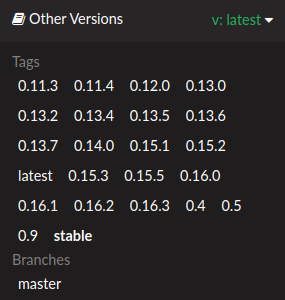
We now also provide links to all previous release documentation.
The docs of the latest (dev) build and stable (last public release) tags provide direct access to the current releases.
At last, omega-ml documentation now provides a release note and changes log.
So far, this information was only available from the github release page. The release and change notes in the docs are generated automatically, using git commit logs.
https://t.co/3oVg8UqN0l
#MLOps interest is at an all time high. So is confusion about the topic. Is it #DevOps for AI? A process? A bunch of tools?
Read this 1-pager by @omega_ml founder Patrick Senti to learn about the key MLOps concepts, features and criteria.
https://t.co/ieWTVnBKKD
MLOps for humans: @omega_ml with exciting new features:
native metric tracking in model training & production, mlflow models & projects, R api for models, datasets, notebooks and scripts, refreshed docs & built-in help.
https://t.co/UhvkLoy8Fo
https://t.co/fxTam9tN3S
@AdiPolak@mouthorjoe Indeed, that's why we have built @omega_ml, a Python-native MLOps framework & platform that runs from laptop to cloud. https://t.co/bXbc9pnznB