Kripto şirketi Tether altındaki yükselişin altında yatan başlıca faktörlerden biri. Dünyada altın alımında Çin merkez bankasından sonra 27 ton ile 4. Sırada geliyor. Birinci ve ikinci sıralarda ise Polonya ile Özbekistan var.
Şirket ayrıca altının tokenleştirilmiş bir versiyonunu da piyasaya sürüyor ve metalin sahipliğini blok zincirinde dijital haklara dönüştürüyor.
Teksas bölgesinin öneminden bahsedecek olursak, küresel ekonomi her zamankinden daha fazla bu bölge üzerinden işliyor mevcut durumda. Houston ve diğer limanlar, dünyaya rekor miktarda petrol ve doğal gaz taşıyor. Kuzeyde de Dallas bölgesi, bir bankacılık taşrasından finans merkezine dönüştürülüyor. Batıda ise teknoloji şirketleri şimdiye kadarki en büyük yapay zekâ veri merkezlerini inşa ediyor.
Bölge kendisinden sonraki yedi eyaletin toplamından daha fazla doğal gaz santrali inşa ediyor. Yenilenebilir enerji üretiminde de öncü eyalet konumunda; rüzgâr ve güneş enerjisi tesisleri, iklim politikalarına daha duyarlı kabul edilen Kuzeydoğu gibi bölgelerden bile çok daha hızlı bir şekilde kuruluyor.
#BRSAN şirketini oldukça pozitif etkileyebilecek bir haberden bahsedeyim. Permian havzasındaki yeni veri merkezi çılgınlığı Borusan’ın Baytown’daki operasyonlarını 3 ana koldan doğrudan büyütme potansiyeline sahip.
1- Doğalgaz iletim hatlarına dev talep
2- Enerji arzı için sondaj (OCTG) ve kuyu kaplama artışı
3- Coğrafi ve lojistik üstünlük. Şirket Made in USA korumasından yararlanır ve ABD dışından ithal edilen borulara uygulanan Section 232’den muaftır. Bu durum da havzadaki yeni altyapı ihalelerinde şirkete büyük rekabet avantajı sunar.
https://t.co/2nYHRx6yZL
Trump, Exxon ve Chevron şirketlerinin tek bir çeyrekte elde etmiş olduğu karlardan rahatsız olup kazandıklarını halka geri vermeleri gerektiğini söylüyor. Benzer bir adım #tuprs için de oldukça negatif olacaktır. Bakalım zaman ne gösterecek.
https://t.co/9CWHrrR55Q
GLP-1 ilaçları artık sadece diyabet ve obezite ile sınırlı kalmayıp kalp-damar hastalıkları, uyku apnesi, böbrek hastalığı ve hatta madde bağımlılığı gibi çok geniş bir hastalık yelpazesinde test ediliyor; bu da potansiyel pazarın diyabet/obezite ötesinde 100+ milyon Amerikalıyı kapsayabileceğini gösteriyor. Yatırım açısından bakıldığında Novo Nordisk ve Eli Lilly gibi şirketlerin büyüme hikayesinin henüz erken evrede olduğu, endikasyon genişlemesinin gelecekte ciro/kâr marjı üzerinde önemli bir katalizör olabileceği söylenebilir.
Şu an için GLP-1 pazarı bir düopol. Novo Nordisk, diyabet için Ozempic ve obezite için Wegovy adıyla satılan semaglutid ile pazarın öncüsüydü. Eli Lilly ise diyabet için Mounjaro ve obezite için Zepbound adıyla satılan daha etkili tirzepatid ile liderliği ele geçirdi.
Lilly enjeksiyonluk ilaç pazarının yaklaşık %60'ını kontrol ederken, Novo hap pazarında %85'lik bir paya sahip; ancak satışlar henüz yeni yeni artmaya başlıyor. Hapların 2030 yılına kadar pazarın dörtte birini oluşturması bekleniyor ve şu ana kadar enjeksiyonluk ilaçların satışlarını aşırı derecede etkilemiyor gibi görünüyorlar.
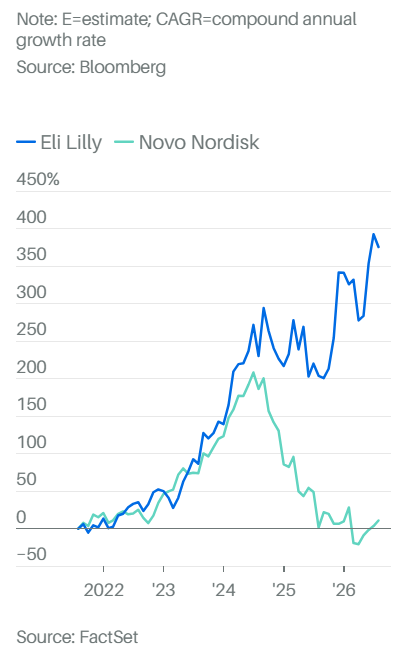
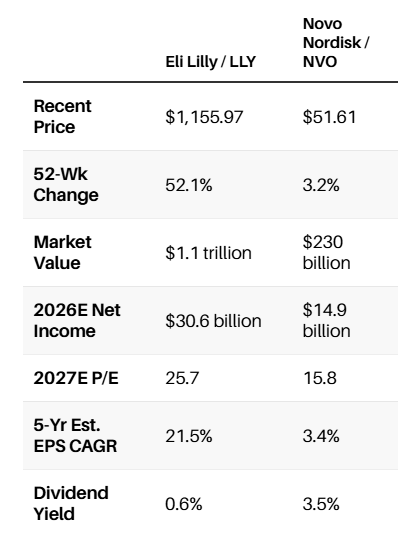
#NVO Novo Nordisk'in hisse senedi #LLY Eli Lilly'ninkinden çok daha ucuz olsa da, Lilly'nin kazançları çok daha hızlı büyüyor.
Aşağıda iki şirketin karşılaştırmalı verilerini ve yıllık bileşik büyüme oranlarını bulabilirsiniz.
@ali_hakan_kara@ali_hakan_kara The Economist'e göre Türkiye'de Big Mac fiyatı 6.91$, İsviçre'de 9.04, İsrail'de 7.67, Britanya'da 7.40$ seviyesinde hocam.
4. Çeyrek sonuçlarıyla beraber diğer bankalara kıyasla zayıf sonuç açıklaması beklenen #ykbnk yılbaşından bu yana bankacılık endeksinin gerisinde kalmaya devam ediyor.
Türk hisse senetlerine yatırım yapan IShares MSCI Turkey ETF geçtiğimiz hafta Agustos 2018’den bu yana ilk defa 35mnUSD ile en yüksek girişi görmüş.
Aralık ayından bugüne ise toplam alım tutarı 64mnUSD’a ulaşmış durumda.
Pearson Uluslararası Ekonomi Enstitüsüne göre:
%10'luk küresel gümrük vergisi önümüzdeki iki yıl için Amerika'nın büyümesinden 1% götürecekken,
%10'luk gümrük vergisine ek 8.3 milyon düzensiz işçiden 1.3 milyonunun deport edilmesiyle Amerikan ekonomisinin 2028'e kadar 1.2% daha küçük olacağı düşünülüyor. Tüm işçilerin deport edilmesi halinde ise 2028'e kadar 3-10% arasında daha küçük ekonomi bekleniyor. Ayrıca kümülatif enflasyonun 13-23% arasında daha fazla olmasının beklendiğinin de altını çizelim.
UBS'e göre ise Trump'ın uygulayacağı 60%'lık bir gümrük tarifesi Çin'in büyümesinden önümüzdeki yıl %2.5 götürecek.
Cehenneme uyanılan bir sabah. 6 şubat. Yaşanılan en uzun gece. Kaybettiğimiz sevdiklerimiz, memleketimiz ve bir ömürlük hatıralar. Unutmayacağız. Ansızın aklımıza gelen acı bir hatıra olarak kalacak.
https://t.co/RybEzvFXLG
Ve son olarak Enerji, Yapay Zeka, Emtialar hakkındaki değerlendirmeleri aşağıdaki gibidir:
Energy’s next big thing
-Energy storage for the electrical grid is about to hit the big time. By the reckoning of the International Energy Agency (IEA), a forecaster, grid-scale storage is now the fastest growing of all the energy technologies. In 2025, some 80 gigawatts (GW) of new grid-scale energy storage will be added globally, an eight-fold increase from 2021.
-Grid scale energy storage is on the rise thanks to four potent forces. The first is the global surge in deployment of solar and wind power, which are intermittent by nature. That did not matter when only small amounts were used on the grid, but they can now make up half or more of generation capacity in some markets, creating a headache for grid operators on cloudy and still days. Big batteries attached to the grid, which store energy when it is abundant and release when it is needed, solve that problem neatly. The IEA predicts that in 2025 the combination of solar photovoltaic generation and battery storage will be cheaper than the coat of coal-fired power in China, and new gas-fired plants in America.
-The second factor boosting energy storage for the grid is Chinese overcapacity in battery manufacturing, which has led to a big drop in the price of lithium son batteries the kind used in laptops, smartphones and more recently electric vehicles (EVs). Since 1991 the price has plunged by 97%, and in 2025 prices for grid batteries will converge with the historically much lower prices for Ev batteries. As growth in EV sales has slowed and the lithium-ion buttery glut has expanded, battery-makers in Asia have been forced to find new buyers. For the first time, the market for grid batteries in China now exceeds that for consumer electronics, and will grow further thanks to policy mandates requiring the deployment of grid-scale storage with wind and solar farms.
-A third boost for energy storage is the power guzzling surge driven by the rise of artificial intelligence. Goldman Sachs, a bank, reckons that global power demand at data centres will rise from 240 terawatt hours (Twh) in 2020 to 600 TWh in 2025. But tech giants have noisily committed to climate-friendly goals such as net-zero emissions, which means they cannot turn to coal and gas plants. They need vast amounts of renewable energy, with storage to ensure power is provided round the clock.
-The fourth and most intriguing of the forces at work, though, is the rapid emergence of innovative energy-storage alternatives that go beyond conventional lithium-based batteries. Sodium-ion batteries are a promising alternative, being cheaper and less flammable. This is particularly attractive for operators of data centres, who can get cheaper insurance by avoiding lithium. BloombergNEF, a research firm, expects makers of sodium batteries, led by China's HiNa, to begin large-scale manufacturing for grid storage in 2025. Form Energy, an American startup, has raised $1.2bn to develop a low-cost battery based on iron-air chemistry. It will start operations in 2025 in California and Minnesota.
-Other energy-storage systems use gravity. Switzerland's Energy Vault has developed a hybrid system involving pumped water and lithium batteries which it plans to test in 2025 in a 500-metre mineshaft in Sardinia. The firm has an agreement with SOM, the architectural firm behind Dubai's soaring Burj Khalifa, to embed its gravity-based storage system into future skyscrapers in order to reduce their carbon footprints.
➤ Old-fashioned pumped-hydro storage, in which water is shunted between reservoirs at different heights, still makes up most of the world's grid-scale energy-storage capacity. India's Greenko, a big renewable-energy developer, has modernised this gravity-based approach and found an economical way to build lots of it. The firm plans to have 50GWh of storage operational in 2025, with another 50GWh coming within the next few years.
►Compressed gas is another approach showing promise. Italy's Energy Dome stores carbon dioxide under pressure in distinctive white domes. When energy is needed, the gas is expanded and passed through a turbine. The firm has a facility in operation in Italy, and plans to start building one in America in 2025. The system developed by Canada's Hydrostor, by contrast, uses air as its working fluid. The firm will start construction at a big facility in Australia in 2025, with an even bigger one planned for California.
In sum, an energy-storage revolution is under way. Lithium batteries will rule for the time being, but many alternatives are following behind, promising cleaner and more reliable energy in the future.
The real limits on Artificial Intelligence
-Fifteen years after his death, David Blackwells name will be on every tech nerd's lips in 2025. Nvidia, a semiconductor giant, has named its latest superchip after the mathematician and game theorist, who was the first African-American inducted into the National Academy of Sciences.
-Blackwell is a graphics processing unit (GPU), the kind of AI workhorse chip that has turned Nvidia into a $3trn giant. The superchip is integral to a new Nvidia platform that will prompt some of the biggest AI firms, including the cloud-service "hyperscalers"-Amazon, Microsoft and Google-to build new server farms for generative-AI computation on a huge scale, with unprecedented energy requirements.
-Demand is booming. Baron Fung of Dell'Oro, a research firm, estimates that sales of servers for generative-AI tasks will rise by more than three- quarters in 2025 compared with 2024, reaching $147bn, mostly thanks to hyperscalers' spending on Blackwell GPUS. As a result, energy demand is also surging. Lucas Beran, also of Dell'Oro, says data centres used to have power requirements of 100-200 megawatts (MW), but big ones now require 300-500MW.
-The International Energy Agency (IEA), a forecaster, estimates that over the next two years, global power consumption from data centres could more than double from its 2022 level, reaching 1.000 terawatt hours by 2026-equivalent to the electricity consumption of Japan. Expanding the grid is hard. Ensuring that electricity is carbon-free is harder still. There are plans to restart a nuclear power station at Three Mile Island in Pennsylvania to power several Microsoft data centres, and Google has ordered nuclear reactors from Kairos Power, a startup.
-Whether you call them Al factories, data centres of server farms, these new facilities will be giant supercomputers. Elon Musk's so-called "gigafactory of compute" in Memphis is expected to boast 200,000 GPUs. But the energy and chips are not the only real-world constraints on AI.
-The pressure to build bigger and better generative-AI models may also create strains along the semiconductor supply chain. Nvidia has already encountered engineering snags in the production of its Blackwell chips by TSMC, a Taiwanese firm, which delayed the l launch. David Crawford of Bain, a consultancy, says that if demand for the GPUs remains strong, there could be shortages of high-bandwidth memory and advanced packaging.
-At the local level, environmental groups in Memphis are already protesting that the power consumption of Mr Musk's AI factory will disadvantage local people. At the global level, the IEA says some countries, such as the Netherlands, have put curbs on data-centre construction because of grid constraints. Some tech firms will seek to ease pressure on the grid by erecting on-site generators, but these are often fired by natural gas.
-The new data centres need energy not just to power their Al servers, but also to keep them cool. Systems built around Blackwell GPUs will rely on closed-loop liquid cooling-a technique for which demand is expected to surge in the coming year. Such changes will require more than just a retrofit.
-Some countries will find it easier to build generative-Al infrastructure. China's central-planning system facilitates bringing together server farms, power plants and workers. But it is cut off from Nvidia's fanciest GPUs because of American trade restrictions. Neither East nor West will find building the next wave of generative Al easy.
Vitamin Boost
Amid softer markets, three commodities will stand out.
-For much of 2024 commodity prices were driven by low demand. America slowed down and economic woes worsened in China, the world's biggest importer of raw materials. So prices for everything from coal and cobalt to natural gas are lingering at levels that prevailed before Russia's invasion of Ukraine in 2022. For many commodities, this outlook-depressing for traders but helpful to Western central bankers-will carry through to 2025.
-Crude oil could become even cheaper, despite persistent geopolitical tensions, as producers outside the Gulf continue to increase output. And although it is a critical ingredient in all things needed to speed up the green transition, copper may remain unsteady because of shorter-term worries about China's property Sector. For a small group of materials, however, pricing will be driven by supply concerns, as market disruptions keep prices red-hot. Three commodities will stand out.
-Brazil accounts for 70% of global production of orange juice. In 2024 São Paulo, the most productive state in its citrus belt, faced a crippling drought. At the same time citrus greening, an incurable bacterial disease that turns oranges bitter and kills trees, went rampant in the region's groves. The price of orange- juice futures in New York, which soft-drink companies use to hedge against price swings, broke records. It will take years before replacement trees can bear fruit, even as seekers of vitamin C keep on buying orange juice. So expect the big squeeze to continue.
-The market for another morning favourite will also be jittery. In 2024 prices for arabica coffee beans hit the highest price in a decade after an unseasonal episode of frost hurt yields in Brazil, producer of 40% of the world's supply. That created more demand for lower-quality robusta beans, which are most often used in instant formulas. Producers of fancier coffee started adding more robusta to their regular blends but major droughts have also hit Vietnam, the largest grower. Shipping problems linked to attacks in the Red Sea increased the pressure. Some late rain in growing regions may have helped, but stocks fall beans remain low. In 2025 coffee-drinkers may have to swallow higher prices and blander flavours.
-Coffee and oranges are tasty, but hardly viral. Uranium is mildly poisonous, but more essential. Demand for it is expected to increase as nuclear plants, a reliable source of low-carbon power, play a bigger role in the energy mix of China, India and other big economies. But potential for disruption abounds. In August Kazatomprom, which produces one-fifth of the world's mined uranium supply in Kazakhstan, trimmed its output target by 15-19%. Soon afterwards Vladimir Putin hinted that Russia, home to 44% of global uranium-enrichment capacity, might limit exports in response to Western sanctions. Logistical issues and tricky geopolitics could cause a meltdown in the market for the radioactive metal.
Beyond the hype
Don’t expect a productivity boost from AI in 2025.
-Some argue that the latest wave of AI technology is more significant than electricity and the internet combined, and so it will spread fast. But so far there is little sign of this. America's Census Bureau asks businesses whether they use AI to produce goods and services (ie, for more than just a quick query on ChatGPT). Only 5-6% answer in the affirmative. In Canada, 6% of all firms used AI to produce goods or delivering services in the past year, according to official data. The results for Britain are more impressive, with 20% of firms using AI, though its statisticians ask the question in a different way.
-Even in Britain, however, the trends are unimpressive, with the same share having used AI a year ago. Adoption elsewhere has bounced around, with no sign that AI is diffusing across businesses. Small wonder, then, that it is hard to pinpoint any economic impact. GDP growth is decent, but hardly stronger than it was in 2022, the year that OpenAI's GPT-3 was released to the public. Productivity growth remains in the doldrums, far below where it was in the 1960s or 1970s. Al-boosters will tell you that the technology is transforming the fortunes of this company or that. Don't believe them.
-The labour market tells the same story. Unemployment across the OECD club of mostly rich countries recently dipped below 5%, its lowest for decades. The share of working-age people in employment is at an all-time high. There is not much evidence of a surge in people leaving their jobs, which is what you would expect if AI were making people surplus to requirements. Wage growth also remains fairly high. Ask central bankers, and they will tell you that labour demand is currently too high, not too low, as they seek to bring inflation back down to 2% targets. So much for the idea that AI is destroying jobs.
-Will an Al wave break over the economy in 2025? Don't bank on it. Only about 7% of American firms, when asked, say that they have plans to adopt AI in the coming months. Capital spending across the rich world remains fairly weak, suggesting that businesses are not investing in the tools that would allow AI to give them a big productivity boost. The question for the coming year is how long this disconnect between the financial markets and the real economy on the usefulness of AI can endure.
The Economist'in içerisinde muazzam bilgiler içeren "The World Ahead 2025" dergisinden kendimce hem çok ilgi çekici hem de ufuk açıcı bulduğum yerleri sizlerle farklı postlar altında paylaşıp bir kez daha vurgulamak ve sizlerin de faydalanmasını sağlamak istiyorum.
"The Economist - The World Ahead 2025" Recap
•Western economies face a new challenge: reducing deficits, by increasing taxes, cutting spending or boosting growth. Many may also have to increase defence budgets. Europe has suffered persistent shortages of arms, despite warnings that its defence industry is underpowered. If Europe wants a long term peace, it must plan for war. Today’s required course of action for defence spendings by EU countries is to invest 3% of GDP. Mr Trump's policies will make things worse: hefty import tariffs could hamper growth and reignite inflation. In parts of the Middle East, a booming youth population, with a shortage of jobs, risks instability.
•The biggest gamble in business history: more than 1trnUSD is being spent on data centres for artificial intelligence. Spending on AI data centres between 2024 and 2027 is expected to exceed 1.4trnUSD. Across the economy, only 5% of American businesses say they are using AI in their products and services. The most prominent AI breakthroughs come in other areas, such as drug development or defence. (As intelligence is added to drones, which are emerging as key weapons systems of the future.)
•Mr Trump's priorities: Tariffs, illegal immigration, tax cuts, drug regulation, military procurement, Biotech and AI.
-The Pearson Institute for International Economics reckons a 10% universal tariff increase and retaliation from trade partners would knock one percentage point off America's growth for the two years after its introduction and continue to impose a drag on growth indefinitely.
-If Trump deports only 1.3m irregular workers (out of an estimated 8.3m), America's economy will be 1.2% smaller than expected by 2028; if he throws them all out, it will be a stunning 7.4% smaller according to the Pearson Institute for International Economics. If deportations combined with proposed tariffs, the damage will be even worse: an economy anywhere from 3% to 10% smaller than expected by 2028, and cumulative inflation 13-23% higher.
By another estimate, every 100 deportations will reduce the number of jobs for the native-born by 8.8. 11m residing in the US illegally, over 4mn are Mexican, 2mn are from Central America, over 800,000 from South America and 400,000 from the Caribbean. Mexico is the largest trading partner of the United States. US’s trade imbalance with Mexico was around 160bnUSD in 2023. Beside this, Trump is also unhappy about car factories in Mexico, and Chinese investments. Mexico could also be hit hard by Trump’s attempts to stem the influx of fentanyl, a drug made by gangs in Mexico and exported north, and which killed around 75,000 Americans in 2023.
Events taking place around the world in 2025:
-Non-Europeans visiting Britain must have an ETA (electronic travel authorization) which costs 10 pound.
-Elections are held in Ecuador in February.
-Climbing season begins on Mount Everest in March. For the first time, drones will be used to carry supplies up and rubbish down to reduce waste.
-Expo 2025 begins in Osaka, Japan in April.
-Ryanair ends its use of paper boarding passes and airport check-ins as of May.
-Fifa club World Cup begins in the US in June.
-Microsoft withdraws support for Windows 10, Office 2016 and Office 2019 as of October.
-Presidential and parliamentary elections take place in Chile in November.
-The African Cup of Nations football begin in Morocco in December.
-From the Christmas day, drivers of EVs in London must pay the city’s 15 pound congestion charge to drive in the centre, they were previously exempt.
•A big source of tension for France will be fixing the dreadful public finances. France’s efforts to curb the budget deficit to 5% of GDP in 2025, still well above the EU’s 3% limit, will be closely watched by Brussels and financial markets. Big business and the rich will face extra taxes.
•Germany’s new government will have to negotiate a snap budget. Country’s industrial giants are struggling with energy prices, high taxes, red tape and labour shortages and huge car industry appears to have no answer to the rapid rise of Chinese EVs.
•For Britain material improvements must be shown to the National Health Service, transport, policing and the courts. A new path, King Charles III England Coast, will make it possible to walk around the coast of England.
•Semiconductor market is expected to grow to over 1trnUSD by 2030, about twice the current size. According to Ajit Manocha, by 2050 the market could be as big as 5trnUSD. Innovations in semiconductors have a crucial role to play in uniting digitalization and decarbonisation. A current state-of-the-art GPU-a kind of processor that can perform AI functions- contains about 80bn transistors, each 4nm wide. It is estimated that this will scale down to 2nm within five years, increasing power efficiency, and the number of transistors will rise to 480bn.
Argentina: the making of an economic miracle?
Prices increased during 2023 by 211%. With Jewish Javier Milei, they began by slashing public spending by 30% in real terms, achieving fiscal balance in their first month. Devalued currency and raised import taxes, narrowing the black market premium from over 100% to a manageable 25%. Country risk, a measure of risk default, plunged by 40% and monthly wholesale price inflation (which spiked to 54% in December 2023) fell to 2%. Primary policy will be the pursuit of a balanced budget. Financing needs, aside from rollover, will be nil. Debt-to-GDP ratio will steadily decline, effectively restoring fiscal solvency. What lies ahead in 2025 is more of what they’ve already done: strict fiscal balance, no money growth, and deregulation. Argentina has suffered from an overdose of deficits, money printing and useless regulations.
China
If Trump impose 60% tariffs on goods, that would knock 2.5 percentage points off Chinese economic growth over the subsequent year according to UBS. The new Washington government will continue the policy of impeding the flow of Western technology, such as advanced chips, to China. These restrictions aim to hinder the modernization of China’s armed forces- and to ensure that America has and upper hand in the industries of tomorrow, such as artificial intelligence and quantum computing. Another big issue is China’s chemical exports to US which are used for making fentanyl.
Bold stimulus is needed to revive sentiment and spending, and to reverse a slump property sector, which accounts for a fifth of GDP.
Shanghai – financial hub,
Shenzhen – a tech centre,
Guangzhou – export powerhouse
These first-tier cities are losing their lustre by becoming unaffordable for most Chinese. Median house prices are typically 30-40 times higher than median incomes. They also have a poor quality of life, with many companies demanding a “996” work schedule. (9am-9pm, six days a week) Underpaid- overworked and less spending residents. Profits in Beijing’s restaurant sector fell by nearly 90% in the first half of 2024. Many second- or third- tier cities meanwhile are on the up. Their infrastructure is top-notch, housing is relatively cheap and the pace of work is more relaxed. In the summer 12m students will graduate from China’s universities. Many will look for jobs, not in Beijing and Shanghai, but in cities like Changsha and Nanjing- provincial capitals with vibrant cultural industries.
Talented young people will help China’s smaller cities make technological progress with industries like high-end manufacturing, biotech and semiconductors. In the coming year officials will focus on developing its “low-altitude-economy”, China’s preferred term for delivery drones and flying taxis.
Sabina shoal – The outcrop in the Spratly Islands lies 150km west of the Philippine province of Palawan, but is also claimed by China, Vietnam and Taiwan. No claimant has a long term presence.
The next phase of green innovation is trickier. Cement factories, chemical plants and steel mills- all big sources of carbon emissions- need large amounts of heat to work and burning fossil fuels is still the most practical way to provide it. Big ships and planes, meanwhile, are difficult to power with batteries. New technology is needed. In 2025 Chinese firms will increasingly be trying to develop it.
The shock of "overtourism" will subside in 2025
-The influx of tourists, they grumble, is causing congestion and pollution, driving up housing costs and skewing development priorities away from the needs of locals. Many are calling for authorities to do something about it.
-Some things have been done. In 2024 Venice limited tour groups to 25 people and, on peak days, instituted a €5 ($5.30) fee for day-trippers. Amsterdam is planning to move its cruise-ship terminal away from the city centre, and forcing some ships to dock 85km away in Rotterdam. Barcelona and some parts of Greece are cracking down on cruise ships and short-term rentals, like those offered by Airbnb. Rome is mulling a €2 fee to see the Trevi fountain. New Zealand, a country with eight times as many sheep as tourists, has tripled its levy on visitors.
-The impact of these moves is unclear. Nearly half a million people happily paid Venice's fee, about the cost of a coffee in Piazza San Marco, which suggests that it was too small to deter day-trippers. Large tour groups split up into parties of 25, but stuck close together. Moving cruise terminals out of city centres may increase road traffic as tourists travel to and from ports. And abolishing Airbnb-type rentals reduces competition and lets incumbent hotel operators charge more. Such moves are not only cosmetic, they are an overreaction to overtourism.
-The summer of 2024 was a record- breaking one for travel as post-pandemic tourism continued to boom. Arrivals for the whole year are expected to slightly exceed the 2019 peak. Yet that boom is misleading. Globally, between 1995 and 2019, international tourist arrivals grew at an average annual rate of about 5%, before collapsing with the lockdowns of 2020 and 2021. For arrivals to return to 2019 levels meant growth rates of 66% in 2022, 46% in 2023 and at least 38% in 2024. A growth rate of 5% can seem manageable; a growth rate of 40% can feel like an unstoppable deluge. Confronted by 25 years' worth of growth in three, even the most hospitable people will reach their limits.
-The good news is that 2025 is likely to feel quieter. Airlines, hotels and cruise lines are seeing traffic to their websites dip. Airbnb warned in August that foreign demand from Americans a huge tourist market-was slowing. Online travel agents say prices are moderating. Hotels and other travel-and-tourism companies are issuing similar warnings. The signs are that things, especially in Europe, may be returning to normal. Tourist numbers will still climb, but growth will return to its more sedate, pre-pandemic pace.
-In 2023 London received 18.8m visitors, more than any city except Istanbul.
To be continued...
Sektörler ve görünümleri için değerlendirmeleri şu şekilde:
Business environment
-Even if 2025 brings no new major conflicts, geopolitical tensions will weigh on the global economy. World GDP will grow by just 2.5%. European economies will strengthen but emerging markets will be flat due to trade barriers, climate change and technological hurdles. Inflation and interest rates will fall, but high public debt and defence budgets will crimp governments ability to spend.
Automotive
-After nearly stalling in 2024, global new-car sales will grow by 2% in 2025. Sales of new trucks will be speedier, rising by 4% thanks to expanding infrastructure in emerging markets. Electric vehicles (EVS) will be the car market's sole spark, surging by almost a quarter, though demand will stay below recent highs. Range anxiety and high prices will push buyers towards plugless models instead.
-Efforts to cut vehicle emissions, though fitful, will be a focus. Norway aims to make all new cars emission-free by 2025, the first country to do so, though vans will miss the target. Australia, an emissions laggard, will finally introduce fuel-efficiency standards. But the EU has delayed implementing its Euro 7 standards until 2028. Even so, cars running on petrol and diesel will hit roadblocks. More cities will impose zero-emission zones, with Stockholm the first to ban fossil- fuel guzzlers from its centre.
-China will beat its goals for electrics, generating half the world's sales. Its EV-makers will gain ground BYD, the world's biggest, aims to sell 1m vehicles outside China, helped by new plants in Brazil and Hungary Vietnam's VinFast will target India and Indonesia. Western firms will hit back. Volkswagen and Tesla will be developing cheaper plug-ins, as Toyota launches a self-driving EV for China. But higher tariff barriers for China's EVs will complicate green-car plans, as will tighter local-content requirements. As supply chains splinter, carmakers will look to new chip and battery plants to support EV production.
Defence
-Wars in Ukraine, Lebanon and Gaza will stoke demand for weapons, but defence spending will be unevenly spread. America, the biggest spender, will raise its military budget by 4%, to $884bn. but China, the second-biggest, will increase its spending faster. NATO will debate a national defence spending target of 2.5% of GDP, although one in three members have missed the current goal of 2%. The alliance will draft a broad strategy to counter Russia and will hand Ukraine $43bn to fight on. But Germany plans to halve its outlay to Ukraine, to save money. Worried that America's commitment to NATO will fray, the EU will launch rapid-deployment forces and expand production of shells. Meanwhile much of Russia's Soviet-era kit will be useless by mid-2025. America will support Israel, despite some misgivings at home. China's navy will keep skirmishing in Asian waters, bolstered by new diesel-electric submarines. The Philippines will lift defence spending in response; Australia will boost troop numbers by offering foreign residents citizenship for enlisting. Japan will deploy new drones, and America its hypersonic missile, designed to fly at 3,800mph (6,115kph).
TO WATCH: Flying low, Global tensions may soar but America's air force will ground 250 old planes in 2025, leaving it with fewer than 5,000 aircraft, a recent low. New models will help, like the F-35 stealth jet-if its bugs can be fixed.
Energy
-Energy consumption will rise by 2% to a record 14.5trn tonnes of oil equivalent in 2025. Fossil fuels will provide over 80% of that, increasing carbon emissions by 1.7 times from 1990 levels. Coal use will dwindle in Europe and North America, but India and Russia will stick with the black stuff. China's coal consumption will near its peak.
-More oil will be burned, too. OPEC will continue cutting oil output to keep Brent prices around $77 a barrel in 2025, though non- OPEC output (mainly from the Americas) will surge. The EU will keep switching away from Russian oil, as the Czech Republic connects to supplies imported by pipeline from Italy. The Baltic countries will disconnect from Russia's power grid, but Russian gas will continue to flow to Europe, mostly via Bulgaria.
-Green energy will flourish. Renewables (including hydro) will make up 14% of global supply. Wind and solar will deliver a sixth of all electricity. Gujarat will get a massive solar farm that will supply 4% of India's power. Zambia will build dozens of solar mini-grids to serve outlying villages. Texas will gain its first grid-connected geothermal plant. China, India, South Korea and Turkey will switch on (carbon-free) nuclear reactors, taking the global total to 447.
TO WATCH: H2-oh. China will smash a country-wide target to make more than 200,000 tonnes of green hydrogen. In fact Inner Mongolia and Gansu, in the north and north-west, plan to produce multiples of that on their own. The catch? New pipelines will be needed to ship the fuel to China's populous east.
Financial services
-Banker will lobby regulators in 2025 as the Basel 3"end-game" rules, drawn up after the financial crisis of 2007-09, kick in. American banks, wary of falling interest rates, will resist pressure to boost capital buffers. Backsliding could prompt protests from their EU rivals, but Asia's banks, buoyed by faster growth, will be more sanguine Regulators will worry about loans to commercial property, given the shift to hybrid working, as global bank loans rise by 7% to 112trnUSD.
-Climate change will undermine Insurers' calculations. Yet Swiss Re, a big insurer, predicts the industry will grow rapidly, with life-insurance premiums reaching $3.1trn and non-life premiums $4.8m Environmental-disclosure rules will tighten in many countries, EU companies will issue their first sustainability reports. But an American backlash against "sustainable" investing will spread. Cash is no longer king: the world will have 2bn credit cards but only 3m cash machines in 2025. The lines between banks and fintechs will blur further: the Philippines will permit new digital banks, Spain's REVA will launch one in Germany. Brazil will push forward with its central-bank digital currency, Drex. The EU will decide whether to move ahead with a digital euro. The US dollar, however, will remain dominant, defying China's efforts to expand foreign use of the yuan.
TO WATCH: Clearing up. Despite Brexit, LCH, a London clearing house, still processes around 95% of euro-denominated interest-rate swaps, and most denominated in dollars. The EU wanted investors to switch to rivals like Germany's Eurex by 2025. Hard luck (for now).
Food and farming
-Most food commodities will get cheaper in 2025 as supplies swell. EIU's index of food, feedstuff and beverages will dip to 25% below the peak of 2022. Beverages and sugar will lead the decline, with oilseed and grain prices holding firmer. As El Niño blows over, La Niña will damage harvests in the Americas and help them in Asia. Wheat production will rebound despite the travails of Ukraine, a main producer. India will ease restrictions on rice exports as global prices slide. Even cocoa prices, which have soared during the last two years, will drop by a quarter, to chocolate-lovers' delight.
-Palm-oil producers and coffee markets will have an extra year to prepare for the EU's delayed deforestation rules, just as American drinks-makers postpone targets for plastics use. But new EU rules will promote food composting and plastics recycling. China will clamp down on food additives, Japan on food packaging. Britain will extend its sustainable-farming incentives. Bur funding for a global biodiversity plan will not measure up. Sin taxes on tobacco, alcohol, fat and sugar will spread. Germany may even impose one on meat.
-Consumers will spend $11.5trn on food globally, nearly 6% more than in 2024. They will eat more fish and meat, despite rising sales of vegan food. But even as food sales accelerate, food companies' profits will fall from recent highs. Unilever will cut 7.500 jobs and Danone will refocus its strategy on nutrition products.
Health care
-Health-care systems will ache in 2025 as populations age and staff struggle. Nearly 12% of the world's population will be aged 65 or over Yet only 10% of global GDP will be spent on health, down from 11% during the covid-19 pandemic. Worldwide spending will reach 11trnUSD, nearly half of it in America.
-Compulsory spending will outpace voluntary as countries expand public-health insurance The United Arab Emirates will oblige expats to get insured; China will work to improve its public hospitals and clinics. Even so, a goal set by the World Health Organisation (WHO) to extend universal health care to 1bn more people globally will be missed. Nigeria's plans for a universal system will falter, India's government will miss its spending targets. America will debate the cost of Obamacare subsidies as their expiry looms again.
-The WHO will embark on its 14th four-year plan, focusing on climate change. As deaths from extreme weather rise, governments will develop warning systems; carmakers in America will add heat alerts to cars. Alarm over infectious diseases will push governments to sign a delayed pandemic treaty.
-The number of obesity drugs will balloon as China and India produce cheaper versions. Novo Nordisk try to turn its fat-busters into heart treatments. With further, expensive therapies emerging, overall drugs sales will bulge to 1.7trnUSD.
TO WATCH: Plague prep. Vaccines will advance in 2025. Bavarian Nordic will make 10m mpox jabs. Scientists will test an avian-flu shot and an all-in-one jab for coronaviruses. Deliveries of mRNA vaccines for cancer may even begin.
Infrastructure
-Green policies will prompt a frenzy of construction in 2025 Gross fixed investment, a proxy for infrastructure spending, will rise by 6% to $28trn (about 25% of world GDP). Nearly a fifth will be in America, where Biden-era subsidies will spur spending but undershoot infrastructure needs. Europe and China will invest heavily in green infrastructure and digital networks.
-Money will come from governments, pension funds and sovereign-wealth funds, as well private companies. Much will flow into renewable energy (see Energy). This in turn will support digitalisation, though the rise of data centres will strain power grids 5G telecoms networks will also expand-gradually (see Telecoms). Japan's World Expo will conjure a digital future and Saudi Arabia will invest in its futuristic city, Neom
-Transport infrastructure will lag, despite a shift to greener travel. Europe will see a renaissance in its railways, gaining a night train from Brussels to Venice and new departures from Amsterdam. Eastern Europe, over-reliant on planes, will get a direct Budapest- Belgrade rail link. India will build mads, adding close to 13,000km in the year to March 2026 China will expand ports in Africa and open one in Peru, shoring up trade routes-and its military might.
TO WATCH: Building troubles. Wars and online sabotage will threaten infrastructure plans in 2025. The fallout from the Gaza-Israel war will imperil power plants and the Sues canal The UN will push forward with a treaty on cyber-crime as risks multiply. Hundreds of millions of cyber-assaults on critical infrastructure will occur in 2025.
Information technology
-Wags might suggest renaming this section "AI". The craze for artificial intelligence will help total IT spending grow faster, rising 8% to $3.6trn in 2025, though not quite as fast as during the pandemic fuelled bonanza in 2021, when it surged by 14%. Data centres will see investment and revenue grow as more companies try to harness ChatGPT and other large language models. In America around 30% of businesses will invest $10m or more in Al, up from 16% in 2014, says RY, an accountancy firm. Apple will bring its generative-Al tools, Apple Intelligence, to more iPhone users.
-Some of the investment craze may be plain crazy Gartner, a consultancy, predicts 30% of generative AI projects will not pass the "proof of concept" stage amid daunting costs and uncertain benefits. Even schemes that make it further will not always justify the hype Regulators, meanwhile, are circling. In 2025 parts of the EU's AI Act will take effect. The African Union will try to forge a common Al strategy
-In hardware, chipmaking rivalries will heat up, with Nvidia, the king of AI silicon, trying to fend off competitors such as Arm and Google. Governments will vie to attract chipmaking to their shores, to protect supply chains Taiwan's TSMC hopes to open its first, long- delayed plant in America. America Micron will manufacture its first India-made chips.
Media and entertainment
-No Olympics. Fewer massive sporting events. And no American election. 2025 holds less excitement for advertisers than did 2024. Growth in global ad spending will slow in 2025 to about 4%, according to Dentsu, an advertising giant. Sales of digital ads-more than 60% of the total-will rise at their slowest pace since 2020.
-Advertisers will turn to other digital tools. Al will be in vogue for making ads and targeting punters, though media giants' battles with AI firms over copyright and other matters will drag on. Social media, crucial for advertisers, will attract regulators' scrutiny. American lawmakers will continue to tussle with China's TikTok. Malaysia will make big technology platforms apply for licences, roiling free- speech advocates.
-Cable TV will be in its death throes. In 2025 72% of all American households will have either cut the cord or never had one. Its demise has been hastened by the launch of ad-supported tiers on streaming platforms such as Amazon Prime and Hulu. The death knell will sound with the loss of live sport on cable platforms. From 2025 Amazon will hold the rights to National Basketball Association games for 11 years. World Wrestling Entertainment's weekly shows will go to Netflix.
-Streamers are also hurting the box office. Even in 2025 cinema revenues will not recover to pre-pandemic levels: PWC, a consultancy, forecasts they will reach $41bn. Helping cinemas' cause will be "Avatar 3" and the eighth film in the "Mission Impossible" series, both of which were delayed by Hollywood strikes.
TO WATCH: Upon a star. Disney has struggled in India. But if regulators comply, its dreams will come true in 2025 when its Indian arm merges with the streaming business of Reliance Industries, a local behemoth. The new firm will have 750m Indian viewers.
Metals and mining
-Green policies and rising construction will drive metal prices higher in 2025, even as other industrial commodities decline. EIU's base-metals index will climb by 7.5%, clearing its peak in 2022. Demand for electric cables and batteries will power copper prices Infrastructure investment will firm up prices for steel, iron ore and aluminium, and galvanise zinc. Tin will shine thanks to electronics consumption. Gold, a safe haven in uncertain times, will glisten, and diamonds regain their sparkle.
-Dimmer fortunes await other metals. Nickel, cobalt and lithium will rise slowly as EV sales falter and carmakers toy with new types of battery. Lead prices will struggle upwards, while platinum and palladium dip.
-Mining companies will hold investment steady. Anglo-American will keep capital spending at $5.7bn; Vale will stay at $6.5bn. Governments from Latin America to Africa will court investors eagerly. Ecuador will offer mining permits and Chile lithium contracts China's grip on rare-earth minerals will prompt a search for alternatives-including under the sea.
Property
-Falling interest rates will bolster property markets in 2025, although city centres will remain quieter than before the pandemic. Office leasing will pick up as more employers insist on seeing staff a few days a week. Shops in prime locations will be resilient. But warehouse leasing will flatten out as the online-retail surge subsides. Tourist cities will be buoyant but hotel-building will be slow, except in the Gulf and India.
-Mortgages will get cheaper bur shortages will keep house prices and rents unaffordable for many. Governments will encourage more building, especially in Europe. Britain's will recolour parts of the green belt to help provide 1.5m more homes. Dutch construction will recover, while even Spain's crumbling housing market is due a change of fortunes. With more housing, the average number of people per household will dip to 2.4. in Europe and 3.3 worldwide.
-European bank regulators will keep an eye on the housing market for signs of popping bubbles. In China house prices will fall by 4% despite government efforts to stabilise the troubled sector. Office values will drop in America, while bad loans rise, Globally $2.1trn of real-estate loans will mature, three-quarters of them in America Energy-saving targets will also bite. In the EU, many older buildings will need to be retrofitted-or become stranded assets.
Retail
-Global retail-sales volumes will expand by more than 2% in 2025 from the year before, the fastest since 2021, helped by slowing inflation in the rich world. This is despite the economic obstacles hampering both bricks-and-mortar and online retailers. Elevated interest rates and credit-card debts will deter discretionary spending. shrinking many store networks: Family Dollar, an American discount-shopping chain, will shut more than 300 outlets. Pity also purveyors of furniture and other household goods in rich countries, where would-be buyers of houses (and their contents) will be put off by high prices.
-Other barriers will be regulatory. American lawmakers will protect domestic businesses by cracking down on Shein and Temu, China's low-cost online sellers. Another Chinese firm, TikTok, plans to expand its Shop feature in Europe, even as its future in America is under threat. Online shopping in North America (as in Asia) claims about 18% of all sales higher than the global average.
-The greening of commerce will add red tape. French lawmakers will seek to ban advertising of fast fashion to curb carbon emissions (producing textiles used by EU citizens generated 270kg of CO2 equivalent per person in 2020). Το boost re-use and recycling, the EU will make businesses separate used clothing and footwear from other rubbish. Greenness (and cheapness) will spur more young shoppers to buy second-hand clothes. ThredUp, a resale platform, says hand-me- downs will account for 10% of the fashion market by 2025.
Shipping and logistics
-Tensions in the Middle East will disrupt maritime traffic through the Suez Canal, the shortest link between Asia and Europe, into 2025. Shipping companies will keep rerouting vessels around the Cape of Good Hope, lengthening journeys-and depriving Egypt of hundreds of millions of dollars of revenue. More delays and losses for shippers globally could come from strikes by disgruntled port workers.
-Regulatory whirlpools also await shippers. From 2025 they will have to pay to pollute, with the EU'S emissions trading system covering 40% of their emissions, rising to 100% by 2027 The EU's busy regulators will clamp down, too, on rules that allow tariff free trade for low-value goods. That will weigh on cross-border trade generated by e-commerce-until now a boon for air-cargo carriers.
-The trucking industry also faces a bumpy road. Difficult working conditions are making it hard to replace ageing drivers. Australia alone has tens of thousands of unfilled positions, with shortages set to last into 2025 and beyond.
Telecoms
-As older mobile technologies lose favour, 5G subscriptions will surge by more than 25%, to 2.8bn, in 2025, reckons Ericsson, a large telecoms firm. 5G handsets will make up three-quarters of sales, boosting smartphone shipments by 2%, according to IDC, a research company. Even so, 5G coverage has been slow to materialise, only lately reaching more than 50% of subscribers in North America. Meanwhile Pakistan, struggling economically and politically, will finish its auction of SG spectrum in 2025. Africa lags badly, with fewer than one-third of countries having launched 5G services. Undeterred, 3GPP, a mobile-broadband standards-senter, will start work on 6G in 2025.
-Progress on fixed-internet service will be slow. Foreign exchange shortages and the risk of theft of telecoms infrastructure will make Nigeria miss its ambitious aim to extend broadband access to 70% of its citizens by 2025. Only 81% of India's population will have access to the internet.
-In 2025 the French government buy Nokia's subsea-cable business. Vietnam plans to add up to four cables by 2025, seeking to triple in international links to is by 2030. More help for web users may cur in 2025 from companies such as OneWeb and Elon Musk's Starlink which provide internet services via satellites. If, that is, governments allocate spectrum in time.
Travel and tourism
-Tourism departures will fly to a new high of 1.6bn in 2025, boosting economies while irritating local residents. China's outbound tourism, a tenth of the total, will finally surpass pre-pandemic levels. Thailand will benefit from having loosened visa requirements Indonesia may follow. China will relax rules for inbound travelers. But as tourists love of overseas shopping will wane. Asia's share of tourism spending will nonetheless hit 37%, on par with Europe's
-Europe, though, will draw more than half of international arrivals. Protests against over-tourism will continue, crowded cities will restrict short-term rentals. The EU will improve surveillance by demanding that tourists from more than 60 countries, including Britain and America, pay $7 for a "visa waiver. As Norway limits landings in Svalbard, visiting the Arctic will get harder. But some parts of the Middle East and Africa will welcome more travellers, as Saudi Arabia and Zambia invest in hotels.
-From the EU to New Zealand "sustainable" travel will be in vogue. Move airlines will join Corsia, an emissions-cutting pact. Britain will mandate greener aviation fuels. But the global tourism industry will vent 5-8% of greenhouse gases. China's Comac will tout its C919 plane, taking market share from Airbus and beleaguered Boeing.
TO WATCH: Indian summers. In 2025 the number of Indians travelling abroad will climb by 17% to 29m-one-fifth of China's total but faster-growing. Many will visit the Middle East and America, but around 70% will stay in Asia thank to visa exemptions. India's tourists will shell out $1,400 per person, far Above the world average of $1,033