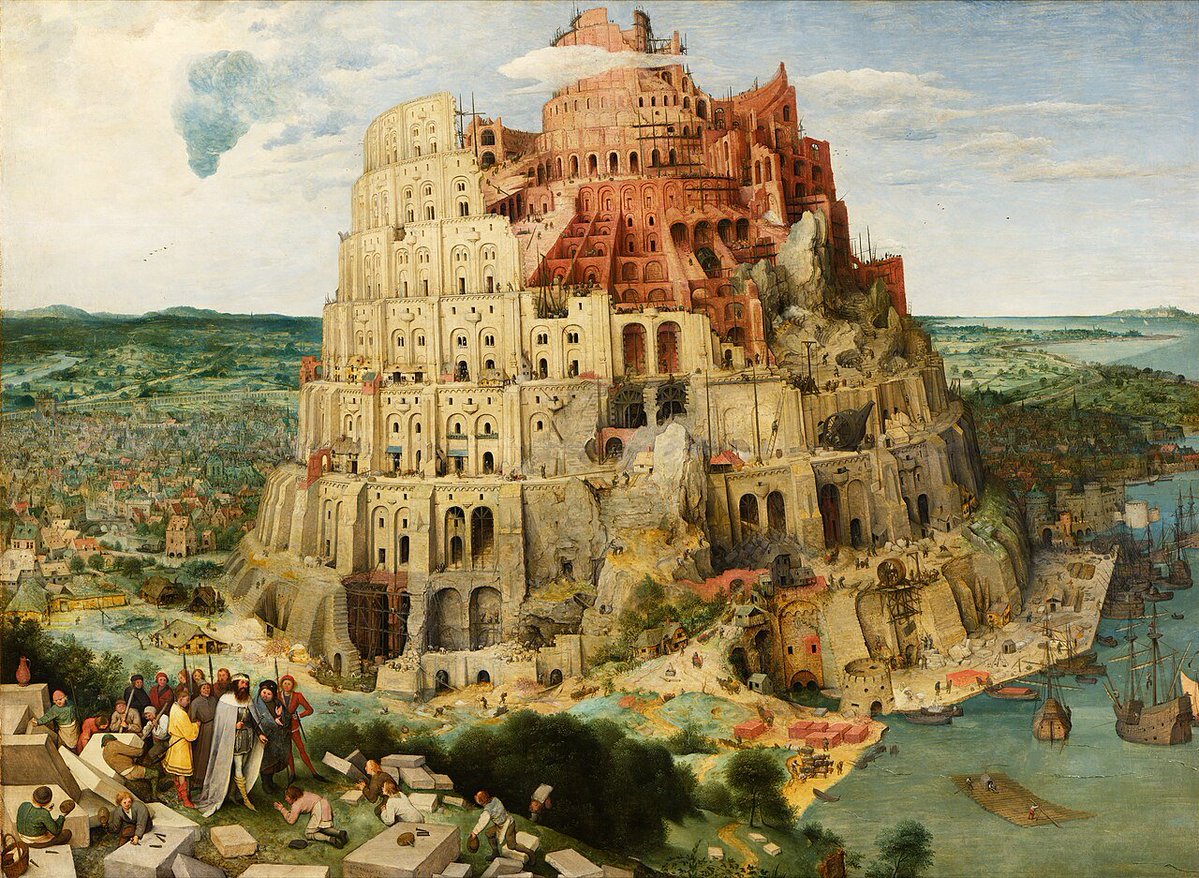
Can a civilization become technologically advanced while becoming culturally poorer?
We can build skyscrapers in months, communicate across continents in seconds, and use artificial intelligence to produce art, music, and literature.
Yet many cities are replacing distinctive architecture with identical glass towers. Traditional crafts are disappearing as mass production takes over. Libraries and bookstores struggle for survival, while millions spend hours consuming short videos.
The Romans built aqueducts that transformed urban life, but they also invested in public baths, forums, theaters, and monuments.
Renaissance Florence produced extraordinary advances in banking and commerce while supporting artists such as Brunelleschi, Donatello, and Michelangelo.
Today, we measure progress through GDP, stock market gains, technological innovation, and economic growth.
But how should we measure the cultural achievements of a civilization?
If a society becomes wealthier, faster, and more technologically sophisticated while losing its artistic traditions, architectural character, and cultural memory, can we still call that progress?
And perhaps the harder question: Are we already living through that contradiction?
Photo: The Tower of Babel by Pieter Bruegel the Elder (1563)
🚨🇵🇹 Portuguese Federation president Pedro Proença: “Cristiano Ronaldo is the best player in history. He has dedicated more than two decades to Portuguese football and is the ultimate symbol of Portuguese identity”.
“His presence with the national team is well-deserved thanks to his exceptional sporting abilities, and this is undeniable. He will always remain part of this group whenever he is fit and ready”.
“What happened between him and Jorge Jesus was simply a misunderstanding that needs to be resolved internally”.
“Cristiano is part of the national team; he is our icon, and he captained the team in the first of the four matches”.
“Cristiano Ronaldo is a Portuguese icon and an exceptional player. He could have ended his career at the World Cup, but he didn't because of his love for his national team”.
“I can attest to the bond he shares with the Portuguese people and our national team”.
“Now that the four matches are over, we have the time and calm to sit down together and resolve the misunderstanding”.
“Cristiano is part of our legacy, and he will always be here whenever the coach wants him”.
Let me educate you slowly, so nothing is lost in translation.
You said Europe was rich before colonisation. Rich by what standard? The same Europe that was crawling through the Dark Ages? Illiterate, plague-ridden, eating off dirt floors, while Timbuktu was running a university that enrolled 25,000 students?
Let’s talk about what “rich” means.
While Europe was in intellectual darkness, the Moors (Africans and Arabs from North Africa), crossed into Iberia in 711 AD and civilised them. They brought algebra, astronomy, medicine, architecture, philosophy. The University of Al-Qarawiyyin in Morocco, founded in 859 AD, is the oldest continuously operating university on earth. Not Oxford, not Cambridge, but Africa!
When European scholars wanted to learn, they went to Cordoba, a city the Moors built, where the library held 400,000 volumes at a time when the largest library in Christian Europe had maybe 400 books.
Four hundred books!
The Greeks you love to quote, Pythagoras, Thales, Solon, Plato, all travelled to Egypt to study. Herodotus documented it, Diodorus Siculus documented it, even Aristotle acknowledged it. The mystery schools of Egypt were the intellectual foundation of what Europe later called “Western civilisation.” Greece didn’t invent wisdom, they imported it from us.
And before any of that,
Mali Empire, Songhai Empire, Great Zimbabwe, Kush, Axum, Carthage, the Kingdom of Benin, whose bronze casting in the 13th century was so precise that when Europeans first saw the Benin Bronzes, they refused to believe Africans made them. They invented a mythical lost civilisation to explain it. Because the alternative, that we were brilliant, broke their entire narrative.
Now here is what your argument conveniently omits.
When Europe arrived, they didn’t meet savages. They met civilisations. So they did what colonisers do, they destroyed the evidence.
The Great Library of Mali in Timbuktu, Sankore University, housed between 700,000 and 1 million manuscripts covering mathematics, astronomy, medicine, law, and theology. French colonial forces and subsequent chaos burned, looted, and scattered what centuries had built. Scholars are still recovering manuscripts from the sand.
The Benin Bronzes (3,000 to 5,000 masterworks) were seized by British forces in the Punitive Expedition of 1897. Stolen, carted to London, sold to museums across Europe. Some are only now being returned, 130 years later, after the world shamed them enough.
The Alexandria Library? Burned.
Carthage? Rome didn’t just defeat it. They salted the earth, they wanted no memory of it.
The Museum of Cairo, Nubian sites, burial monuments… looted systematically, catalogued in European museums, repackaged as their discovery of our heritage.
And Timbuktu’s Ahmad Baba Institute, one of the greatest repositories of African intellectual heritage, the jihadists who attacked it in 2012 were themselves downstream of the chaos that colonial border-drawing and resource extraction created.
This is not clout chasing , this is accounting.
A man burns your house down, takes your furniture, and then mocks you for being homeless. That is not a victimhood mindset.
You want us to “fix our shithole countries”? We are. But let’s be honest about who broke them. The Berlin Conference of 1884, where Europeans sat in a room and divided a continent they did not own, splitting ethnic groups, merging enemies, designing dysfunction… that was not ancient history. The grandparents of people alive today were born into that world.
The IMF's favourite trick: compare 🍎 to 🥔.
When discussing "aid dependency", they often use **Sub-Saharan Africa** for aid figures but then switch regional definitions for GDP comparisons. Convenient. 🙃
Using OECD DAC aid to **all of Africa** and IMF's 2025 Africa aggregates:
💵 ODA to Africa: ~US$70–80bn
🌍 Africa GDP: ~US$3–4tn
➡️ Aid ≈ 2% of GDP
In PPP terms:
🌍 Africa PPP GDP: ~US$11–13tn
➡️ Aid < 1% of PPP GDP
That's not an economy "dependent on aid". That's a narrative dependent on selective denominators. 📊✨
The strongest case for Sir Alex Ferguson over Pep Guardiola is actually pretty simple.
Football management is more than tactics.
Pep may have influenced football more stylistically, but Ferguson mastered every single aspect of management at the highest level for over 25 years. He wasn’t just coaching a team, he was running an empire.
What makes Ferguson unique is that he built multiple great teams from scratch and kept winning through entirely different football eras. Most managers have one peak cycle. Ferguson had about four.
The early 90s side with Cantona was different from the Treble side. The Treble side was different from the Ronaldo/Rooney era. Then he still won another title in 2013 with a squad that honestly had no business dominating the league the way it did. That level of reinvention over two decades is probably the hardest achievement in football management history.
And unlike Pep, Ferguson did not always have the best squad, best structure, or most money. He regularly outperformed stronger teams through mentality, adaptability, and sheer force of leadership. There’s a reason rival fans still talk about “Fergie Time” almost like mythology, his teams psychologically overwhelmed opponents before games even started.
Another thing people underrate is how difficult Ferguson’s environment was. The Premier League during his era had constantly changing rivals:
Arsenal under Wenger
Chelsea under Mourinho with Roman Abramovich’s money
Liverpool historically
Newcastle’s rise in the 90s
Blackburn spending heavily
Then later the rise of billionaire-backed clubs
Yet Ferguson remained the constant.
Pep, meanwhile, has mostly coached elite, ready-made superclubs with extraordinary infrastructure already in place. That’s not his fault, but it matters in historical comparisons. Ferguson turned young players into world stars repeatedly. Beckham, Giggs, Scholes, Ronaldo, Rooney different generations entirely. Pep improves elite players, Ferguson often created them.
And then there’s the longevity argument, which is massive. Staying at the top for 25+ years in football is nearly impossible now. Dressing rooms change, tactics evolve, player power grows, ownership changes happen, pressure increases. Ferguson survived all of it and still retired as champion.
Pep may end up as the greatest tactical coach ever. But Ferguson’s argument is that he was the more complete football manager leader, builder, psychologist, developer, winner, and cultural architect all in one.
@KG6783@CoffeeTonny@tomorwl@KyleTrainEmoji People fear the End of the World.But when you die,your world ends.Why are so many indifferent to the suffering of people during the Cultural revolution,what Mao did was unacceptable.
From Nigeria to Kenya to South Africa, Angola,
I see many Africans laugh when countries like Iran are attacked.
But ask yourself this:
If those who once colonized Africa came back today,
how many African countries would hold for even a week?
How many could defend themselves against the US , the UK , France ?
Look at Europe. Look at Asia.
They are building their own weapons industries and defense systems.
Not because they are foolish,
But because they understand power.
Depending on others for your guns and security
is dependence, not independence.
Iran is surviving today, due to it's own home made missiles and weapons.
Africa must think seriously about what independence really means. Africa must learn not just to laugh.
@piersmorgan They’ve had weapons and never used them until provoked. Until attacked. Why is Israel allowed ambiguity but Iran isn’t?
Every country has the imperative to protect themselves. Global rules and order mean nothing after the West has allowed Israel to do.
This WaPo article is unreal: they unironically mock China for not being imperialist and failing to use force to defend its interests, arguing that they're losing out to the U.S. (in Venezuela, Panama, etc.) which does precisely that.
In essence the article can be summarized as: "You Chinese losers thought you could gain influence by actually building things? The only thing that actually works is bombing people."
I'm not even exaggerating. The author literally writes that "China can spend all the money on infrastructure it wants... But in a crunch, it is only military force that counts."
He argues that China's approach was "a colossal waste of money" because "control of infrastructure can be changed" with a US-led "change of regime" and "ownership of any asset can be overturned."
His article's conclusion? "You can’t buy an empire, nor can you purchase global influence. It is only hard power that counts for anything."
As cynical and brutish as the article is, it's also refreshingly honest. It is factual that China's strategy was to win over the Global South by investing in their infrastructure and development, while the U.S. maintains its influence through regime change, various forms of coercion, and the threat (or use) of force.
The conclusion that it is China that should feel embarrassed by this as opposed to the U.S. is, however, completely insane.
Every sane person on earth should hope that it is China's approach that ultimately prevails, for the sake of our collective future as humanity. China is ultimately trying to prove that one can prevail geopolitically without violence, by building instead of destroying: don't be like this idiot WaPo writer and root for the answer to be "no".
Src for the article: https://t.co/UgxwltA4CK
25 POINTS EACH. But according to the media, Amorim is a disaster… and Maresca is apparently the next Guardiola (because nothing screams “elite coach” like being level on points with a team you spent all summer mocking).
The funniest part? If United had simply taken the chances we created in a few key games, we’d be comfortably above Chelsea and the narrative would flip overnight.
But sure, keep telling us how Maresca is “growing into the role” while Amorim is “struggling.” The table says they’re the same. The context says Amorim is doing more with less. And the eye test says United are building something, while Chelsea are still trying to figure out what they actually are.
@TUNOptyltd We lost,but this was one of your greatest slips. I could've split it into multiple 100 dollar bets, and I would've boomed. Promising night turned sour.