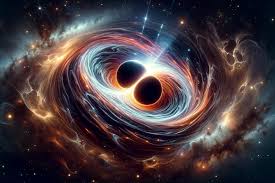
Discovery of the #Higgsboson, also known as the 'God particle,' revolutionized our understanding of the universe. By giving particles mass, Higgs boson helps explain why matter exists and why the universe looks the way it does. The search for new #physics continues #cosmology
What if every force in the universe is just a different view of a single, unifying field? Exploring the quest for a Theory of Everything and the principles of omni-physics. #Physics#OmniPhysics#TheoryOfEverything
NASA's spacecraft OSIRIS-REx now called OSIRIS-APEX, has been dispatched to study the asteroid Apophis, set for an unusually close #Earth flyby in 2029 - a rare event not witnessed since recorded history
Potentially visible in the Eastern Hemisphere.
Although the Rock is still 5 years from nearing Earth , scientists will be watching it as it nears its first of six close passes with the sun.
Having returned in September after seven years , OSIRIS-APEX previously collected samples from the space rock Bennu. Apophis also dubed the "God Of Chaos", is anticipated to pass Earth on April 13 2029, at a mere 20,000 miles, closer than some satellites left
A #NASA spacecraft that recently returned from deep space has been relaunched for a mission to study the "God Of Chaos" asteroid as it begins to near Earth's orbit
The Sun's Gravity is Massive!
Did you know the Sun's gravity is strong enough to hold a whopping 99.86% of the mass of the entire solar system? That's one powerful star! #OmniPhysicsFunFact#NASA#Space#Sun#Gravity
Voyager 1 is currently more than 15 billion miles (24 billion kilometers) from Earth, and it takes 22.5 hours for any radio signal to travel from the craft to our planet.
Launched in 1977, Voyager 1 zipped past Saturn and Jupiter in 1979 and 1980 before flying out into interstellar space in 2012. It is now recording the conditions outside of the sun's protective magnetic field, or heliosphere, which blankets our solar system.
This octopus shows us how effectively it can change colour and camouflage to match its sorroundings as a scuba diver slowly approaches it.
The octopus is able to achieve this amazing camouflage thanks to tiny chromatophores found in its skin.