Lean Startup & Turnaround Evangelist, CA & Mentor, Life-Long Learner, ENTJ, Interim CXO and "Corporate Seismologist" to Delighted, students and founders.
@UltramagaI@USAPippa@Arkypatriot@Savsays H has nothing to do with a Sikh Gurdwara, where everyone is welcome and invariably get fed with love. They are peaceful, hard working, inclusive and serve all specially during crises. Just go inside one and experience it. God Bless 🙏
@rajuser1000@RepJayapal OCI holders have to comply with the rules of political neutrality?
Does tweeting misinformation by non Indian citizens, cross the redline and invoke revocation of OCI as aconsequence?
Bangalore, 9 November 1935.
A physicist who had fled Nazi Germany stood before the South Indian Science Association to talk about one number. 137.
Then he printed his own theory's answer for it. It was wrong.
First, the number.
Combine the electron's charge, Planck's constant and the speed of light. The units cancel. A pure number is left, about 1/137.
Max Born's question: why that value and not another?
He said a perfect theory should derive it by pure mathematical reasoning, without recourse to experience.
He did not trust the one famous attempt. Of Eddington's 136 to 137 theory he wrote: "I was never able to understand this theory which seems to be itself rather mystical."
So he tried his own field theory. It gave 82.4. Experiment said 137. Off by a factor of 1.66.
He published both numbers anyway and called it "the right order of magnitude".
C.V. Raman communicated the lecture to the Proceedings of the Indian Academy of Sciences.
January 1937. B.S. Madhava Rao, University of Mysore, working at IISc, published a paper on the fine structure of hydrogen's spectral lines. Its last sentence:
"I wish to thank Prof. Max Born who suggested this problem to me in the winter of 1935 and also indicated the method of procedure to be adopted."
So the Bangalore visit was more than a lecture. Born handed an Indian researcher a live problem.
P.S. 137 is the inverse of the fine structure constant. The modern value is 137.036.
Photo 1 & 2: Max Born, "The Mysterious Number 137", Proc. Indian Acad. Sci. A2 (Dec 1935), p. 533 & 557. Indian Academy of Sciences.
Photo 3: B.S. Madhava Rao, "On the fine structure of the Balmer lines", Proc. Indian Acad. Sci. A5 (1937), p. 62
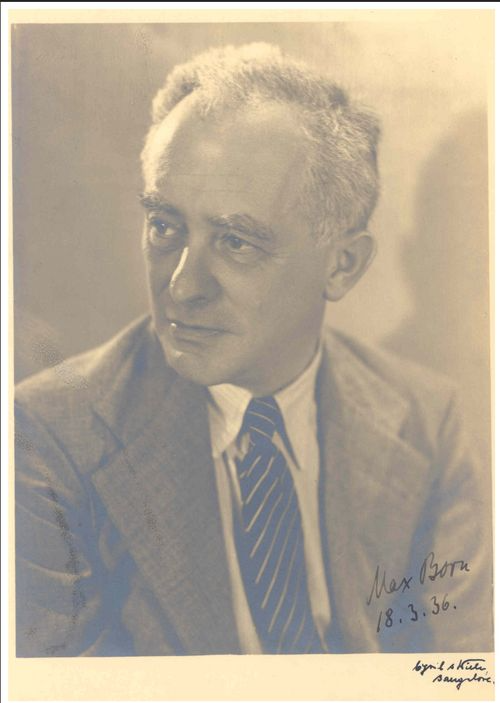
Photo 4: Born's signed studio portrait, Bangalore, inscribed "Max Born 18.3.36"
Every ethnicity and immigrant group scams more than white people EXCEPT INDIAN HINDUS.
I am so sick of the psyop. Fuck the woke right. All they do is lie.
In May 1921, American polymath Walter Russell entered a 39-day coma-like state, during which he claimed to have accessed “the source of all knowledge.” Upon awakening, he frantically wrote down what he had seen—pages filled with philosophical, scientific, and spiritual revelations that would later form the foundation of his manuscript *The Universal One*. Though he sent his findings to 500 leading minds of the time, nearly all dismissed him as mad—except one. Nikola Tesla, the visionary inventor, was so struck by Russell’s insights that he urged him to seal the work away for a thousand years, insisting that humanity was not yet ready for its truths.
Walter Russell’s revelations reimagined the very structure of reality. He argued that matter was not solid but crystallized light slowed by thought—that everything around us, from rocks to human bodies, was composed of light patterns, shaped by consciousness. He believed the universe was fundamentally mental, not material, and that all things moved in rhythmic cycles—expansion and contraction, like breath. He dismissed opposites like good and evil as illusions, asserting instead that everything sought harmony and balance. To Russell, death wasn’t an end but the release of compressed light returning to its source. Even time, he claimed, wasn’t linear, but a spiral where past, present, and future coexisted.
These ideas were radically ahead of their time, blending metaphysics, wave dynamics, and a deep sense of universal unity. He believed electricity was a living spiral of energy, not merely electrons in motion, and that the vacuum of space was in fact a vibrant sea of untapped potential. Health, in his view, was the natural rhythm of the body, and disease was simply a disruption of that flow. Though ignored or ridiculed during his lifetime, Russell’s work now draws new attention in an era where quantum physics and consciousness studies begin to echo the same questions. To many, he is no longer a forgotten eccentric, but a prophet of a paradigm yet to come.
-Golden Historical Images
@DMcfarlan83187@malik_alee66879 True.
Is there any national minimum wage enforcement agency that needs to pay a visit to this "charming and welcoming" restaurant? Better to eat at home than risk being insulted?? We eat out for the vibe, ambience and memories.. what chance of that when greeted this way??
INDIA IS THE MOTHERLAND OF HUMAN POPULATIONS, GLOBAL SPIRITUAL TEACHING AND ASPIRATIONS
India was the basis of human populations on Earth back to the Ice Ages owing to its favorable climate, great rivers, access to the Ocean and global communication.
India was the cradle not of mere material or intellectual Civilization but of higher Consciousness, Cosmic Intelligence, great Rishis, Yogis and Self-realized Sages. YOGA AND VEDANTA HAVE LONG BEEN OUR EVOLUTIONARY GUIDING POWER. WE MUST HONOR IT ONCE MORE FOR ALL HUMANITY.
"Master, you have the golden scalpel technique. Why not open my eyes?"
A famous Chinese poet wrote this line to an Indian Brahmin monk. He was going blind. He knew who could save his sight, and it was not a Chinese doctor.
The poet was Liu Yuxi of the Tang dynasty. The poem is called "Zeng yanyi Poluomen seng", "To the Brahmin monk, an eye doctor".
The golden scalpel (jinpi shu) is cataract couching, a surgery that Tang records connect with Indian medicine.
Indian eye medicine was already inside the Tang imperial system. An Indian eye text, the "Tianzhu jing lun yan", is quoted in the Waitai miyao, a medical compilation from 752 CE.
A "Treatise on the Eyes" attributed to Nagarjuna circulated in Tang China. A Bulletin of SOAS paper traces Sui and Tang eye surgery to Indian surgical ideas.
The poem does not say whether the operation took place.
Sources: Liu Yuxi, "Zeng yanyi Poluomen seng" (Liu Yuxi ji jianzheng, 1989); "Ophthalmic surgery: a chapter in the history of Sino-Indian medical contacts", Bulletin of SOAS; Wang Tao, Waitai miyao (752)
OAS traces Sui and Tang eye surgery in China to Indian surgical ideas.
So a great Chinese poet, going blind, asked an Indian monk-physician for help in a poem. The poem does not say whether the operation happened or worked.
P.S. The monk is unnamed and "Brahmin monk" is a translation.
@Indian_Response@ben_kew Way back the cultural and civilisational respect between China and India was massive. Heartwarming story about Cataract surgery between Chinese patient and Indian surgeon.
"Master, you have the golden scalpel technique. Why not open my eyes?"
A famous Chinese poet wrote this line to an Indian Brahmin monk. He was going blind. He knew who could save his sight, and it was not a Chinese doctor.
The poet was Liu Yuxi of the Tang dynasty. The poem is called "Zeng yanyi Poluomen seng", "To the Brahmin monk, an eye doctor".
The golden scalpel (jinpi shu) is cataract couching, a surgery that Tang records connect with Indian medicine.
Indian eye medicine was already inside the Tang imperial system. An Indian eye text, the "Tianzhu jing lun yan", is quoted in the Waitai miyao, a medical compilation from 752 CE.
A "Treatise on the Eyes" attributed to Nagarjuna circulated in Tang China. A Bulletin of SOAS paper traces Sui and Tang eye surgery to Indian surgical ideas.
The poem does not say whether the operation took place.
Sources: Liu Yuxi, "Zeng yanyi Poluomen seng" (Liu Yuxi ji jianzheng, 1989); "Ophthalmic surgery: a chapter in the history of Sino-Indian medical contacts", Bulletin of SOAS; Wang Tao, Waitai miyao (752)
OAS traces Sui and Tang eye surgery in China to Indian surgical ideas.
So a great Chinese poet, going blind, asked an Indian monk-physician for help in a poem. The poem does not say whether the operation happened or worked.
P.S. The monk is unnamed and "Brahmin monk" is a translation.
Ramanujan used chalk and a slate because paper was too expensive..
imagine him with Claude..
he grew up poor in Tamil Nadu..
worked as a clerk..
taught himself math from one old book..
in 1913 he wrote a letter to G.H. Hardy at Cambridge..
full of formulas nobody had seen before..
Hardy brought him to England..
but the food was hard to find..
the winters were brutal..
and his health collapsed..
he died in 1920..
at just 32..
still he left behind nearly 3,900 results..
mathematicians spent decades proving what he wrote..
he did all that with chalk..
hunger..
and no one to check his work..
now picture him with a full stomach..
and a machine that never gets tired of his questions
The modern man, particularly the modern western man, worships the intellect. I used to be in this category so I know whereof I speak.
Pure mathematics, the highest intellectual activity known to man, is falling to AI. It is a deeply humbling moment.
At this point, I would assume that most "intellectual jobs" are at risk. That includes much of software.
What will people do? Living in a village (I just came from Lalita Sahasranama pooja for Navaratri), I am not worried about "What will humans do" question.
Humans have infinitely many things to do and I categorise those human activities as nature, nurture, culture and scripture: restoring soil and water, raising children and caring for elders, making music, sustaining festivals, sports and entertainment, studying and practising spiritual traditions.
Those activities can pay well in the sense of being able to afford the goods and services produced with near zero human labor. The task of the political economy is to ensure this income distributional outcome and I reject UBI as an unimaginative and dystopian vision of the intellect-worshipping modern man. The UBI future implicitly assumes monopolization of the means of production and sovereign states already have the power to disallow monopolies.
Hindu philosophy, in all its depth and grandeur, never worshipped the pure intellect. Finally I understand why.
Om Shri Lalitambikayai Namah 🙏
In 1949, almost nobody in the West had a drug that could lower high blood pressure. In India, ~90% of doctors were already prescribing one.
It was Rauwolfia serpentina, the root called sarpagandha. Indian researchers had been publishing on it since 1931.
By 1949 one manufacturer alone had sold about 50M tablets. Those papers sat in scientific libraries around the world, and Western medicine did not pick up the lead.
Then a Bombay cardiologist, Rustom Jal Vakil, put 10 years of his own cases into one paper in the British Heart Journal. He asked 50 physicians across India which drug had worked best, and 46 named Rauwolfia.
In a 50 patient trial, 85% showed a lower systolic pressure after 4 weeks, a fall of 21 mmHg on average. It was the 1st clinical report on Rauwolfia to appear outside India.
Within 5 years, 100+ papers on it had been published worldwide. In 1952 chemists isolated reserpine, its main active compound. In 1954 it was 1st used in psychiatry. In 1957 Vakil won a Lasker Award.
The Lasker citation described the delay as "a block in medical communication that, in retrospect, seems hard to understand".
Source: Lasker Foundation, 1957 Clinical Medical Research Award citation; Tex Heart Inst J 2006;33(2):161-170; Vakil RJ, Br Heart J 1949;11(4):350-355
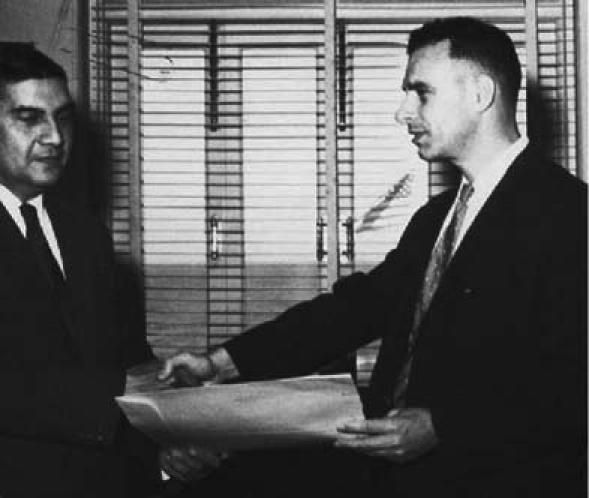
Photo: Vakil (left) receiving the American College of Cardiology fellowship certificate from the American consul in Bombay
@benonwine YES!!! However, he is an International cultural treasure, who has brought endless joy over the years to fans across the world. The wit, humour and command of irony and absurd Monty Pythonesque genius made GB culture truly great. He's a titan. Fun facts Accounting and Training too
Meet Shanti Bhattacharya!
(The Indian Scientist Working on Light-Powered Chips)
What if the next generation of chips could use light, not just electricity, to move and process information?
Meet the IIT Madras professor who has spent decades learning how to manipulate light at microscopic scales.
> Studied Physics at Women's Christian College, Chennai
> Completed her Master's in Physics from IIT Madras in 1992
> Earned her PhD in Physics from IIT Madras in 1997
> Researched optical systems that manipulate and shape light
> Won the prestigious Alexander von Humboldt Fellowship in 1998
> Moved to Germany for research at TU Darmstadt
> Worked on optical systems for CDs and DVDs
> Also developed optics to shape high-power laser beams
> Joined Analog Devices in Cambridge, Massachusetts
> Worked on microscopic optical switches for telecommunications
> Returned to India and joined IIT Madras in 2005
> Built a research programme in diffractive optics and optical MEMS
> Expanded her work into nanophotonics, imaging and metasurfaces
> Received the IESA Technomentor Award in 2021–22
> Awarded the SERB POWER Fellowship in 2022
> Became Head of IIT Madras's Electrical Engineering Department
> Was present at the launch of India's indigenous silicon-photonics design and testing tools in April 2026
Her research explores how tiny structures can bend, shape and control light, opening possibilities in advanced imaging, sensors and optical communication.
In April 2026, IIT Madras launched a silicon-photonics design kit with over 50 verified components, alongside an indigenous platform for testing programmable photonic chips.
The technologies were developed by a dedicated team at IIT Madras's Centre of Excellence for Programmable Photonic Integrated Circuits and Systems.
These are important building blocks for future photonic technologies, with applications ranging from high-speed communications to quantum systems.
For decades, Bhattacharya has worked on controlling light at increasingly smaller scales.
And as India develops its own photonics ecosystem, that field of research is becoming more important than ever.
Mysuru,Oct. 11- Titular head of Mysore Royal Family Yaduveer Krishnadatta Chamraja Wadiyar ascended the Golden Throne at Dubar Hall in Mysore Palace to commence the Khas Durbar (Private Durbar) at Mysore Palace as part of Navaratri festival this morning.
@shailajaUw@Ragnom_@badazn Historically The Koreans used to be proud of a famous Queen from India. Then colonization of mind and culture happened. No Indian person, who knows their own civilisational heritage wants to be described as anything else but Indian! The lousy civic behaviour of a few is not ALL?