Every cow on earth descends from about 80 wild aurochs that somebody in the Near East decided to keep, 10,500 years ago, and that decision built every city you have ever stood in.
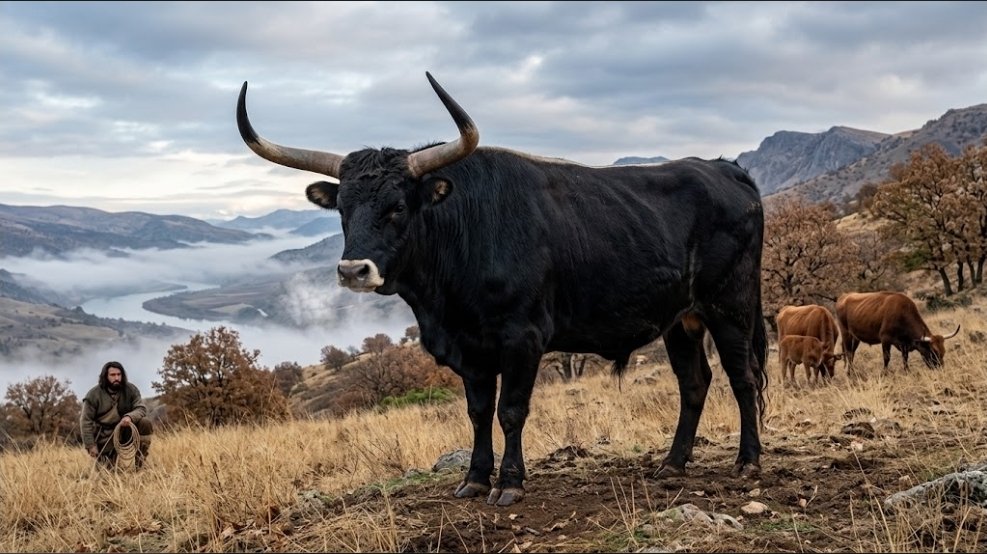
The aurochs was six feet at the shoulder and would kill you. Somebody looked at it and saw milk, a plough, a cart, leather, tallow, a winter's meat and a walking bank account, and started catching calves. The genetics say the founding herd was tiny, 80 animals or so, in the hills of what is now Turkey and Iran. Everything from a Hereford to a Holstein to a Brahmin is their great-great-grandchild.
That is the whole of civilisation in one choice. Wheat fed the people, the cow fed the wheat: pulled the plough, manured the field, carted the grain, and when the harvest failed the cow was the harvest. Every temple had it on the wall. Every language priced things in it. The Egyptians worshipped it, the Hindus still do, the Masai built a people on its blood and milk, and the English put it on a plate and then put the plate on a coat of arms.
Humans have had 10,000 years to pick a food. They tried mammoth, they tried acorns, they tried each other. They chose the cow, in every climate, on every continent, without a single committee.
It is the one thing every ancestor you have agreed on.
The committee has been sitting for twenty years and would like to overrule them.
Farming cost the first farmers 16cm of height, and it took their descendants until the late 20th century to get it back.
The men who hunted
- Ice Age Greece and Turkey
- Diet: the herds that crossed the plain
- Average height: 177cm
The men who farmed
- The last Neolithic villages, same land
- Diet: wheat, barley, lentils
- Average height: 161cm
The farmers' skulls carry something the hunters' mostly do not. It is a spongy pitting of the bone, the mark iron-deficiency anaemia leaves on a child who grew up short of it.
Then the wait began. Through the Bronze Age, the classical world, Rome, Byzantium and the Ottomans, the height never came back.
As late as 1987, a professor at UCLA could write that modern Greeks and Turks had still not regained the average height of their Ice Age ancestors.
The Greek men who finally did were born in the 1990s, into a country eating meat and milk every day. Turkish men are still a few centimetres short.
5,000 years of empires, cathedrals and philosophy, and a hunter with a spear would still have looked down at most of them.
History calls it the dawn of civilisation. The bones call it a downgrade.
Japan spent 1,200 years under Buddhist meat bans and came out of them 8cm shorter than the tomb builders who came before.
In 675 Emperor Tenmu issued an edict banning the eating of cattle, horses, dogs, monkeys and chickens through the farming season. Buddhism spread, the bans were reissued and extended, and for most of the next thousand years meat became something the respectable avoided. In 1687 the shogun Tsunayoshi went further with his Laws of Compassion, which made harming a dog a serious crime.
Japanese anthropologists have measured the femurs from every period. The tallest people in Japan's entire pre-modern record were the men of the Kofun age, the era of the great keyhole tombs, around 163cm. From there the skeletons shrank, century after century, to the Edo period, when the average man stood about 155cm and the average woman 145cm. That is the smallest the Japanese have ever been.
Then meat and milk came back into the country in the modern era. The Japanese man now stands around 171cm, taller than the Kofun ancestors ever were.
8cm lost over twelve centuries of piety, and 16cm regained in little more than one century of beef, pork and milk.
Japan is held up everywhere as proof that rice and vegetables build a long and healthy life. Japan's own graveyards record what 1,200 years of rice and vegetables did to its height.
Bread and circuses is the phrase everybody knows, and the emperor who ran the dole best decided the bread was not enough and added pork.
Rome's grain dole was 300 years old by the time Aurelian took the throne in 270. Some 200,000 citizens drew a monthly ration of wheat, and they had grown restless on it, because a man can be fed on bread and still know he is being fed cheaply.
Aurelian changed the terms. The wheat became baked bread, and the loaf grew. Then free pork went onto the list, and olive oil, and wine at a fixed low price. The pig became a state matter: Italian farmers were assessed for it, and the pork butchers of Rome were organised into a guild answerable to the prefect.
The pork dole survived him by a century and a half. By the 300s the entitlement ran to about 5lb a head each month for the winter, drawn from the public butchers on production of a token.
The men who invented bread as a means of keeping a city quiet found, on the job, that it did not keep a city quiet. What the mob wanted was meat, and the emperor who lasted was the one who worked that out and paid.
Juvenal gave us the slogan. Aurelian gave us the correction, and nobody quotes it.
The fall of the Roman Empire made Europeans taller.
An Oxford researcher assembled the measurements of 18,500 skeletons from 484 sites across Europe, covering 2,500 years. Height is the most honest record there is of what a population was fed as children.
Under Rome, with its roads, aqueducts, trade and famous prosperity, height went nowhere. In much of Europe it fell.
Then the empire collapsed. In the 5th and 6th centuries, the depths of the so-called Dark Ages, Europeans grew taller than they had been for 1,000 years, and taller than they would be again until about 1800.
She tested the data against everything: climate, population, cities, inequality. The factor that tracked height most faithfully, century after century, was cattle. More cows in the farming meant more milk and meat in the children, and longer bones.
Rome was a machine for growing grain. It fed an army and a capital on wheat, it taxed its provinces in wheat, and it packed its people into cities to eat it.
When the machine broke, the towns emptied and the ploughland went back to grass. The cattle moved onto it.
Measured by its monuments, European civilisation peaked under the Caesars. Measured by the bodies of the people who had to live in it, it peaked when the aqueducts fell down and the cows came back.
The Anglo-Saxon king and the Anglo-Saxon ploughman ate the same dinner. The hungry peasant watching his lord eat meat was brought to England by the Normans, and the bones prove it.
In 2022 a Cambridge team published the chemistry of 2,023 skeletons buried in England between the 5th and 11th centuries. Bone keeps a record of how much animal protein its owner ate. They sorted the dead by rank, the sword burials and the jewellery against the plain graves.
The bones matched. The thegn under his grave goods and the ceorl under nothing at all had eaten alike.
Anglo-Saxon England:
- Cnut's law: every free man may hunt on his own land.
- The king travelled to his farmers and ate with them.
- One feast list from Wessex, around 700: 300 guests, 1kg of meat a head.
- November was called Blotmonath, blood month, for the slaughter.
- Rich grave and poor grave, the same diet in the bone.
Then 1066, and about 8,000 Normans took possession of two million English.
Norman England:
- Every deer in the country became the king's.
- A third of England was put under forest law.
- The penalty for killing a hart was blinding.
- The rabbit and the dove belonged to the manor.
- By 1086 about 5% of the land was still in English hands.
- The cow, the sheep and the pig kept their English names in the field and took French ones at the table.
An English monk wrote the Conqueror's obituary in the Chronicle in 1087. He loved the stags, it says, as if he were their father.
In the later medieval graveyards the bones of rank and the bones of the village stop matching.
We picture the feasting lord and the starving peasant as the natural order of the old world. In England it came over on a boat, and it spoke French.
Humans were smashing open animal bones to get at the fat long before anyone invented farming.
Archaeologists have found animal bones at prehistoric sites deliberately fractured by early humans to reach the marrow inside.
At Qesem Cave in Israel, researchers found something even stranger.
Around 200,000 to 420,000 years ago, people appear to have been keeping certain animal bones for later.
The bones still had skin attached.
Researchers experimentally tested the idea and found that leaving the skin on could help preserve the marrow inside for weeks.
Basically, prehistoric humans may have had their own version of food storage.
Not berries.
Not salad.
Bones full of fat.
And marrow wasn’t some useless leftover.
It’s extremely energy dense and protected inside the bone, which makes it a valuable food when you’ve just spent considerable effort getting hold of an animal.
Our ancestors weren’t trimming every visible bit of fat off their dinner and congratulating themselves on choosing the lean option.
They were smashing bones with stones to get MORE of it.
Hundreds of thousands of years later, we remove the fat from meat, manufacture low-fat versions of naturally fatty foods and call that progress.
Then someone eating the whole animal is considered extreme.
Which century actually has the strange relationship with food?
First date. Nice place. White tablecloths, the works.
Waiter: "For madam?"
Her: "The tomahawk. Rare. No sides."
Waiter: "It's for two, madam."
Her: "I've read the menu. I can read."
Waiter: "And for sir?"
Him: "The burrata salad, please. Could I get the dressing on the side. And no croutons."
[The waiter writes both down. He writes hers first, and slowly, like a man taking a statement.]
Waiter: "Any sauce with the steak? Peppercorn, béarnaise?"
Her: "Butter."
Waiter: "Garlic butter?"
Her: "Butter butter. A dish of it."
Waiter: "And to drink?"
Him: "A kombucha, if you have one."
Her: "Water."
[He leaves. He returns with the sommelier, who has no reason to be there and knows it.]
Sommelier: "I understand there's a tomahawk."
Her: "There is."
Sommelier: "For yourself."
Her: "For myself."
Sommelier: "I'd suggest a Malbec."
Her: "Water."
[The sommelier retreats. 20 minutes pass. The steak arrives on a board, a kilo of it, standing on its bone like a monument, and the waiter sets it down in front of him.]
Him: "That's, er..."
Her: "Mine."
[The waiter turns the board 180 degrees with the care of a man rotating a casket.]
Waiter: "Apologies. Habit. Twenty years of habit."
Her: "It's fine. It's the first thing tonight that's made sense."
[The salad arrives. Nobody mentions it. It sits between them like a third person who came uninvited.]
She ate the lot. Fat cap first, then the eye, then she picked the bone up in both hands and the room stopped breathing.
He ordered a chamomile tea.
There was no second date, and the waiter, I'm told, still talks about her.
Americans of the 1800s ate meat three times a day in quantities that would get a modern dietitian struck off, and their doctors described heart attacks as a rarity.
The folk memory says otherwise. Pioneers lived on cornbread, beans and hardtack, meat was a Sunday luxury, and it is only fat modern America that gorges on red meat and pays for it in the cardiac ward. That is the story underneath every guideline: go back to eating like your ancestors, meaning less meat.
Their ancestors kept diaries.
When Lewis and Clark crossed the continent between 1804 and 1806, the Corps of Discovery ran on game. Clark, 13 July 1805: "We eat an emensity of meat." He gave the daily requirement for the party as 4 deer, or an elk and a deer, or 1 buffalo. When the hunting was good it came to as much as 9lb a man a day, for men hauling boats upstream. The tally for the whole journey runs to 1,001 deer, 375 elk, 227 bison, 43 grizzly bears and 190 dogs, which they bought from the tribes and, Clark excepted, came to prefer.
The expedition carried an emergency food, 193lb of dried portable soup, and the men loathed it. The one time the whole party went down sick was in September 1805, on the far side of the Rockies, when the game ran out and the Nez Perce kindly fed them dried salmon and camas root. The captains' journals spend days on the consequences. Sacagawea, about 17 and carrying a baby on her back, ate what the soldiers ate the whole way there and the whole way home.
The men who supplied the fur trade lived the same way on wages: the Hudson's Bay Company's standard daily ration for a working man on the plains was 8lb of fresh buffalo meat.
Settled America ate the same way with cutlery. Pork was the national staple, salted down by the barrel. By the 1840s Cincinnati was packing so many hundreds of thousands of hogs a year that the country called it Porkopolis, and after 1865 the Union Stock Yards in Chicago did the same for beef on a scale the world had not seen. Frances Trollope, who spent two years living in Cincinnati and never forgave it for the pigs in the streets, reported in 1832 that ham and beefsteaks appeared "morning, noon and night", alongside an extraordinary amount of bacon.
When Wilbur Atwater, the founding father of American nutrition science, ran the first proper dietary surveys in the 1890s, he found the average American eating 147lb of meat a year. The average Italian ate 24. Atwater found labourers having beefsteak for breakfast and put the vigour of the American workman down to it. All of it was cooked in lard, butter and tallow, because there was nothing else to cook in.
And William Osler, the most celebrated physician in the country, writing the standard medical textbook in 1892, described angina as a rare disease.
The 20th century is where the lines cross. Beef eaten per head peaked in 1976 and has since fallen by about 40%. Butter and lard collapsed. Vegetable oil went from nothing to the biggest single item in the nation's fat supply, and chicken breast replaced the steak. Americans, in other words, did what they were asked. They followed the advice for more than 40 years, more faithfully than any population has ever followed a diet.
Frances Trollope would not recognise a single thing on the modern plate. She would not recognise the people sitting in front of it either.
“You’ll get scurvy eating only meat.”
Except two men ate nothing but animal foods for an entire year under medical supervision and didn’t.
In 1928, Vilhjalmur Stefansson and Karsten Andersen entered Bellevue Hospital in New York to test what actually happened when humans lived entirely on animal foods.
Meat. Fat. Organs.
No fruit.
No vegetables.
No vitamin C supplements.
Doctors monitored them throughout the experiment.
Neither developed scurvy.
Neither developed any clinical sign of vitamin deficiency.
The results were published in the Journal of Biological Chemistry in 1930.
Humans absolutely need vitamin C. We cannot make it ourselves.
But vitamin C isn’t exclusive to oranges, berries and vegetables.
Fresh animal tissues contain it too, particularly certain organs.
Traditional Greenland diets provide another example. Researchers examining historical Inuit foods found vitamin C coming from animal foods including seal meat and organs.
So yes, humans need vitamin C.
No, humans do not need fruit to obtain it.
Apparently nobody told the sailors they should have packed liver instead of limes.p
A Florida man says he was 90% covered in psoriasis, battling depression since age 4 and on the verge of giving up — until he switched to an extreme "lion diet" of nothing but ruminant meat.
Stephen Lashbrook, 50, told Fox News Digital that within a week of committing to the strict carnivore diet on Jan. 1, 2024, his itching and suicidal thoughts stopped. Within a month, his skin began clearing and his chronic pain eased. His daily menu now consists of about 1.5 to 2 pounds of grass-fed ground beef, usually cooked in an air fryer.









![SamaHoole's tweet photo. First date. Nice place. White tablecloths, the works.
Waiter: "For madam?"
Her: "The tomahawk. Rare. No sides."
Waiter: "It's for two, madam."
Her: "I've read the menu. I can read."
Waiter: "And for sir?"
Him: "The burrata salad, please. Could I get the dressing on the side. And no croutons."
[The waiter writes both down. He writes hers first, and slowly, like a man taking a statement.]
Waiter: "Any sauce with the steak? Peppercorn, béarnaise?"
Her: "Butter."
Waiter: "Garlic butter?"
Her: "Butter butter. A dish of it."
Waiter: "And to drink?"
Him: "A kombucha, if you have one."
Her: "Water."
[He leaves. He returns with the sommelier, who has no reason to be there and knows it.]
Sommelier: "I understand there's a tomahawk."
Her: "There is."
Sommelier: "For yourself."
Her: "For myself."
Sommelier: "I'd suggest a Malbec."
Her: "Water."
[The sommelier retreats. 20 minutes pass. The steak arrives on a board, a kilo of it, standing on its bone like a monument, and the waiter sets it down in front of him.]
Him: "That's, er..."
Her: "Mine."
[The waiter turns the board 180 degrees with the care of a man rotating a casket.]
Waiter: "Apologies. Habit. Twenty years of habit."
Her: "It's fine. It's the first thing tonight that's made sense."
[The salad arrives. Nobody mentions it. It sits between them like a third person who came uninvited.]
She ate the lot. Fat cap first, then the eye, then she picked the bone up in both hands and the room stopped breathing.
He ordered a chamomile tea.
There was no second date, and the waiter, I'm told, still talks about her.](https://pbs.twimg.com/media/HSqjNtIW4AAaXq7.jpg)