The #Trump presidency, have raised concerns regarding the Five Eyes alliance’s integrity and the potential risks posed to its security framework. These apprehensions were fueled by Trump’s perceived closeness to Russia and incidents like the ‘Signalgate’ controversy, which involved the mishandling of classified information.
https://t.co/qlBGPF4aXz
Hey #BlueCrew Night Owls 🌜🦉Signal Gate #FBR
Drop a comment! 💬 Like ❤️Retweet ♻️
I you to MEET NEW FRIENDS! #DonkParty#MEGABOOST
If Starlink provides service could encrypted Signal messages be intercepted? Codes are made to be cracked. #SignalGate
#johnnysomali , whose controversial actions in various countries have sparked widespread criticism and legal repercussions. #Somali
https://t.co/cYrDthKJh7
Huge shout out to all our #BlueCrew friends who helped make #freedonkandbrittney #4 on 🦋.
We will be boosting weeknights at 8PM and if you missed this week's there are 7 #MEGABOOSTS on mine and @AZ_Brittney timeline.
We 💙 you guys and absolutely humbled by the support!
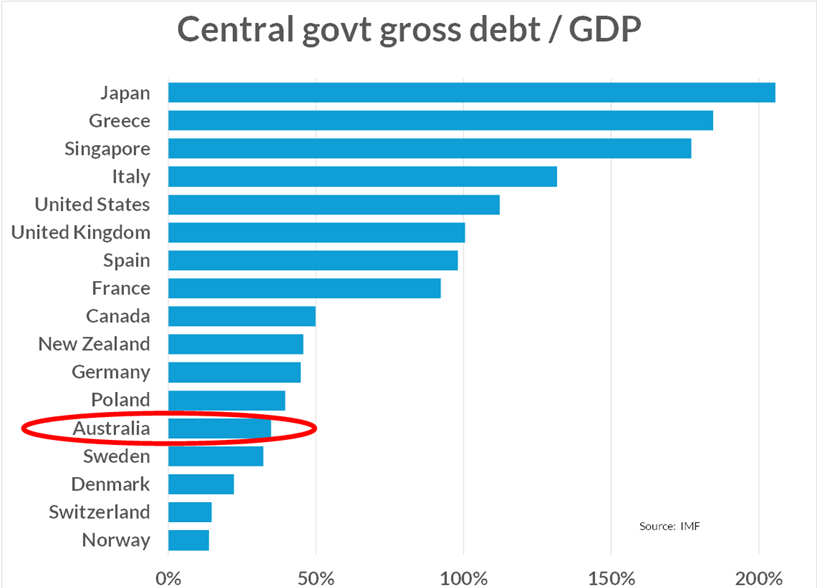
YOU’D STILL RATHER BE US – OUR LOW DEBT IS A BLESSING IN A VOLATILE WORLD
My new article in the Fin is grumpy about a bunch of things, so it is worth noting the good news upfront: Australian federal government debts and deficits are a fraction of those in most of the nations we compare ourselves too.
The chart is OECD data, which uses gross debt. Net debt is an even better measure, and it is remarkably low. At $541bn, it is less than 20% of national income.
(If you hear someone talking about “a trillion dollars in debt”, they’re using the gross figure – meaning they’re trying to exaggerate. The political cycle swings: before they came to office, the current government talked a lot about “a trillion”, and now it’s the opposition. Always use the net number.)
Yes, I think our low debt is due to our great luck. But low debt is a blessing in an increasingly volatile world. It gives us opportunities that aren’t open to heavily indebted governments such as those in Japan, the US and the UK.
Very happy to take that win – it’s a big one.
After the talks in Jeddah and the American proposal for a ceasefire on the frontline, Russia stole almost another week – a week of war that only Russia wants.
We will do everything to further intensify diplomacy. We will do everything to make diplomacy effective. But every day now is about defending our independence, our state, and our people. We must remember – it is the support of our army, all our defense and security forces, and our state that determines everything.
I thank each and every one who does not forget that Ukraine’s defense and resilience are paramount. I am grateful to all Ukrainian soldiers, every one of our units. I thank everyone who works for our defense and for our state. I thank all Ukrainians for every fundraiser for our Ukrainian army.
We must remember – as long as the occupier is on our land, and as long as air raid sirens sound, we must defend Ukraine.
"It's absolutely clear Donald Trump is dangerous." Adam Bandt calls for Australia to end AUKUS deal, arguing the $300+bn submarine agreement makes Australia "less safe". #auspol#ABCInsiders
To watch @elonmusk who gets $8 million a day in hand outs from the American Government call Social Security a “ponzi scheme” is revolting. He’s the parasite punching down on poor working class Americans, veterans, children & the elderly.
UK Prime Minister Keir Starmer said Putin cannot be allowed to "play games" over Ukraine ceasefire.
In comments released by Downing Street before the Coalition of the Willing meeting, he said the Kremlin's complete disregard for this deal only serves "to demonstrate that Putin is not serious about peace" and that Russia must stop its barbaric attacks on Ukraine and agree to a ceasefire now.
According to the PM, Putin is trying to delay, saying there must be a painstaking study before a ceasefire is possible, "but the world needs to see action, not a study or empty words and pointless conditions."
"If Russia finally comes to the table, then we must be ready to monitor a ceasefire to ensure it is a serious, and enduring peace, if they don't, then we need to strain every sinew to ramp up economic pressure on Russia to secure an end to this war," @Keir_Starmer said.
My MAGA neighbor five minutes ago: “I just read that tariffs are going to raise prices for stuff. I don’t get it. I thought China was going to pay them.”
I explained how tariffs work. I wish you could see the look on the guy’s face when it sunk in.
So much ignorance out there.
There are news reports today that Australian government officials are concerned that the Trump administration will pressure Australia over its monopsonistic Pharmaceutical Benefits Scheme which keeps drug prices in Australia lower than they otherwise would be - the PBS does not make drugs eligible for government subsidy unless the price is agreed.
This is not news. big pharma has never liked our PBS. This piece of history from the Obama years and the negotiations over the Trans Pacific Partnership is from my memoir “A Bigger Picture”
“I became prime minister just as the negotiation of the TPP was concluding in Atlanta and we came under enormous pressure from the Americans to agree to amendments to patent protection for biologics, a new and increasingly important type of drug created by complex biological, as distinct from chemical, processes. The amendments would benefit the immensely influential US pharma lobby but would inevitably be politically damaging for us as an increase in the cost of some drugs in Australia was a likely outcome.
“We were only just getting the China Australia Free Trade Agreement through the parliament in the teeth of furious opposition from the unions and we simply didn’t have the political capital available to have a fight over the TPP too. President Obama called me to press the case and did so with his characteristic quiet charm. But I couldn’t help him; we wouldn’t change our law relating to data protection for biologics. It was political kryptonite for us.
Barack said that meant the TPP could fall over and we’d be blamed. I took a deep breath and quietly replied, ‘Well, Mr President, like you, I think the TPP is vital for our region. But you know, nobody is marching in the streets here saying “Sign the TPP”, but they sure will be marching if they think we’re going to put up the price of drugs on our Pharmaceutical Benefits Scheme. Those pharma companies hate our PBS because we use our monopoly buying power to force down prices – but that’s not my problem. Sorry, no can do.’
Barack Obama entirely understood the politics. And he acknowledged he was an unlikely advocate for big pharma. We just moved on to talking about Syria and other security issues. I then gave Andrew Robb (our Trade Minister) authority to stonewall on the issue. ‘Just say “no” to drugs, Andrew,’ I told him.
Our ambassador in Washington, Kim Beazley, reported to me on 3 October that, following my call with the president, Obama’s National Security Council trade adviser was trying to elevate the issue to one of national security, and was arguing that our standing our ground wouldn’t just put the whole deal but the alliance at risk. We were warned that the atmospherics with the Americans would likely be poisonous if talks collapsed.
Peter Varghese, secretary of DFAT, Julie Bishop our Foreign Minister , Andrew Robb and I talked. We resolved that we would not be spooked by the US pressure and concluded the idea that Australia was standing in the way of the US rebalance in the Asia Pacific was self-serving bunkum. The USA was trying to knock us off one by one on biologics, and Australia was by no means the only TPP party that could not accept eight years. We recognised that if we failed in Atlanta it wouldn’t be because of Australia. So, concluding our position on biologics was both entirely defensible and in our national interest, I instructed our negotiators to hold firm. And we did.
The deal was signed in Atlanta – only to be abandoned a year later by President Trump. But it was a reminder that, especially when it comes to trade, nations – particularly big ones – will ruthlessly pursue their own interests. It was important that at our first encounter, Obama saw that I was just as committed to Australia’s interests as he was to America’s.“
This is a very important essay, by former submarine commander RADM Peter Briggs and not just for Australia which is likely to spend billions and end up with no submarines. Given the chances of Australia ever getting a Virginia are vanishingly small, isn't time for the US and Australia to face reality and look at a different solution? Another must read from @warontherocks@EvansRyan202
https://t.co/EQEKoB9jlB