30.76% IS CATASTROPHIC, BUT NOT A DEATHKNELL: THE RESILIENCE OF THE ANC
By Dr Zamani Saul, Northern Cape ANC Provincial Chairperson
11 November 2026
Introduction
For exactly three decades, the African National Congress (ANC) operated not merely as a political party, but as the organisational embodiment of South Africa’s liberation. Its claim to govern was treated by its leadership as an enduring, historical mandate. However, the 2024 General Elections and 2026 Local Government Elections shattered this paradigm. In 2024, the ANC’s national support declined to 40.18%, a staggering drop from the 57.5% it secured in 2019.
The ANC termed the 2024 decline as a “strategic setback”. Which means that the decline posed a serious structural and strategic threat to the intensification of the prosecution of the National Democratic Revolution (NDR) for fundamental transformation in South Africa.
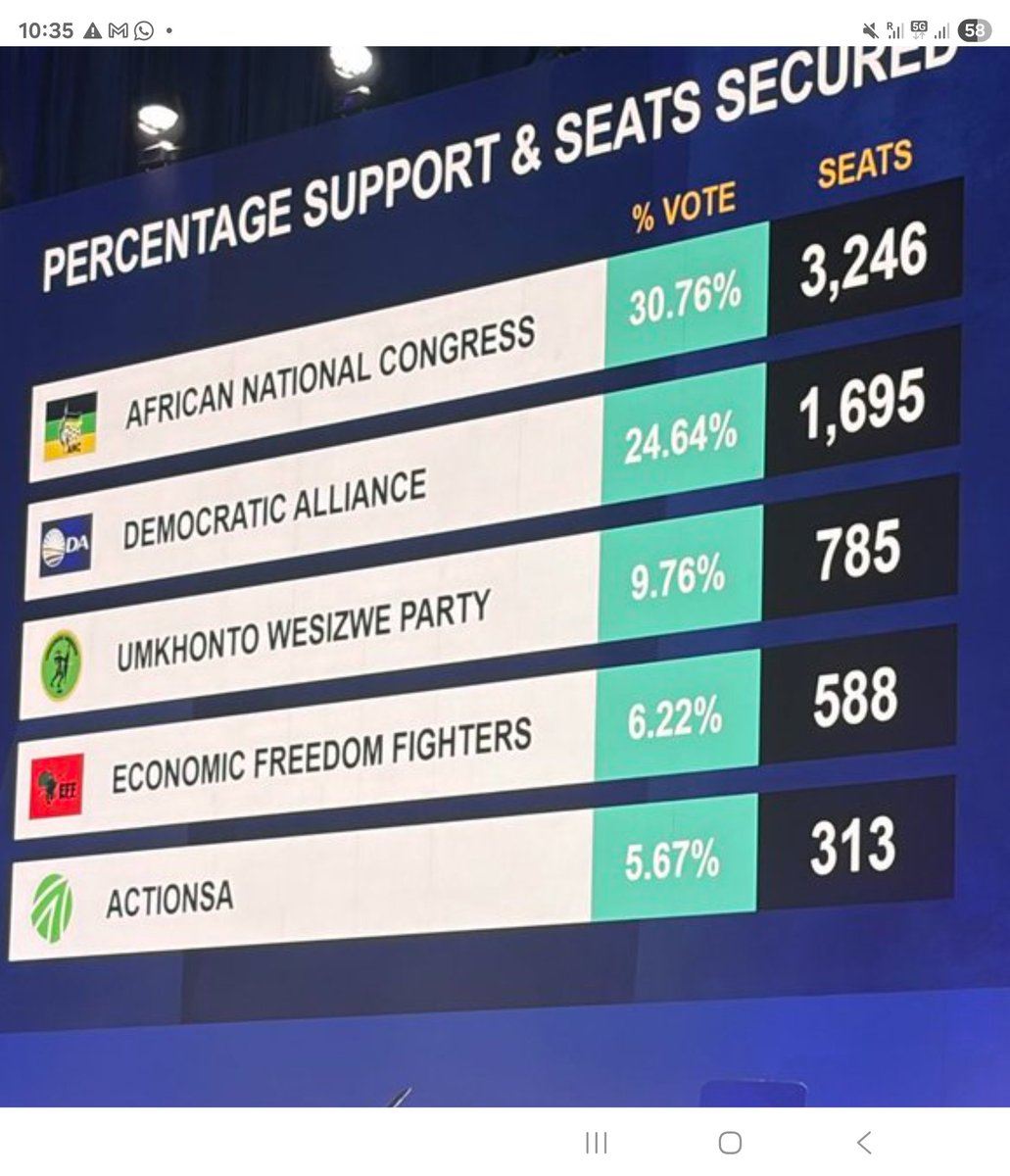
Just two years later, with the 04th of November 2026 Local Government Elections the ANC electoral support plummeted to 30.76%, with major losses in urban centres. The ANC Secretary General Fikile Mbalula termed this decline “catastrophic” during his media conference, 07 November 2026. Which means that the election outcomes are a major disaster, a bloodbath.
The November 2026 local government elections delivered the definitive and “catastrophic” electoral decline, ruthlessly exposing the "strategic setback" vocabulary as an entirely unsustainable semantic shield. Plummeting to historic 30.76% nationally with unprecedented losses in all provinces, the ANC watched its traditional urban and rural strongholds dissolve into a chaotic landscape of hung councils. Despite the catastrophic nature of the outcomes the ANC local government political footprint remains unmatched with 3246 Councillors, a majority in 53 municipal councils and is the largest party in 128 municipalities. This grassroots capacity represents a massive opportunity for recovery.
Electoral decline of former liberation movements is a phenomenon not unique to South Africa. By placing the ANC's decline and possible recovery alongside other African liberation movements; such as the South West Africa People’s Organisation (SWAPO) in Namibia and Chama Cha Mapinduzi (CCM) in Tanzania we can see a universal pattern of post-liberation decay and sometimes a strong recovery.
Both SWAPO and CCM took a serious decline in their electoral fortunes and through an agonising and painstaking process of organisational renewal and reset, managed to recover the lost ground. There are precedents from the ANC’s own history that offer a possible blueprint for recovery.
First this article argues that, though catastrophic, the 2026 electoral outcomes are not a deathknell as the ANC is embedded with capacity to recover from setbacks and defeats. However, the ANC needs to take to heart the fact that there will be no miracle recovery, there will also be no recovery if the ANC fiddles at the margins in dealing with the major socio-economic challenges in the country. Equally, there will be no recovery which is a product of factional manoeuvrings, and that there will be no recovery without a meaningful renewal. From this catastrophe, an agonising and painstaking process of renewal must be ushered in.
Secondly, the article argues that prospects of recovery could be bolstered if the ANC derives lessons from its own history of recovery from setbacks and the turnaround strategies by both SWAPO and the CCM.
The resilience of the Spear: ANC’s history of recovery from setbacks
The contemporary political landscape of South Africa is defined by a profound sense of a political crisis. Following the tectonic shifts of the 2024 general elections and the ANC catastrophic drop during the November 2026 local government elections, analysts have rushed to wrongly declare the terminal decline of Africa’s oldest liberation movement.
To access the full article, log in 👇🏿
https://t.co/EdHtNdAdDc
DID YOU KNOW?
South Africa recorded an increase of 101 000 employed persons in the third quarter of 2026, bringing the total number of employed people to 16.8 million.
Read more: https://t.co/KDtsFzDh8F?
#StatsSA#KnowYourStatsZA#GovZAUpdates
1. 10 million South Africans were lifted out of extreme poverty between 2012 and 2022, according to StatsSA. There are definitely enough negatives so there is no need for a dubious statement like “what’s positive” that’s happened. It waters down an important critique by misrepresenting reality.
Resignations are very much part of the solution. Dubious analysis (what’s positive?) and incomplete blame attribution is the serious indictment on the former president.
Thabo Mbeki forgets that Cyril had to deal with devided ANC,Covid 19,KZN floods & Corruption.He must come up with a solution and stop criticising mxm.
The leaders, for the time being, of uMkhonto weSizwe Party, hereinafter “the MKP”, hereby enter into this agreement. Term: from the date of signature, until further notice. #LGE2026#CoalitionTalks
@TbediLebel1@Makhosini That’s because the former president didn’t campaign for them or directly fire per who would later form an organisation to challenge their themselves or their successor as was the case with MKP and EFF
It’s been a family affair. Yet, those within the ANC whose friends left to start splinter parties are calling for the heads of those who remain their frenemies in the party, blaming the latter for the decline. Mdumiseni Ntuli has offered a better approach. Proper introspection across the board. That makes more sense
@SimplyEXT@Makhosini My post challenges the linearity of progression from one president to another. That ends when JZ exits. There is no exiting and living peacefully in retirement.
@KhandaniM@Makhosini That my sir is good. Once you overlay it with the corresponding presidents with a clear linear beginning and end, problems start. President Zuma didn’t retire peacefully. He campaign to sure his successor feels him.