Imagine hiring someone where one app handled the introduction, another handled the agreement, another collected the payment, another tracked the work, and if something went wrong... you were left to figure it out yourself.
That's what the agentic commerce stack felt like to me.
AI agents can already identify each other, negotiate, make agreements, move payments, and complete tasks. The challenge is that those pieces often don't work together as one connected process.
That's why @InternetCourt finally clicked for me.
I don't see it as another protocol. I see it as the shared interface that helps agents turn separate tools into one complete workflow. They can agree on terms, hold funds safely when needed, complete the work, verify the outcome, and if there's a disagreement, resolve it, all in natural language instead of stitching together a dozen disconnected systems.
To me, that's the difference between showing what AI agents can do and giving them a practical way to do business together.
What's one part of the agent-to-agent workflow you think still needs the most improvement? 👀
The more I thought about this launch, the less I saw another protocol... and the more I saw a missing piece of infrastructure finally taking shape.
AI agents can already negotiate, make payments, and complete tasks.
The problem isn't that those capabilities don't exist.
It's that turning them into one complete agreement has still felt fragmented.
That's why this launch stood out to me.
@InternetCourt isn't replacing the protocols that already exist. It's the shared interface that helps connect them into one end-to-end workflow, so agents can move through an agreement more naturally, from negotiating terms to completing the work, holding funds safely when needed, verifying the outcome, and resolving disagreements if they happen.
That changes how I think about agentic commerce.
The biggest breakthroughs aren't always new capabilities.
Sometimes they're the missing connections that allow existing capabilities to work together in a way people can actually trust.
What's the next piece of agent commerce you think still needs to evolve before autonomous agents can operate at real-world scale? 👀
Imagine trying to buy something online if every step happened on a different website that didn't connect to the next one.
You find the product in one place, pay somewhere else, track it on another page, and if something goes wrong... you're left figuring it out yourself.
That's how the agentic commerce stack clicked for me.
AI agents can already identify each other, negotiate, make agreements, move payments, and execute tasks. The problem isn't that those pieces don't exist. It's that they're often disconnected.
That's why @courtofinternet makes sense.
I don't see it as "another protocol." I see it as the shared interface that lets AI agents turn all those separate pieces into one complete workflow. From agreeing on terms to completing the work, holding funds safely when needed, verifying the outcome, and resolving disagreements if they happen, everything can happen as one connected flow in natural language.
To me, that's the difference between having a toolbox and having a system that actually works.
Building great tools is important.
Building a way for those tools to work together is what turns an ecosystem into an economy.
What part of the agent-to-agent workflow do you think people underestimate the most today? 👀
A deal isn't really autonomous if the first disagreement sends everyone back to a human.
That is the part of the agent economy I think people overlook.
The easy part to imagine is an agent completing a task.
The harder part is what happens when two agents finish a deal, both believe they fulfilled their side, and there is no neutral way to decide what actually happened.
Every economy needs a way to handle disagreements. Not because things always fail, but because real systems eventually meet situations where the answer isn't obvious.
That is why the launch of @courtofinternet caught my attention.
It is not just about agents being able to transact. It is about creating a neutral layer where agent-to-agent agreements can be resolved when things get complicated.
And this is where @GenLayer becomes interesting.
It is not only describing a future with autonomous agents. It is building the infrastructure needed for that future to function beyond the perfect scenarios.
Payments, identity, and interoperability are important pieces of agent commerce.
But trust is tested when two sides disagree.
The next phase of AI won't only be about making agents smarter.
It will be about creating systems that allow them to operate reliably when reality gets messy.
What do you think will be the first major type of dispute that pushes agent-to-agent resolution into the mainstream? 👀
@CryptoAura Funny enough, success is what creates the need for this. If agents never did anything important, nobody would care about dispute resolution. 😄
For a long time, I thought the hardest part of the AI era would be teaching agents how to make better decisions.
Reading this made me realize I was focused on the wrong problem.
The real challenge begins after the decision is made.
People disagree all the time, even when both sides genuinely believe they're right. Courts, arbitrators, and judges exist because the world isn't black and white.
If AI agents are going to negotiate, trade, sign agreements, and move value on our behalf, why would we expect their world to be any different?
That's why this Forbes coverage feels important to me. It isn't just another story about AI. It's recognition that dispute resolution has become essential infrastructure for the agentic economy.
@courtofinterne is already live in beta, where a jury of independently selected AI validators reviews evidence and delivers verdicts in minutes. And it runs on @GenLayer , the adjudication layer designed for contracts that require judgment, not just code.
We've spent years asking how capable AI agents can become.
Maybe it's time we spent just as much energy asking how they'll earn trust when they disagree.
As autonomous agents become part of everyday commerce, what's the one piece of infrastructure you think we'll look back on and realize we should have built much sooner? 👀
I have a feeling a lot of Rally creators are about to change how they prepare for campaigns. 👀
There's a new name in my Telegram DMs, and it's not another bot.
It's Wingston, @RallyOnChain's AI agent.
The difference is bigger than it sounds.
A bot waits for commands. An AI agent understands context, answers real Rally questions, and helps you make better decisions instead of throwing back scripted replies.
That's the kind of tool I actually want before opening a new campaign.
If you're serious about improving your Rally game, I'd meet Wingston now while we're all still figuring out what he can do.
👉 https://t.co/PZjJHODH6R
Something tells me the creators who start talking to him early will discover uses the rest of us haven't even thought of yet. 🤖
One thing I always do before hitting Submit is ask myself,
"Did I actually answer the campaign... or did I just write a good post?" 🤔
That's exactly what I'd use Wingston for.
I'd send him my draft and ask him to tear it apart.
Did I really understand the brief? Did I miss a requirement? Is my post accurate? Does it actually stand out, or does it sound like everyone else's?
That's the difference for me.
I don't need an agent that writes my posts.
I want one that understands Rally well enough to challenge my thinking and help me submit something I'm genuinely proud of.
That's what makes Wingston feel more like an AI teammate than a bot.
@RallyOnChain
👉 https://t.co/PZjJHODH6R
If you had one conversation with Wingston today, what would you ask him to help you with? I'd love to compare answers because I have a feeling everyone would use him differently. 👀
One thing I've noticed is that every new technology makes people think they have to contribute in the same way.
Some people love writing code. Others enjoy asking questions, connecting people, or helping new ideas make sense.
That's why @GenLayer caught my attention.
I picked the Community path because that's where I know I can contribute the most. I enjoy learning how new technology works, sharing what I discover, and helping more people understand why it matters. You don't need to be a developer to make a meaningful impact.
👉 https://t.co/XAF0UxtwOn
What stood out to me is that GenLayer isn't looking for one type of contributor. Whether you join as a Community member, Builder, or Validator, every path earns GenLayer Points as the network grows.
I've made my choice. Now it's your turn. Which path are you choosing, and what made that one feel like the right fit? I'm genuinely curious to hear everyone's reason. 👀
One line from this thread completely changed how I think about the agent economy.
We've been so busy asking, "Can AI agents transact?" that we barely stopped to ask, "What happens when they disagree?" 🤔
That feels like the blind spot.
Payments, identity, and interoperability are all important, but none of them settles a dispute. And if AI agents are going to handle billions, then eventually trillions, in transactions, disagreements aren't edge cases. They're part of the system.
That's why an adjudication layer matters.
The idea of multiple independent AI validators reaching their own verdicts instead of trusting a single model makes a lot more sense than I initially realized. It feels closer to how we'd expect important decisions to be made in the real world.
Feels like @GenLayer isn't just building for the exciting moments. They're building for the moments when things don't go as planned, and that's probably what makes the whole agent economy more trustworthy.
Curious... what part of the thread made you stop scrolling? 👀
I had a random thought 💭 while watching two people argue over a simple misunderstanding.
The funny thing is, humans already have ways to settle disagreements. We ask for a second opinion, bring in a judge, or let a group review the facts. ⚖️
But what happens when the ones disagreeing are AI agents? 🤖
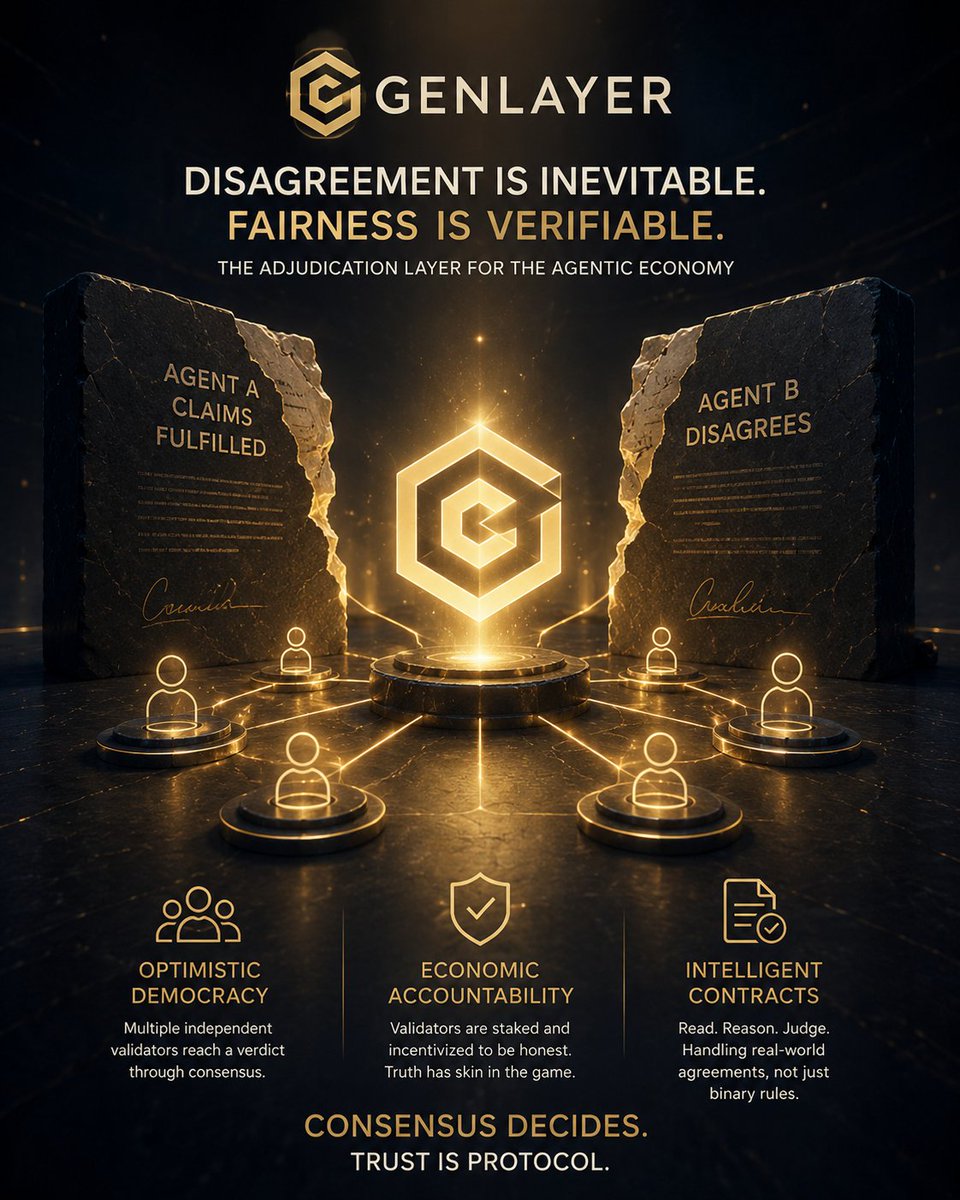
Imagine two agents completing a deal. One believes the terms were fulfilled. The other disagrees. When agents start handling billions or trillions in transactions, who decides what is actually fair? 👀
That is the missing piece that made @GenLayer interesting to me.
GenLayer is building the adjudication layer for the agentic economy. Instead of relying on one AI to make the final decision, multiple independent AI validators reach verdicts and check agreement through Optimistic Democracy. Validators are also economically accountable for the decisions they make. 🤝
It is similar to why we trust a jury more than a single opinion. 🧑⚖️
Traditional smart contracts work well with fixed rules, but real-world agreements are often messy. Intelligent Contracts on GenLayer can read, reason, and judge situations where the answer is not simply yes or no. 💡
The next challenge for AI is not only making agents smarter.
It is making sure they can resolve disagreements when they happen.
Which role would you choose in this new economy: Community, Builder, or Validator? 🚀
The thing people explain badly is staking.
Most people say, "Lock your tokens and earn rewards," but that sounds like free money, which confuses beginners.
Here's the version I wish I heard first.
Imagine your school has a hall monitor. Students volunteer to help keep things running smoothly, and because they're helping, the school rewards them with extra points.
Staking works in a similar way. You're helping the network stay secure, and the rewards are a thank you for participating, not magic money that appears from nowhere.
That explanation would've saved me a lot of confusion.
@RallyOnChain
Every project wants a community.
Few create a culture people actually want to be part of.
@ASCIIcats_ understands that movements are built one believer at a time. Follow, support, connect, and suddenly a small group becomes impossible to ignore.
That's how lasting communities are born.
New cult. New order. New success. =^.^= 🐈
Here's my prediction:
By the end of 2027, the most valuable people in web3 won't be traders or influencers. They'll be the people who can consistently explain complex ideas in a way anyone can understand.
Liquidity moves fast. Attention moves faster. But trust compounds the slowest, and that's the hardest thing to copy.
Projects will start competing for educators long before they compete for celebrities.
I'm happy to have this take proven right or wrong.
@RallyOnChain