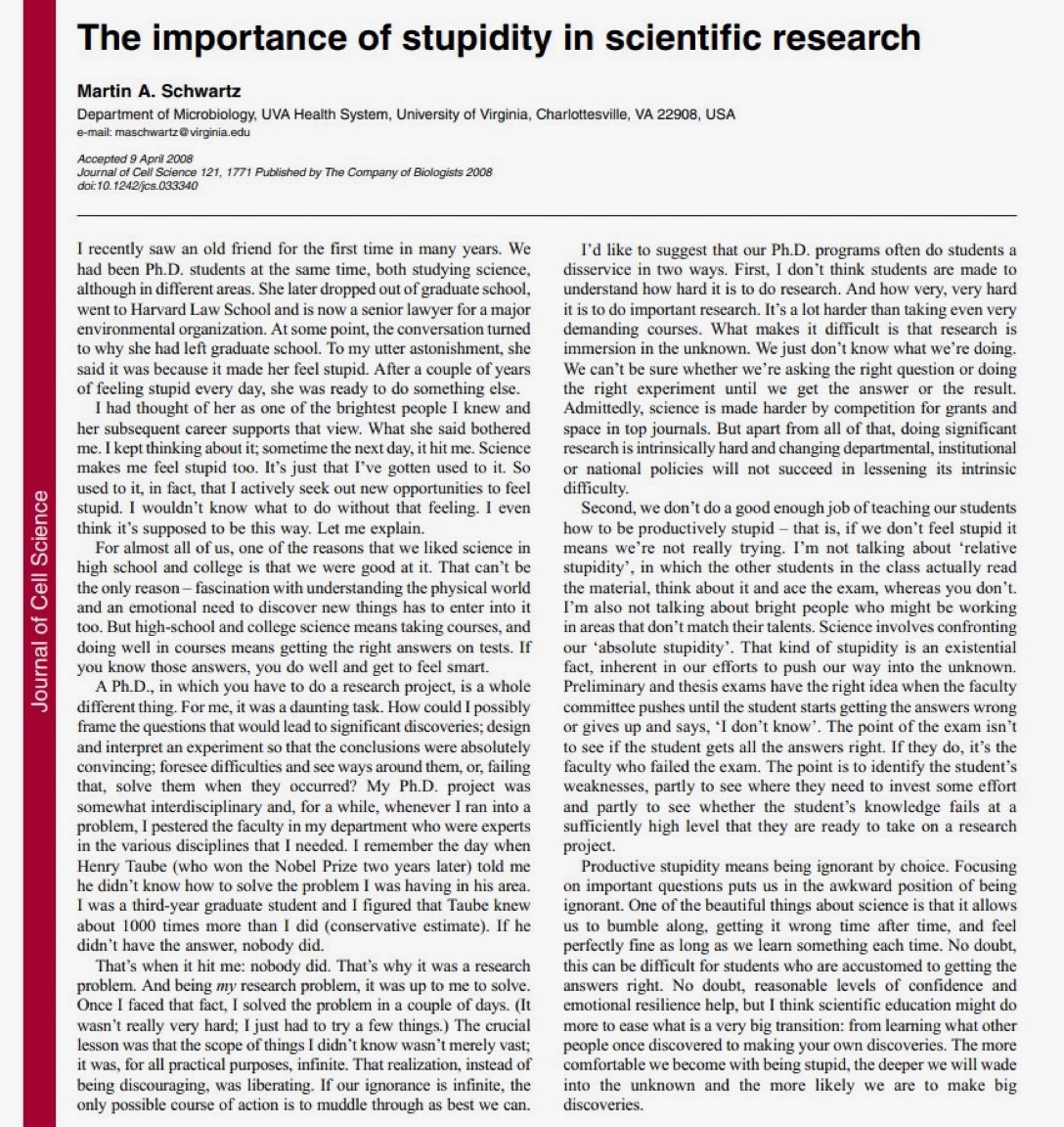
This article should be mandatory reading for every medical student, PhD candidate, researcher—and honestly, for anyone who mistakes expertise for certainty.
“The importance of stupidity in scientific research” sounds provocative, almost offensive. But Martin Schwartz is not glorifying incompetence. He is describing the real operating system of discovery.
Science is not built on knowing.
Science is built on tolerating not knowing.
That distinction matters.
Most of education rewards correctness.
School teaches us to answer.
Exams reward speed, certainty, and precision.
You feel intelligent when you get things right.
Research is the opposite.
Real research begins exactly where competence ends—at the frontier where nobody knows the answer, including the people you thought must know.
That moment is psychologically brutal.
You ask the expert.
The expert shrugs.
You assume you’re missing something.
Then you realize: no—this is the work.
You are not failing.
You are standing at the actual boundary of knowledge.
That feeling—“I must be stupid”—is often not a sign of inadequacy.
It is often the first sign that you are finally asking an important question.
Medicine struggles with this.
We train doctors to avoid uncertainty, to fear being wrong, to perform confidence.
But the best clinicians and the best scientists know how to sit inside ambiguity without collapsing into fake certainty.
This is why AI in medicine also deserves caution.
Systems trained only to reproduce established answers may become extraordinarily good at passing exams while being terrible at discovering what matters next.
Guideline intelligence is not the same as scientific intelligence.
Discovery requires productive stupidity:
the willingness to stay with the uncomfortable,
to look ignorant,
to ask naïve questions,
to be wrong repeatedly without protecting your ego.
Most people want the authority of expertise.
Very few want the humiliation required to earn it.
But progress lives there.
Not in certainty.
Not in performance.
Not in sounding smart.
In the quiet discipline of saying:
“I don’t know… yet.”
And continuing anyway.
🌍 Pneumonia: A Preventable & Treatable Threat🫁
Simple interventions can save lives:
✅ Vaccines that fight pneumonia
✅ Clean air and improved living conditions
✅ Good nutrition
✅ Timely antibiotics and oxygen therapy
#pneumonia#WorldPneumoniaDay#Pneumolight
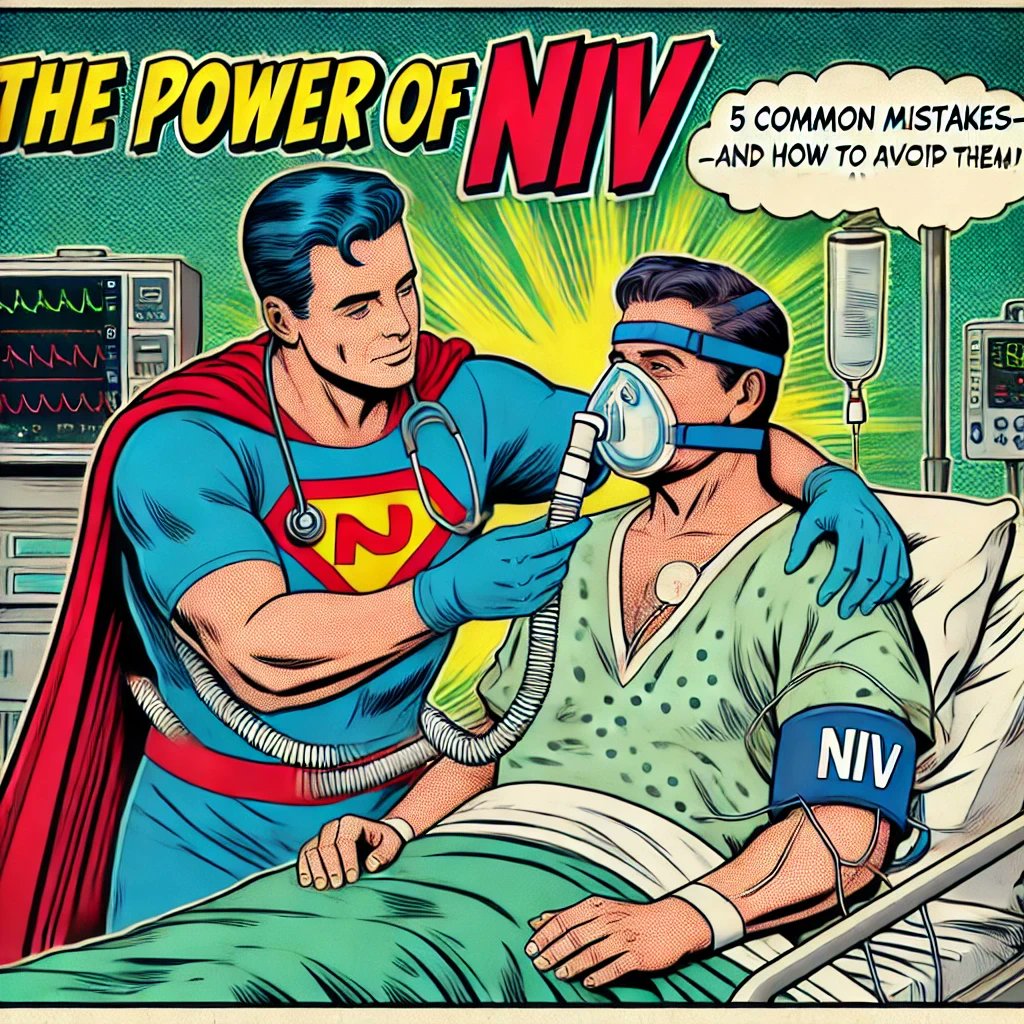
(1/x) Non-invasive ventilation (BIPAP/CPAP) is one of the few interventions that consistently demonstrates improvement in patient important outcomes... but only if done correctly.
A 🧵on avoiding the 6 biggest NIV mistakes
The past is in the past, so make the most of today with these incredible values John shares to help leaders win at life!
Learn more by ordering your copy here: https://t.co/H89HngGysd
#MaxwellMoments#bookclub#values
1/14
🤔Why does it take weeks for the radiographic evidence of pneumonia to clear?
Patients often feel better DAYS after starting treatment.
And yet the chest x-ray takes WEEKS to return to normal.
Why the delay?
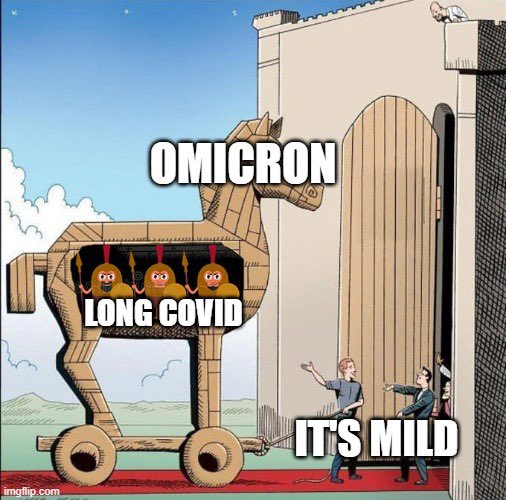
“Mild” but hospitals overloaded.
“Mild” but healthcare workers burnt out.
“Mild” but thousands of flights cancelled.
“Mild” but no booster shots for kids in under-ventilated schools.
“Mild” brain damage.
“Mild” collapse of society.
…“Mild” my ass.
#COVID19#Omicron#LongCovid
Starking difference between vaccinated and unvaccinated.
#VaccinesWork
Please magpabakuna kapag nabigyan ng pagkakataon
Mag follow up sa LGU kung di pa natatawag.
At nabakunahan man o hindi, 😷 🤲 🧍🏻↔️🧍🏻♀️ 🏠
Maging mas maingat! 🙏🏻
Your immune system does well at fighting threats it's seen before. But Covid is new—and its mutations, such as Delta, are even newer. Vaccination prepares your body to fight Covid, so it doesn't have to face a dangerous enemy sight unseen.
Hindi po additional na beds lang ang kailangan ng mga puno nang hospital. Yung mga healthcare workers po ang badly needed na mga tao rin- nagkakasakit, napapagod, naka quarantine rin. Wag lang add ng mga beds at akalaing yon ang lunas.😳😳😳