Putin’s stubbornness is hurting Russia itself
The blockade of the ports of the Azov and Black Seas has put Russian farmers on the brink of a catastrophe of unprecedented scale.
We will continue to demand full accountability for the crimes committed in the context of Russia’s war of aggression against Ukraine, and we urge all countries to join this call for justice. 🇸🇪 Foreign Minister @MariaStenergard for #NB8 🇸🇪🇩🇰🇪🇪🇫🇮🇮🇸🇱🇻🇱🇹🇳🇴 at the #HRC63
We have to respond with a new level of escalation to the terror inflicted on Ukraine’s civilian population.
More than anyone, we want peace. But we were given no choice.
We must burn this fucking country to the ground.
Only 12 countries are capable of manufacturing ballistic missiles—and Ukraine is now among them (WSJ).
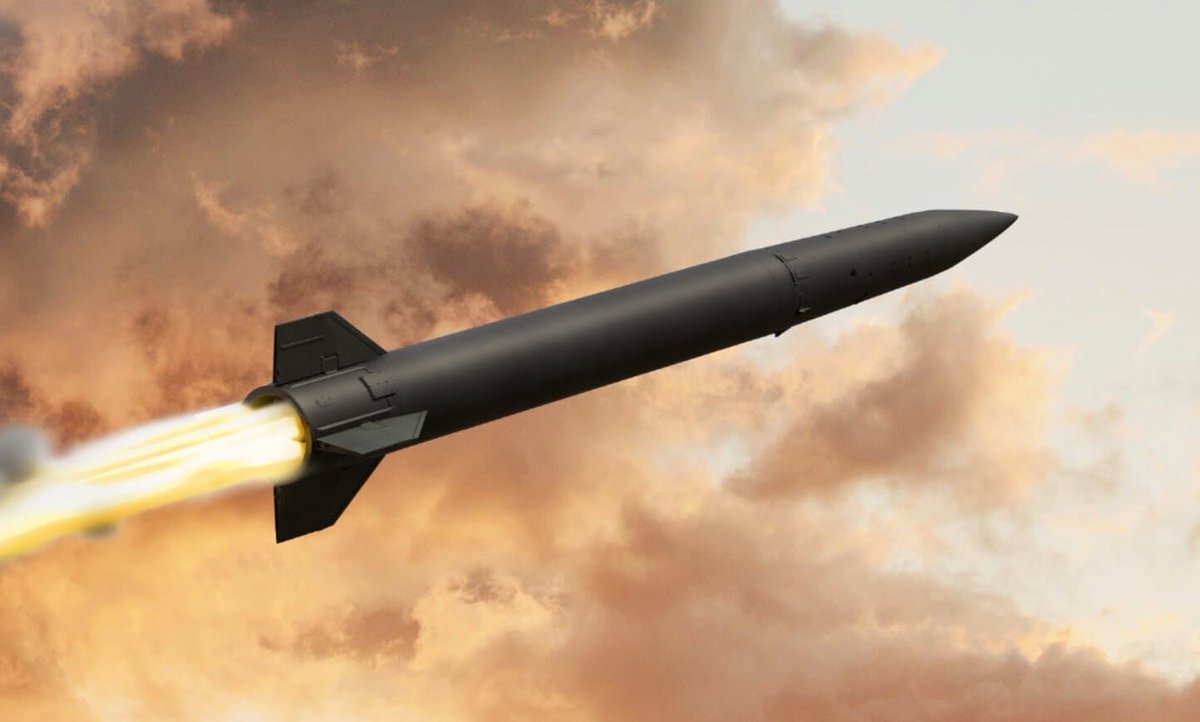
The first combat deployment of the Ukrainian FP-7 ballistic missile highlights the development of Ukraine’s defense industry. Other nations with such capabilities include the US, Russia, Iran, China, and France.
Ballistic missile production is costly due to complex guidance systems and engineering requirements—such as the need to withstand extreme temperatures.
Ukraine’s defense industry also manufactures drones for air, land, and maritime operations, as well as electronic warfare systems, howitzers, and two types of cruise missiles.
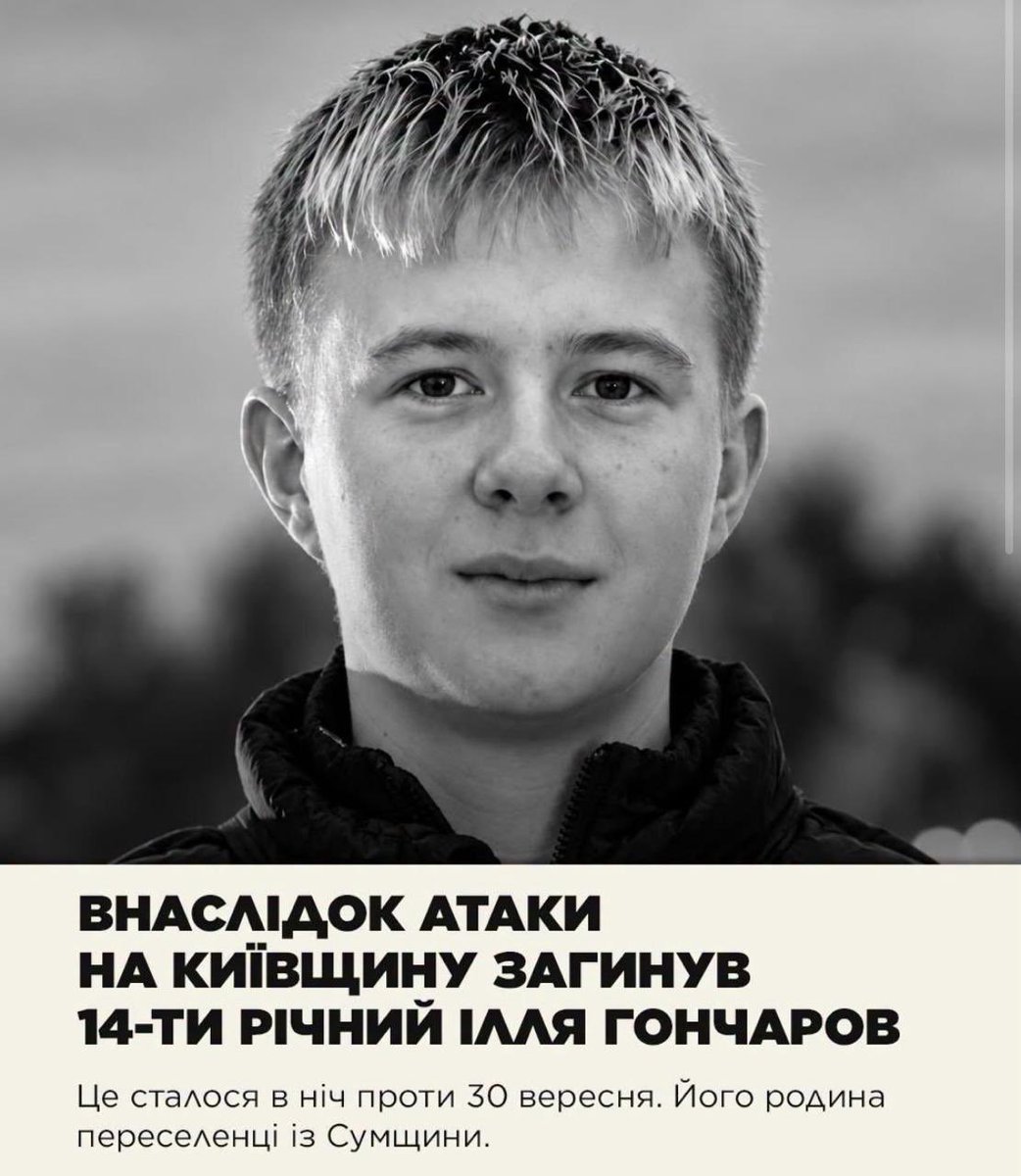
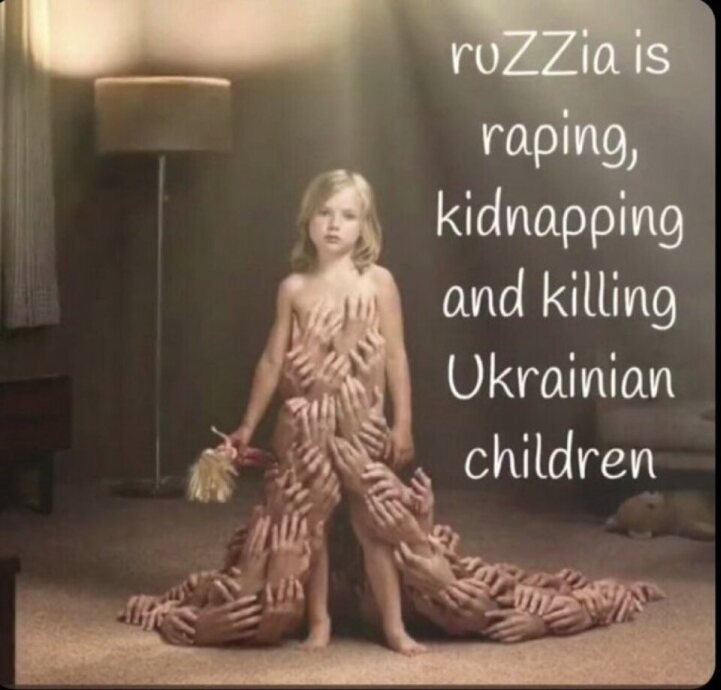
💔 His name was Ilya Goncharov.
He was only 14.
His family fled the constant russian attacks in Sumy region, hoping to find safety near Kyiv.
But the war followed them.
A russian strike destroyed their home in Vyshhorod. His parents and sister were pulled alive from the rubble.
Ilya wasn’t.
Another Ukrainian child who should have had an entire life ahead of him💔
Putin had almost everything he needed to leave behind a very different Russia: enormous oil and gas revenues, an educated population, a powerful industrial base, access to Western technology and investment, and an open world.
A quarter of a century later, the result is very different: war, sanctions, international confrontation, growing repression, and a country increasingly cut off from much of the developed world.
And yet Gorbachev and Yeltsin are still blamed in Russia for having “destroyed the country.”
History can have a very bitter sense of irony.
Historians will be baffled that the West did not close Ukraine’s airspace, if for no other reason than humanitarian considerations.
Russia knows that attacking NATO would mean confronting a military alliance vastly more powerful than Russia.
🇺🇦 Ukraine just put it's own FP-7 tactical ballistic missile into combat
🔥🔥
Test is over. Now comes production.
Ukraine is building its own long-range strike capability. 🇺🇦
Stay strong as you are🫡
(Video: Zelensky _official)
President Zelenskyy:
"From intelligence reports and individuals within Putin's inner circle, we know that in early September Putin declared: 'From now on, there are no rules.' The Russians failed to occupy us, so now they are resorting to massive strikes and mass killings. Naturally, they want to destroy our bridges and, as we understand, our data centers, internet infrastructure, mobile networks, hospitals, kindergartens, schools, universities — everything. They want people to flee their cities, and we must do everything in our power to save our people and our cities."
The Russians made a conscious choice to invade Ukraine, murder their people, & destroy the country.
Ukrainians have no choice. It's fight and win, or die as slaves.
The Russians can end this war now. All they have to do is go back to their country & leave their neighbors be.
Macron: Europe has become too slow compared with China and the US.
Over the past 20 years, Europe has fallen behind the US in GDP per capita.
More than two-thirds of that gap comes from weaker innovation. Europe has to innovate much faster. 1/
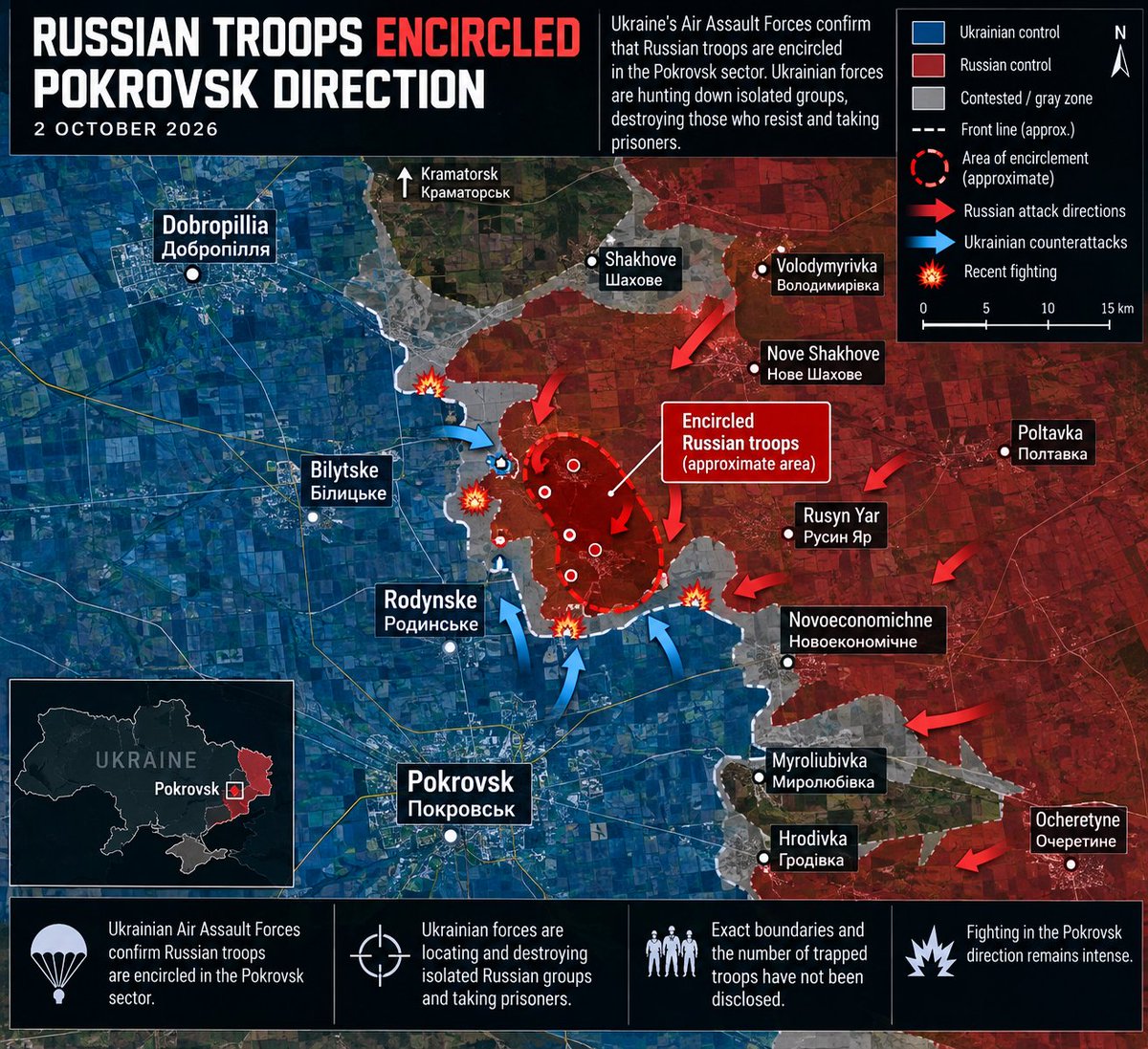
🇺🇦 RUSSIAN TROOPS ENCIRCLED ON THE POKROVSK FRONT
Ukraine’s Air Assault Forces confirm that Russian troops are trapped in an encirclement in the Pokrovsk sector.
Ukrainian forces are hunting down isolated Russian groups, destroying those who resist and taking others prisoner.
The exact location and number of trapped troops have not been disclosed — but the Ukrainian command explicitly confirms that Russian forces are surrounded.
The cleanup is underway.
Putin’s speeches should be listened to through a special filter. Criminal and prison language is now the primary language of Putin’s power.
Therefore, the Valdai speech should be listened to as a kind of street-criminal conflict scenario: "you don’t respect me," "they started it first," "we warned you," "you didn’t get it the nice way," "now we’ll have to respond." This is not just a style of speech, but a ready-made scheme through which the Kremlin explains and justifies escalation.
I would interpret the Valdai speech as follows:
◾️"He started it first." This is the basic scheme of the entire argumentation. Not "I decided to use force," but "I was forced to respond." Putin literally says about Ukraine: "it wasn’t us who wanted it and it wasn’t us who started the war," and then that Russia was "deliberately put" in a situation where it was "forced" to take up arms. This is a classic street-domestic formula for removing responsibility from oneself: violence is acknowledged, but moral responsibility is shifted onto the one who supposedly "started it first."
◾️"He asked for it." The next step is to make the victim responsible for what will happen to them. This is especially visible in the logic regarding NATO: if Western states provide intelligence, technical support, and help Ukraine strike deep into Russia, Putin already defines this as their "involvement in the war with Russia." He does not say that Russia will not strike; he only says that Russia is not going to do it "tomorrow." The structure is simple: if a strike happens, the previous argumentation already allows one to say - "you were warned, you yourselves crossed the line."
◾️"You don’t respect me." The question of status constantly looms behind the security language. Putin returns again and again to the fact that after the collapse of the USSR the West did not accept Russia as an equal, did not listen to its objections, expanded NATO, and supposedly tried to finally weaken Russia. This is very close to the logic of conflict through "disrespect": the problem is not only in concrete harm, but in the fact that the other side demonstrates that it does not recognize your status. In street and criminal culture, precisely the inability to respond to an insult calls status and authority into question.
◾️"For something like that you have to answer." In this logic, a response ceases to be a choice and becomes an obligation. Putin constantly uses precisely such a causal construction: Ukraine started hitting tankers - "we began to respond"; started hitting oil refineries - "got a mirror response." Linguistically this is very close to the concept of "payback": after a certain action the response is supposedly already dictated by the code of behavior itself. The subject does not say "I decided to strike," but "you can’t not respond to something like that."
◾️"If you swallow it - they’ll stop respecting you." This directly links violence to the preservation of status. In yard and criminal culture it is important not only to win, but not to allow a situation where others decide that you can be humiliated with impunity. That is why the question from Lukyanov about European factories is formulated so interestingly: if Moscow has already named them potential targets, "the warning… will have to be confirmed by something." This is pure logic of reputational compulsion: a public threat itself creates a problem, because refusal to realize it under certain conditions can be treated as weakness.
◾️"You don’t understand the nice way." Violence is presented as a last resort after supposedly repeated warnings. In Putin’s narrative about NATO and Ukraine it is constantly repeated: we said "don’t do it," "stop," they didn’t listen to us - and therefore what happened, happened. This is a familiar scenario of domestic violence: "I warned you," "you didn’t get it the nice way." Its function is to turn a conscious choice of aggression into a supposedly inevitable result of the other side’s behavior.
◾️"If they can - then we can too." Here the yard code already directly transitions into a normative theory of international relations. Explaining Yugoslavia, Putin essentially formulates it literally: the West used force, everyone saw that "if someone is allowed to, then everyone else is allowed too." This is a very important pattern. Law or a universal norm stops working here. The main thing becomes the precedent of the other’s behavior: "you violated the rules - therefore I am no longer bound by them." This is already international relations "according to the code."
◾️"It’s not that we’re like that - life is like that." This is another strong Russian domestic formula, although it is not purely criminal. In the speech it manifests through the words "inevitably," "we will be forced," "we have no other way out." Even the possibility of using all means against NATO Putin explains not by his own decision, but by the balance of forces: NATO is bigger and stronger, therefore Russia "will be forced" to use its "competitive advantages." This creates an image of a world where Russia supposedly does not choose escalation - circumstances force it into it.
◾️And there is one more pattern that is very important for the current situation - "the client answers together with the executor" / "you’re fighting with someone else’s hands." Putin literally uses the formula "fighting against us with someone else’s hands" when speaking about Western support for Ukraine. Its practical significance is great: it allows gradually transferring the status of the adversary from Ukraine to the states that help it. Then a European factory, a satellite system, or a military specialist ceases in the Russian construction to be a "third party" and becomes part of the conflict itself.
If this is reduced to one scheme, it sounds almost like a typical yard conflict: "You don’t respect me → I warned you → you started it first → you didn’t get it the nice way → for something like that you have to answer → you asked for it → now don’t complain." This formula allows the Kremlin to simultaneously be the initiator of the next step and psychologically and rhetorically not recognize itself as its author.
And this, in my opinion, has direct significance for assessing the risk of a strike on NATO. A dangerous signal will not necessarily be the phrase "we have decided to attack." It is much more important to watch whether this linguistic sequence is completed: "this is already direct participation in the war" → "we warned" → "they didn’t understand" → "we are forced to respond." In such a linguistic system a decision to strike can be presented not as a new aggression, but as the fulfillment of an already announced "rule of response."