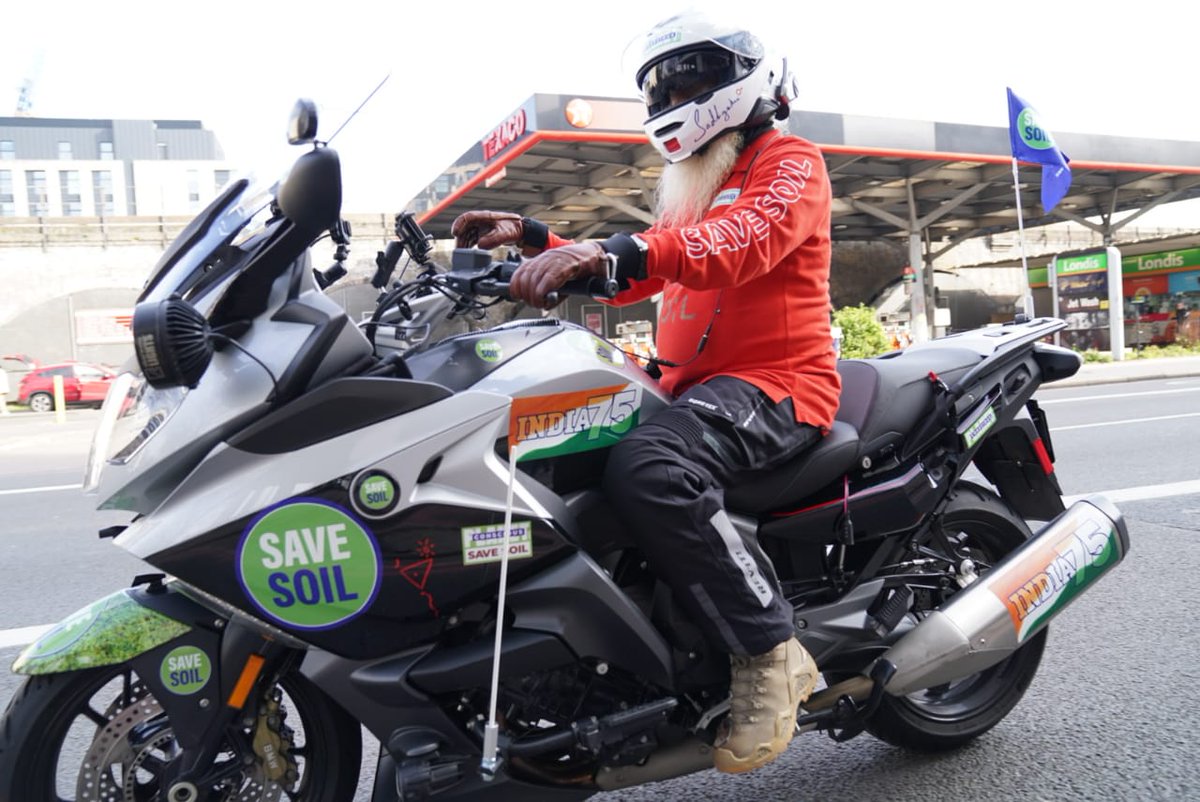
For the next 100 days, the world must reverberate with one energy with one purpose: to #SaveSoil. For every little step you take to make this happen, I will be with you. Talk soil, Sing soil, Breathe soil, Live soil. Save Soil. Let’s make it happen. Be with me. Blessings.–Sg
@cpsavesoil Depaving is such a brilliant solution for modern urban planning! Letting the earth absorb rainwater naturally helps prevent urban flooding while cooling down our cities. 🌱🏙️ #SaveSoil
Many cities are beginning to rethink the ground beneath them.
Depaving removes asphalt and concrete so that soil can absorb rainwater, support vegetation, reduce heat, and help restore biodiversity in urban spaces.
From Genoa to Paris, Copenhagen, New York, and São Paulo, cities are finding ways to replace sealed surfaces with green infrastructure. This is not just beautification. It is a practical response to flooding, heat, and the long-term need for more resilient cities.
Action Now: https://t.co/uVnQCIZBeZ
Source: Re Soil Foundation, “From Genoa to New York: why depaving is reshaping the future of the cities,” 5 June 2026.
A nation’s youth become its greatest strength when courage is guided by conviction and sacrifice is guided by a larger purpose
On the birth anniversary of Shaheed Bhagat Singh Ji, I pay my heartfelt tributes to one of the most fearless young revolutionaries of Bharat’s freedom struggle.
Bhagat Singh Ji chose the path of courage, conviction and sacrifice at an age when most young people were beginning to shape their own futures. His life reminds us that youth is not defined only by dreams, but by the courage to stand for what one believes in and the willingness to dedicate oneself to a larger cause.
For today’s generation, his legacy is a call to think boldly, question fearlessly, live with conviction and dedicate our knowledge, energy and talents to building a stronger and more self-reliant Bharat.
Remembering Shaheed Bhagat Singh Ji with deep respect and gratitude.
- @PawanKalyan
#BhagatSingh #BhagatSinghJayanti
This World Rivers Day, here’s a shoutout to everyone contributing to the revival of River Cauvery — the farmers who welcomed trees onto their land, the teams on the ground supporting them through the year, and the volunteers who continue to show up along the way.
Every tree planted across her basin is a small act of care — holding soil, recharging groundwater, and letting Cauvery flow stronger again.
If a river like Cauvery has ever meant something to you, you’re a potamophile too. 💙 Be part of her revival.
#WorldRiversDay #CauveryCalling #SaveSoil
@cpsavesoil Proof that working with nature doesn't mean compromising on productivity. Lower fuel costs, healthier soil, and equal yields is a massive win-win for farmers and the ecosystem. 🌱#savesoil
An EU-funded project in Sardinia compared conventional plowing, reduced tillage, and sowing directly into undisturbed soil.
The result? Less-disturbed methods matched conventional yields while supporting greater soil carbon, healthier microbial life, and savings in labour and fuel.
Healthy soil is good for both the planet and the farmers.🌍🌾
Citation: Afshar, M.H., Hassani, A., Borrelli, P. et al. Soil degradation in Europe is projected to accelerate under changing land use and climate. Commun. Sustain. 1, 56 (2026). https://t.co/eLdnkQZ23R
A whole grazing world exists beneath the ground.
Soil animals such as nematodes, mites, springtails, earthworms, and millipedes feed, move, and reshape the underground environment. They interact with bacteria and fungal networks, redistribute organic matter, create pores, and influence how carbon moves through the soil food web.
Researchers are now studying how these overlooked organisms affect long-term carbon storage. The more we understand life beneath the surface, the better we can understand soil health.
Action Now: https://t.co/uVnQCIZBeZ
Source: Open Access Government, “The hidden grazers beneath our feet and soil carbon storage.”
Heartbreaking. I was waiting to cheer at what seemed like an assured victory.
But such is the beautiful unpredictability of this game & indeed sport in General…
Keep up your spirit @NihalSarin
The tournament is far from over…
A new study shows that crop residue may do more than add organic matter back to soil.
In an 11-year field experiment in paddy fields, researchers found that returning straw to the field helped increase soil organic carbon. Part of this carbon was protected within soil aggregates, while another part became chemically linked with iron oxides, making it more stable.
The finding points to an important idea: soil health depends not only on what is added to the land, but also on the hidden biological and chemical processes that help retain carbon over time.
Action Now: https://t.co/uVnQCIZBeZ
Citation: Li, B., Huang, J., Liu, L., Li, D., Duan, Y., et al. (2026). Straw return promotes soil organic carbon sequestration through aggregate protection and chemical bonding mediated by iron oxides. Agricultural Ecology and Environment, 2, e018. https://t.co/FnLSA444NL
@cpsavesoil This is incredible research! It just goes to show that the solutions to some of our biggest medical challenges might be right under our feet. We must protect this invaluable resource. 🧫🔬🦠 #SaveSoil#Biodiversity
Soil biodiversity is not only important for ecosystems. It can also open doors for science.
Researchers studying soil-dwelling myxobacteria identified new taxonomic diversity and five new classes of bioactive compounds. Some of these compounds showed antifungal, antiviral, or antibacterial activity.
The finding highlights why microbial diversity matters. The living world beneath the surface may hold compounds and functions that are still unknown.
Action Now: https://t.co/uVnQCIZBeZ
Citation: Agrawal, A., Garcia, R., Chen, G., et al. (2026). Unveiling the Taxonomic Diversity and Unprecedented Biosynthetic Treasure of the Phylum Myxococcota. Advanced Science, e76919. https://t.co/hpfiwjkJ9U
@cpsavesoil Food doesn't come from a grocery store or delivery apps—it comes from the soil. Vital policies need our collective voice before it's too late. Let's keep pushing for 3-6% organic matter in our soils! 🌱 #SaveSoil
Tropical forests cannot be understood with one global rule.
A large satellite-based study found that forests across the Amazon, Africa, and Southeast Asia respond differently to heat, drought, soil conditions, and terrain. Even when climate shifts appear similar, carbon storage can change differently from one region to another.
This matters for climate models and forest protection. Accurate carbon predictions need local data, regional expertise, and long-term monitoring.
Action Now: https://t.co/uVnQCIZBeZ
Citation: Nunes, M., Muller-Landau, H., Görgens, E., et al. (2026). Heterogeneous climatic controls on tropical-forest biomass. Nature. https://t.co/5Gz9BJZ7aU
Keeping soil covered can make a major difference.
In Mediterranean olive groves, researchers found that cover crops reduced runoff, erosion, and the loss of soil organic carbon compared to tillage. The practice helps strengthen soil structure and keeps soil particles from being carried away during rainfall.
For rainfed farms on sloping land, this can support fertility, reduce carbon loss, and make agriculture more resilient.
Action Now: https://t.co/uVnQCIZBeZ
Citation: Gómez-Muñoz, B., et al. (2024). Influence of cover crops and tillage on organic carbon loss in Mediterranean olive orchards. Soil and Tillage Research, 235, 105905. https://t.co/e9g2POCHMm