In app @fomo kols also rugged, Lost everything again in crypto 😭
Lot of rugs and scams in fomo app ,
Fucked up again through fomo app,
Lost entire savings....
Good bye 😢
New day, new updates and new ATH.
The first thing I did was check $CRAWLSCAN with CRAWLSCAN.
CA: 0x19dCb63C4d2F29A6f077F094a4f858fC790145e1
Scored 79.
Same crawlers, same five signals, same hard rules.
There is no branch in the code that treats my own token differently, and the repo is public. Paste the contract yourself and see what comes back.
A scanner that cannot survive its own scan is a landing page with a progress bar.
Now let me tell you what is coming.
Since today, this is the only thing I am focused on. I will release updates daily.
Next is Solana support.
The same methodology on a second chain: holder analysis, operator detection, behavioural clustering, risk scoring, adapted to Solana's infrastructure. This is the one that takes CRAWLSCAN out of a single ecosystem.
Right behind it:
> premium features for token holders
Early project supporters will be rewarded as promised.
> browser extension
Scan a token on the page where you found it, no tab switching.
> telegram bot
Send a contract, get the verdict, the score and the key holder signals back.
Then the part that makes the engine compound:
> operator memory across launches
Today every scan starts from zero. Next it recognises a cluster it has seen before, on a different token, under different addresses.
> launch radar
New launches surfaced automatically when the holder structure looks wrong, before anyone is talking about them.
> wallet profiler
The same intelligence pointed at one address instead of one token.
> watchlists and alerts on tokens, wallets and operators
The core scan stays free and open source.
P.S. I am going live on a Space soon to walk through all of it and answer anything.
I BUILT AND OPEN SOURCED THE FIRST WEB CRAWLER FOR ROBINHOOD MEMECOINS
Repo: [https://t.co/3mGo5WRa5J]
Blockchain shows you wallets but it doesn't show people behind them.
Every scanner you use answers the same four questions.
How many holders. How much liquidity. Is the contract verified. What is the price.
None of them answer the only one that matters:
> how many real people are actually behind those wallets?
A token can show 200 holders while one person holds a third of the float across a dozen addresses. On a holder count that looks like healthy distribution. It is not.
My tool crawls the token's full transfer history since launch and treats wallets as a network instead of a list.
What it checks on every top holder:
> bought vs received
Did this wallet buy on the market, or was it handed tokens.
> virgin wallets
No meaningful history, appeared right around launch.
> history depth
How much this address traded before it touched this token.
> snipers
Who entered in the first seconds, and how much of it they still hold.
> deployer behaviour
What the creator kept, what they dumped, what that does to concentration.
Then it links them. Wallets in the same buy transaction. Tokens originating from the same funding wallet. Direct transfers between holders. Those get merged into one operator cluster.
Fresh wallets entering in the same block with similar sizes get flagged too, but weighted lower, because that is a behavioural signal and not proof.
Infrastructure is excluded on purpose: curve contracts, pools, lockers, routers. Every percentage is measured against real circulating float, not raw balances.
And a 0-100 score built from operator control, virgin share, transfer share, sniper float and top 20 concentration. Hard rules on top, so a nasty concentration number cannot be averaged away into a comfortable score.
Technical side, for the people who care:
> Python 3.12, zero runtime dependencies
> read-only RPC, no private keys, no signing, no custody, ever
> wallet crawlers run in parallel under a hard time budget, so the verdict lands in seconds
> the crawl streams live, you watch it walk the wallets
It is a signal that anyone can use for free now. A clean score means the distribution looks clean right now, not that a token is safe.
MIT licensed. Read it, fork it, break it.
P.S. It compounds. Every scan feeds back into the engine, so the patterns it recognises today are patterns it learned from the launches it crawled yesterday.
The more the network is used, the better it gets at spotting the structures that normally take a human an hour to find.
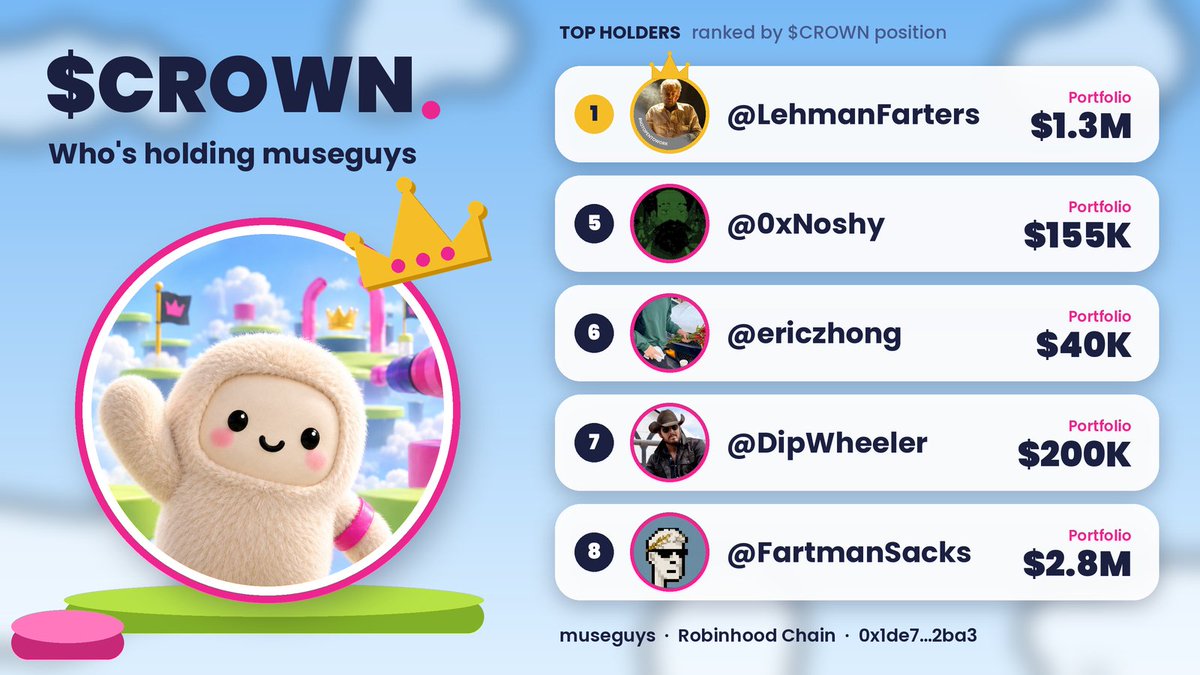
Found @museguysbooyah while trenching in the @bankrbot terminal. Deployed a week ago by @LehmanFarters. Bottomed to 10K and started moving last night. @fomo traders with size started updating theses and socials went live. Paired with robinhood:0x91a2dae9699f0b82540b5886b0d8759c22820ba3
I don't have access to a muse, haven't tested the app.
Notable holders include @0xNoshy, @ericzhong, @DipWheeler, @FartmanSacks.
Could be something. Find it on my fomo account.