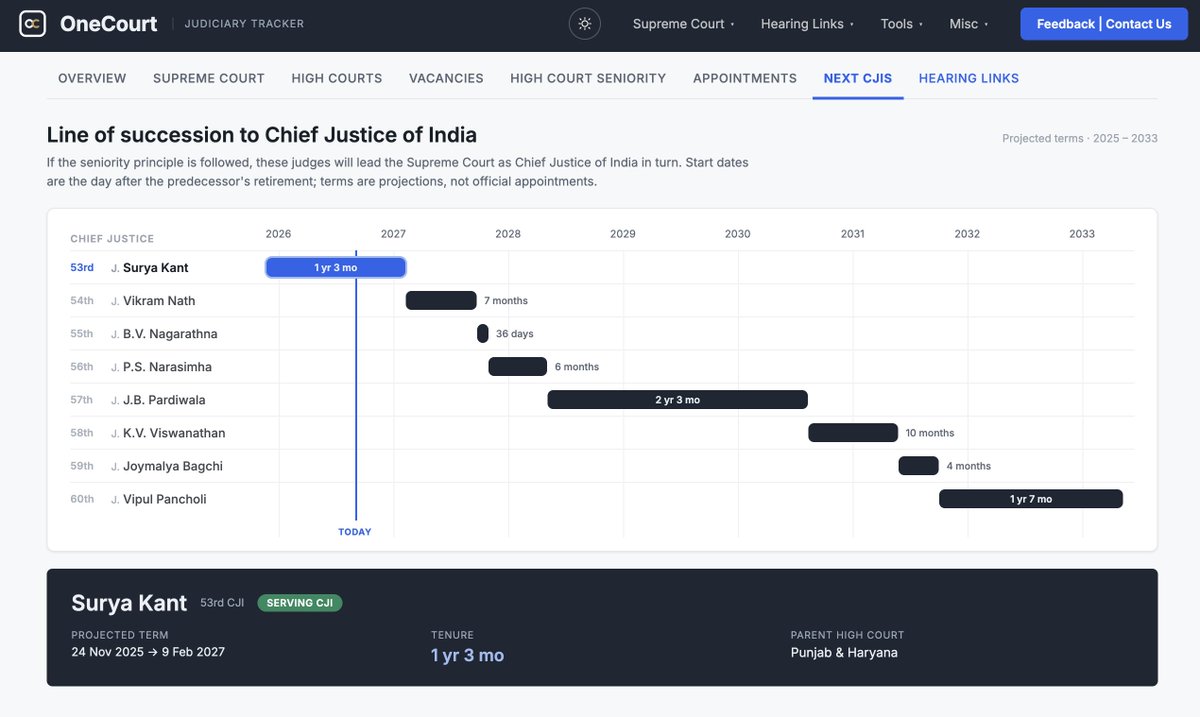
Who will be the next Chief Justice of India, and for how long?
Our Judiciary Tracker maps the projected line of succession through 2033. Justice B.V. Nagarathna, who is projected to become India's first woman CJI, may have a term of 36 days, while Justice J.B. Pardiwala's projected term runs for 2 years and 3 months.
Projections based on seniority, not official appointments.
Explore: https://t.co/MZ95lcbfHv
Court No. 2 (Vikram Nath J. and Sandeep Mehta JJ.) follows with 28 connected matters under a single item (1501), relating to NRC/citizenship proceedings arising from Assam.
Court 7 comprising Dipankar Datta and Sheel Nagu JJ. pronounced judgments in 58 matters across seven items. Through item No. 1504, bench disposed of 49 connected writ petitions concerning madrasah education in West Bengal.
The Supreme Court of India resumed regular sitting today, 13 July 2026, following the partial working days of the summer vacation.
A total of 18 judgments were pronounced in 100 matters are listed "For Judgment" across eight benches.
🄿🄸🄻 🅆🄰🅃🄲🄷
A PIL was filed before the Supreme Court of India seeking a declaration that the SC's directions in its August 22, 2025 order in In Re: "City Hounded by Strays, Kids Pay Price" are unconstitutional, ultra vires, and inoperative to the extent they prohibit the release of "aggressive" dogs without due process.
This PIL was not entertained, and it was dismissed as withdrawn.
Matter: Vineeta Tandon v. Union of India & Anr.
Case No.: Writ Petition (C) No. 1071 of 2025
Bench: Justices Vikram Nath and Sandeep Mehta
UPDATE
Supreme Court asks for suggestions to prevent such issues in future.
Matter remains pending without issuance of notice. Likely to be heard again on December 17.
Today, Supreme Court will hear the criminal contempt petition filed by Supreme Court Bar Association seeking action against advocate Rakesh Kishore who threw a shoe at the Chief Justice of India.
Bench: Justices Surya Kant and J Bagchi
SCBA has initiated criminal contempt proceedings against Kishore under Articles 129 and 142 of the Constitution of India, read with Section 15 of the Contempt of Courts Act, 1971 and Rule 3(c) of the Rules to Regulate Proceedings for Contempt of the Supreme Court, 1975
https://t.co/xIDZdf4bou
AG R Venkatramani, granted his consent on October 26. His letter reads:
"Upon careful consideration of the material placed before me, I am satisfied that the conduct of Rakesh Kishore amounts to criminal contempt of Hon’ble Supreme Court within the scope of Section 2(c) of the Contempt of Courts Act, 1971. His acts and utterances are not only scandalous but also calculated to demean the majesty and authority of the Supreme Court. Such behaviour strikes at the very foundation of the justice delivery system and has the clear tendency to lower public confidence In the Institution of the judiciary, and more so of the highest Court."
Today, Supreme Court will hear the criminal contempt petition filed by Supreme Court Bar Association seeking action against advocate Rakesh Kishore who threw a shoe at the Chief Justice of India.
Bench: Justices Surya Kant and J Bagchi
SCBA has initiated criminal contempt proceedings against Kishore under Articles 129 and 142 of the Constitution of India, read with Section 15 of the Contempt of Courts Act, 1971 and Rule 3(c) of the Rules to Regulate Proceedings for Contempt of the Supreme Court, 1975
https://t.co/xIDZdf4bou
On October 26, SCBA sought Attorney General’s consent. The letter read:
The Executive Committee of the SCBA has unanimously resolved that such a direct attack on the judiciary cannot be overlooked, as it undermines the very foundation of the rule of law. Accordingly, we have prepared a petition for initiating criminal contempt proceedings against Mr. Rakesh Kishore.
PIL prays to declare the collegium system unconstitutional
Janshruti (People’s Voice), an NGO, has filed a PIL before the Supreme Court of India seeking to declare the collegium system for appointing judges to India’s higher judiciary as unconstitutional.
Invoking Article 32 of the Constitution, the petition prays to:
"Issue an appropriate writ, order, or direction declaring that the present opaque and non-transparent system of judicial appointments through the collegium system violates the principles of Article 14 (Equality before Law), Article 21 (Right to Speedy Justice), and Article 39A (Equal Justice and Free Legal Aid) of the Constitution of India."
Read more here: https://t.co/lTu2ur6Amo
Supreme Court adjourns the PIL seeking regulation of the use of AI in the Indian judiciary by two weeks.
Petitioner seeks liberty to implead high courts as parties.
A PIL has been filed before the Supreme Court of India seeking judicial intervention to frame guidelines and policies regulating the use of Generative Artificial Intelligence (GenAI) in the Indian judiciary.
The petition claims that unregulated AI use in judicial functions could violate:
Article 14 (Right to Equality): Due to potential bias and arbitrariness in AI decision-making.
Article 19 (Freedom of Expression): Owing to lack of transparency in how AI systems generate or filter legal information.
Article 21 (Right to Life and Liberty): As GenAI-driven judgments could lack reasoned decisions, violating due process and natural justice.
PIL prays to declare the collegium system unconstitutional
Janshruti (People’s Voice), an NGO, has filed a PIL before the Supreme Court of India seeking to declare the collegium system for appointing judges to India’s higher judiciary as unconstitutional.
Invoking Article 32 of the Constitution, the petition prays to:
"Issue an appropriate writ, order, or direction declaring that the present opaque and non-transparent system of judicial appointments through the collegium system violates the principles of Article 14 (Equality before Law), Article 21 (Right to Speedy Justice), and Article 39A (Equal Justice and Free Legal Aid) of the Constitution of India."
Read more here: https://t.co/lTu2ur6Amo
This PIL will be heard by a bench comprising Justices Surya Kant and Joymalya Bagchi on November 7.
The petitioner, a law student, seeks to appear in person.
PIL before Supreme Court seeks a declaration that:
"Rule of Law and the Supremacy of the Constitution of India prevail over all forms of legislative or executive action, including any law, notification, or order that undermines the fundamental rights guaranteed under Part III of the Constitution."
It also wants struck/read down "...Paragraph 3 of the Constitution (Scheduled Castes) Order, 1950 that violates the fundamental rights of citizens on the ground of religion."