Perhaps, but the Q1 report also shows why buyers are cautious. Net income fell to $7.3M from $25.7M a year earlier, adjusted net income fell to $10.9M from $27.4M, and gross margin fell to 58% from 61% because of growth investments, supply-chain costs, and operating costs.
Analysts have cut targets and at least one firm downgraded the stock after Q1. Oppenheimer downgraded TMDX to Perform after Q1 results, while Stifel later cut its target to $75 from $85 and cited heart-market weakness and competitive-position concerns.
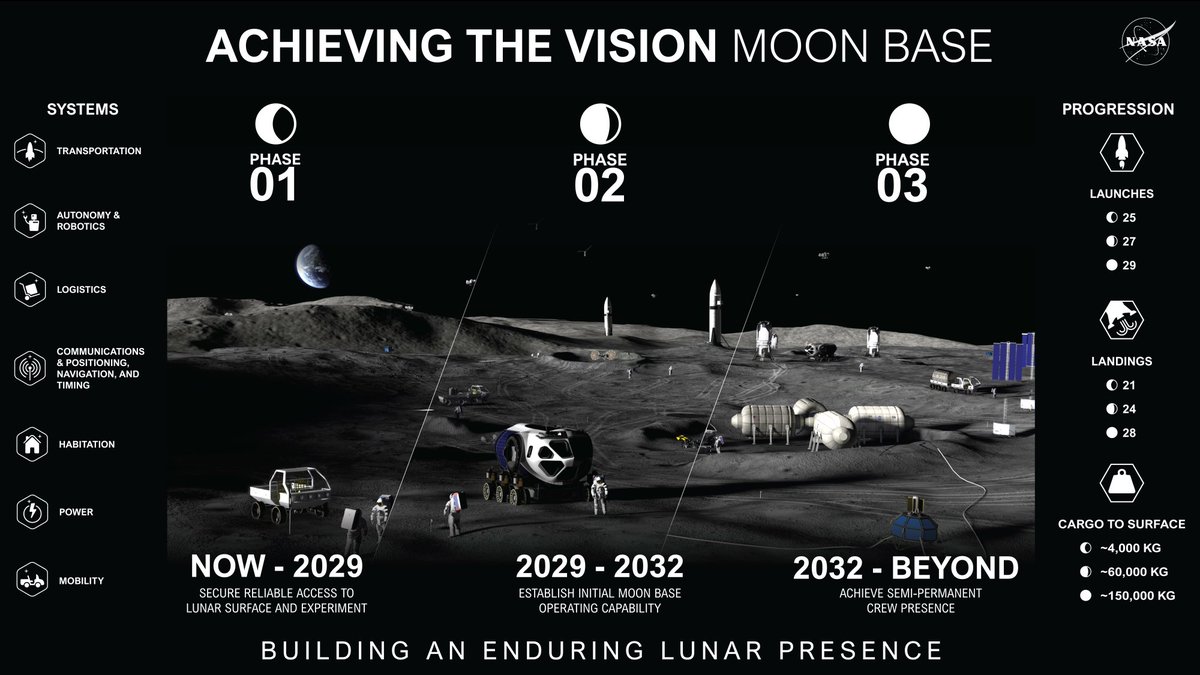
NASA just officially unveiled their master plan for a permanent Moon Base at the lunar South Pole
This is not just about flags and footprints. NASA is moving to establish an enduring, sustained human presence, and they are heavily relying on commercial innovators to build it
The roadmap is highly aggressive:
• Phase 1: Heavy robotic missions and commercial payload deliveries
• Phase 2: Semi-permanent infrastructure, including fission surface power and lunar drones
• Phase 3: A sustained, permanent human outpost
The most important takeaway is NASA explicitly stated this base is the ultimate proving ground to prepare humanity for missions to Mars
While legacy aerospace companies are still struggling to reliably get a small capsule to the ISS, NASA is setting the stage for massive lunar infrastructure....which is exactly the kind of heavy-lift planetary deployment SpaceX’s Starship was designed for
The multi-planetary economy is officially kicking off
The market is now clearly under pressure from yields. SPX and Nasdaq are pulling back from last week’s highs, but VIX is still below 20 and there is no confirmed bottom. Credit spreads are widening mildly, which argues against buying too early.
The China tariff-relief headline is real and mildly bullish, but it is not yet strong enough to overpower the macro shock from oil above $100, 10Y yields near 4.6%, and CPI at 3.8%. For Monday, I would expect headline-driven two-way trading, with upside capped unless oil/yields cool.
Forget killing cancer cells. South Korea just figured out how to talk them back into being normal.
Scientists at KAIST in Daejeon have done something the world has been chasing for decades.
They found a molecular switch that flips cancer cells back into healthy cells.
No chemo. No radiation. No destroying anything.
Just… reversal.
Professor Kwang-Hyun Cho and his team caught cancer in the act. That tiny window where a normal cell is on the edge of turning malignant but hasn't fully crossed over yet. They call it the "critical transition" — the same kind of jump that happens when water hits 100°C and becomes steam.
In that split-second window, the cell is unstable. Normal and cancerous at the same time.
And that's exactly where they hit the switch.
In colon cancer trials, they targeted three master genes — MYB, HDAC2, and FOXA2 — and the cancer cells didn't die.
They went back to being healthy intestinal cells. Like nothing ever happened.
The team built a digital twin of the gene network to map every move a cell makes on its way to becoming cancerous. Then they reverse-engineered the path home.
Their paper landed in Advanced Science, published by Wiley.
It's still early. Lab trials and mice. Human treatment is years away.
But the idea of curing cancer without killing a single cell is no longer science fiction.
Source: KAIST (Korea Advanced Institute of Science and Technology), published in Advanced Science journal
How can anyone defend this horrendous cruelty in the name of science
EXPOSING THE TRUTH: INSIDE YORK UNIVERSITY’S PRIMATE LAB
Leaked whistleblower footage from York University has exposed the harrowing reality for research macaques. Recorded between 2024 and 2025, the evidence reveals primates living in extreme distress with severe physical trauma, including metal posts protruding from their heads and bleeding surgical sites. In one tragic instance, a macaque named Kenny was forced to rip out his own brain implant after hours of agitation and pain.
The evidence further highlights profound psychological suffering, with animals constantly pacing, swaying, and struggling against restrictive neck collars. Neglect reached such a level that animals were filmed drinking their own urine due to acute dehydration, while lab records since 2009 document over 15 escapes and chronic infections. Although the university maintains it complies with regulations, independent experts have condemned these conditions as inhumane, prompting a formal inquiry by the Canadian Council on Animal Care.
#AnimalRights #EndAnimalTesting #YorkUniversity #Whistleblower #AnimalWelfare
@LarryNieves@mb_ghalibaf@IrnaEnglish That's your shallow interpretation. Near 90% of Iran's trade typically goes through the Strait of Hormuz. Controlling the "door" is what matters. The rest is irrelevant.
Or you just sell it for big profits after years of appreciation vs China: depreciated structure, no land ownership to sell, etc. Also, just because China housing is depreciated and cheap now doesn't mean it won't continue to depreciate in the future... just like leasing a car forever.
CO2 just hit ~430 ppm at Mauna Loa, highest in ~3M years, yes. But mid-Pliocene levels were already ~350-425 ppm with ~2-3°C warmer temps and higher seas over hundreds of thousands of years, not decades. Today? NASA satellites show Earth greening massively (CO2 fertilization = ~70% of it, equivalent to 2x USA in extra leaves). Crops love it. Extremes aren't exploding. Sea level rise ~3mm/yr, steady.Warmer world with more plant food isn't the apocalypse. It's observable biosphere benefit. Adaptation > panic.
Many economists, governments, and media outlets (including the IMF in many contexts) treat nominal GDP as the default for "largest economy" discussions because it reflects convertible economic power and global market weight. China has led in PPP since around 2016–2017, but the US is still described as the world's largest economy in nominal terms.
@viennoiscafe I'm sorry, but you're wrong about Marx's theory of value and labor. In fact, Marx wrote that value is a purely social phenomenon, a relation between people (their labor) that appears as a property of things due to commodity fetishism.