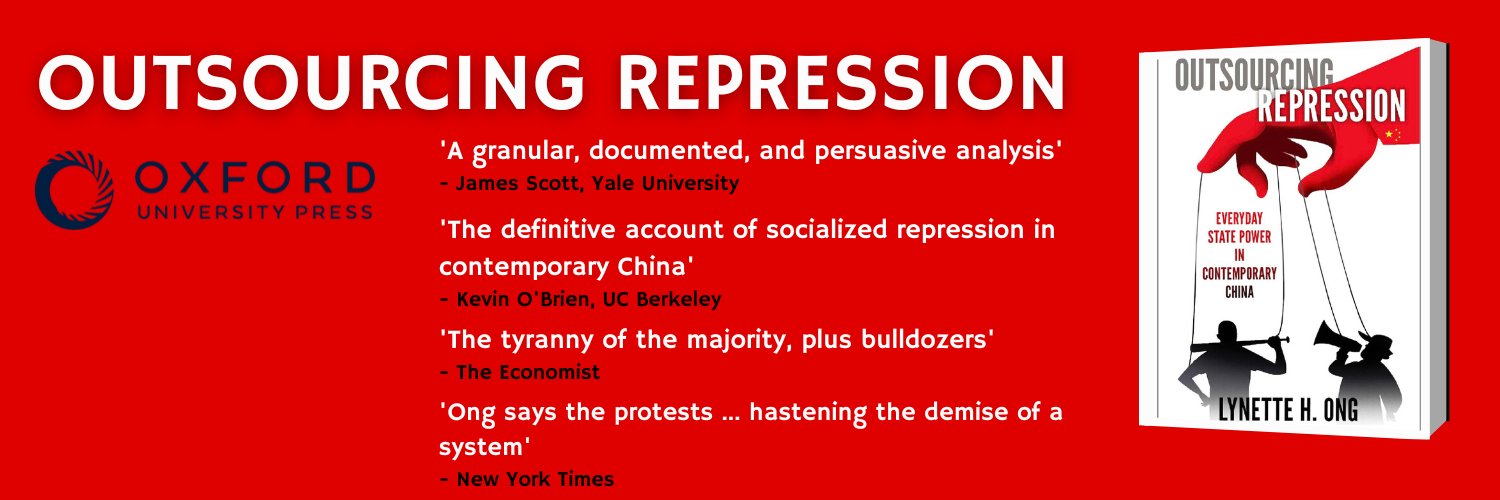
I am thrilled that "Outsourcing Repression: Everyday State Power in Contemporary China" I spent a decade working on is forthcoming @OUPPolitics @OxUniPress!
Available for pre-order now for shipping in mid-March: https://t.co/55e5oUYVts.
#OutsourcingRepression Short thread.
Since the mass protests of 2019, #HongKong's institutions, civil society, media, demographics and business environment have radically shifted. Join Xu Xi, @MarkLClifford, @AnnaKwokFY, and Simon Elegant to reflect on the city's past, present, and future.
https://t.co/aH7R0r8C3E
Today, Canadians honour the memory of all who lost their lives, were injured or went missing during the Tiananmen Square crackdown on June 4, 1989. Canada stands with the survivors and the families and loved ones who continue to demand accountability.
@nytimes ran a story on masking by ICE agents and asks a bunch of political scientists, including myself, who study authoritarian regimes what that means in comparative context.
"In China, the security forces do not wear masks ... But something else happens. In her book, “Outsourcing Repression,” Ms. Ong explains that China’s everyday security policing force draws from ordinary people mobilized from the street and paid a daily rate or hired on a contract. The state does not formally employ them, and when they are caught harming someone, the government can plausibly say it was not responsible. China may be authoritarian, she said, but public officials can be held accountable for abuse. They can be fired, for example, if their forces are caught on camera beating people up."
https://t.co/sjenshpw5H
Recordando a Raúl Pacheco-Vega
Una de las pasiones de Pacheco-Vega eran los métodos de investigación. En esta red compartía sugerencias y los libros que compraba.
Este artículo muestra cómo abordaba el estudio de comunidades vulnerables.
Acceso abierto: https://t.co/f66LgWNmVd
@almaldo2 English translation of the article here:
The death of Raúl Pacheco Vega, an academic at FLACSO, is under investigation.
https://t.co/ILeCxJ9LNE
Me parece que ahora hay que pasar de la tristeza a la exigencia de justicia por el crimen de Raúl Pacheco-Vega, según lo consigna esta nota. No puede ser un asesinato más que queda impune en este miserable país. Ir hasta a las últimas consecuencias.
https://t.co/3QjCK92EZW
@nytimes ran a story on masking by ICE agents and asks a bunch of political scientists, including myself, who study authoritarian regimes what that means in comparative context.
"In China, the security forces do not wear masks ... But something else happens. In her book, “Outsourcing Repression,” Ms. Ong explains that China’s everyday security policing force draws from ordinary people mobilized from the street and paid a daily rate or hired on a contract. The state does not formally employ them, and when they are caught harming someone, the government can plausibly say it was not responsible. China may be authoritarian, she said, but public officials can be held accountable for abuse. They can be fired, for example, if their forces are caught on camera beating people up."
https://t.co/sjenshpw5H
@onglynette Ong: “ICE agents, in a way, are like chengguan in China where they somewhat belong to the state but also do not belong to the state. It has reached a point where the U.S. government right now is more or less like the Chinese government 20 years ago.”
https://t.co/b07LbbTCt5
NEW: Xinjiang has the highest detention capacity in the world, according to FT analysis - enough space for almost 1 in 40 people in the region - more than five years after the Chinese govt announced the camps had closed.
BREAKING: Just days before the June 4 Tiananmen Massacre memorial, the Museum in Los Angeles was broken into, with numerous exhibits vandalized and destroyed. China’s transnational repression cannot be tolerated and must be addressed swiftly.
“Chinese officials told The Times they acted against Ms. Wang, a China correspondent for the paper since 2020, in response to the appearance by video of Taiwan’s president at a Times DealBook summit in New York in December; Ms. Wang played no role in the event.
But Chinese officials had complained for months about Ms. Wang’s coverage, which focused on the lives of ordinary Chinese people and often addressed sensitive matters such as censorship, Beijing’s unpopular response to the coronavirus pandemic and the steady expansion of China’s security state.”
After China Orders a Times Reporter to Leave the Country, the U.S. Reciprocates https://t.co/vUsVikUuTb via @NYTimes
.@onglynette: “The Chinese party state is powerful not because of its bureaucracy per se, but because of its capacity to mobilize society by outsourcing challenging policy implementation and repression to non-state actors. That is where its power lies.”
https://t.co/b07LbbTCt5
"“Bilateral relations have set sail anew, exchanges and cooperation across all fields have been fully restored and the major economic and trade concerns of both sides have been properly addressed,” Mr Wang told his Canadian counterpart Anita Anand, according to the Chinese foreign ministry.
“The two sides agreed ... to resume consultations on political and security issues at the foreign ministry level, as well as high-level dialogue on national security and the rule of law,” the statement said."
https://t.co/ru0iEaynuU
I haven’t seen any. My earlier point is Vivian Wang was kicked out because of her reporting on what I’d call “everyday repression”: Covid measures and neighborhood surveillance, rather than on Taiwan as some presses have reported. V few journalists are doing the former now.