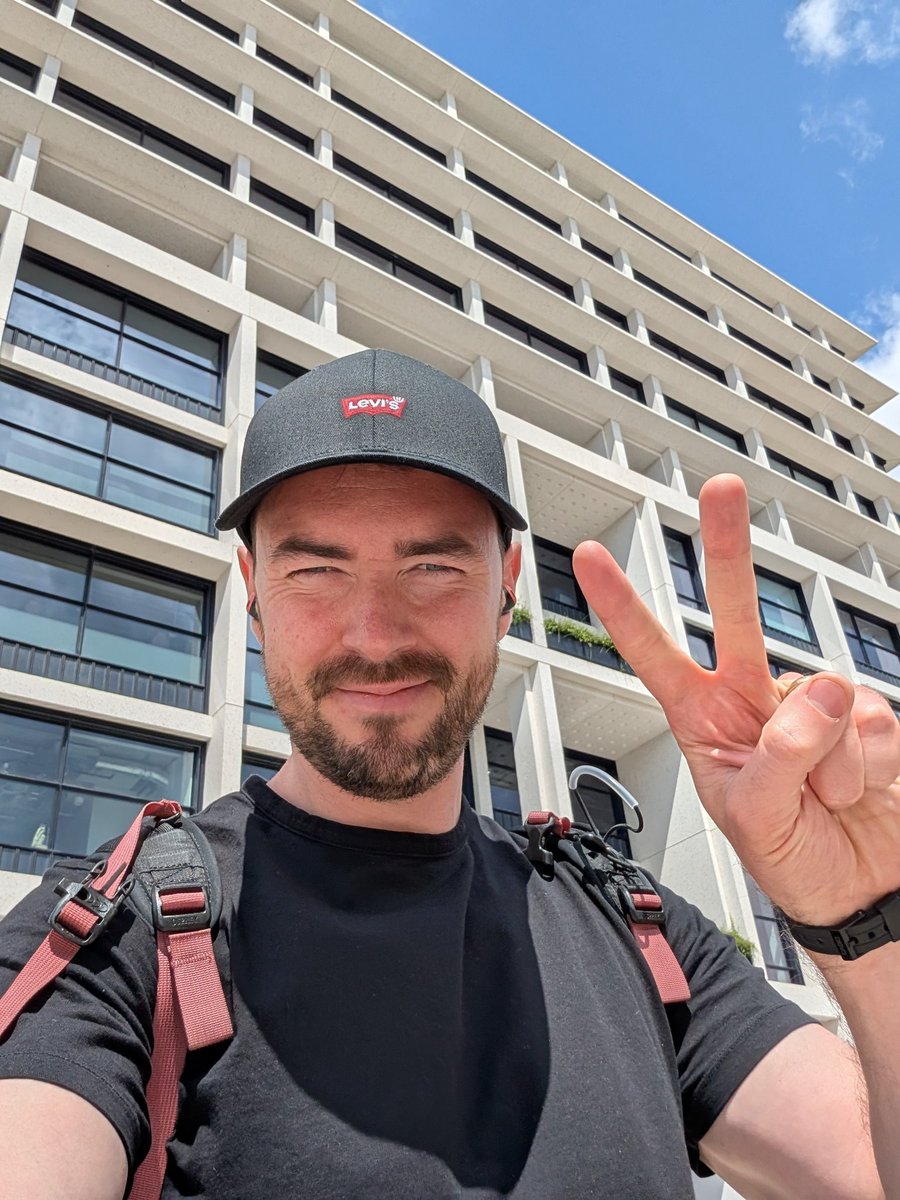
Just landed in NY for this investor demo. Very excited to show our tech - but I have to admit I’m equally excited to visit this iconic @FosterPartners New York jewel!
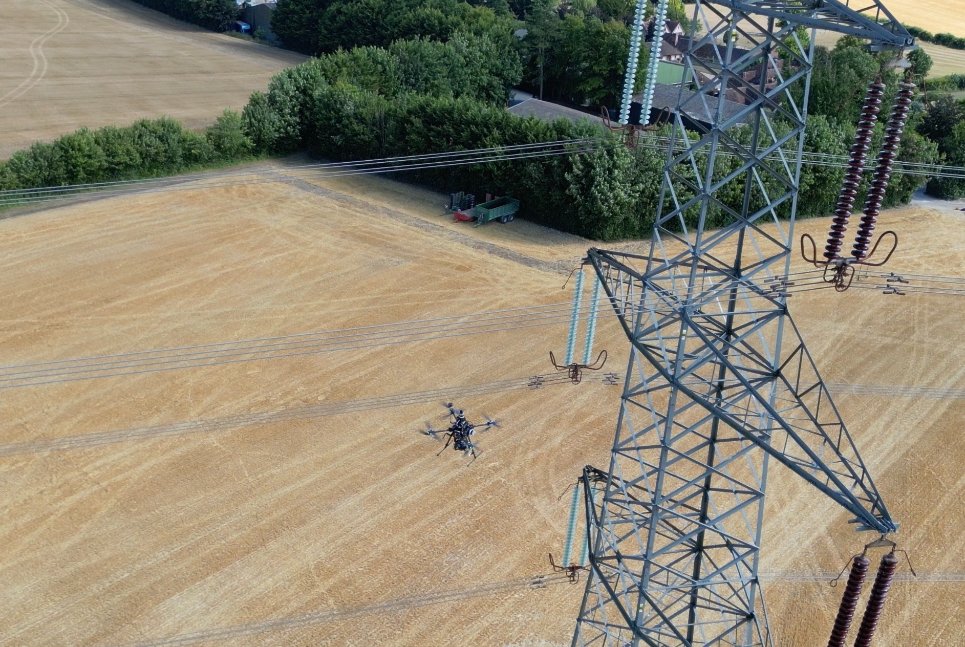
Tomorrow at Hearst Tower, investors will see the https://t.co/dGtothSfc6 platform perform a live autonomous inspection of UK transmission infrastructure, supervised from New York. A demonstration of how asset intelligence can scale as grid investment accelerates. #ElectricityGrid
OK, that's it for today. In just 4 hours, a fully functioning replacement for Evernote, with strict encryption/privacy with both server and front end working very well.
Will be back tomorrow with the android app...
https://t.co/ztxQ5RKmi2
Different people are wired differently, but I basically agree.
Salesforce and Oracle were indeed built by money-motivated men. But Apple and Twitter were art projects. SpaceX and Tesla were engineering feats. And Bitcoin and Zcash are ideological campaigns.
So: money is a metric, but not the only one, and the “capitalism” part of technocapitalism has been stressed a bit too much in recent times. Because the drive to make great art, to advance science, to win in a just cause, will always produce more peak energy than the merely pecuniary. But then, on a daily basis, you have to eat too.
I think of it like cross country skiing. Sometimes you’re advancing with the right ski, and sometimes the left. So when the cause hits a setback, at least there’s a paycheck. But when there is no paycheck, you are driven by the righteousness of your cause.
Elon Musk: Just by adding stationary batteries to the grid, we could double the electricity production in the United States.
“If you look at the total U.S. power generation capability, it's roughly a terawatt, but the average power usage is less than half a terawatt. That's because there are big differences in power usage between day and night.
So, the daily and seasonal variations in power consumption mean that the United States, and really every country, is only producing about half as much electrical energy as it could. Because without batteries, there's no effective way to buffer the energy.
So, what batteries actually enable is even if you don't build any incremental power plants, you could double the energy output of the United States just with batteries. This is a super big deal. And in fact I think that's really where most of the incremental energy production in the United States is going to come from, is literally batteries. So a bigger deal than it may seem.”
Tesla Shareholder Meeting, November 6, 2025
Electricity Production Capacity
US: 1 TW
China: ~3 TW
By 2050
US: 2 TW
China: ~9 TW
China is building 26 and planning for 300 nuclear reactors.
AI is all electrical power. Imagine the scale.
Wonderful analysis from the All In Podcast (highly recommended)
The U.S. is facing a 20% power shortfall for data centers by 2028, which translates to 13-44 gigawatts of missing capacity right when AI demand hits critical mass.
Look at this electricity generation chart. The U.S. is basically flat-lined for two decades hovering around 4,000-4,500 TWh annually while China exploded from 1,400 TWh to over 10,000 TWh. The grid infrastructure hasn't even kept pace with normal industrial demand. Now you throw AI into the mix and electricity consumption for data centers is projected to jump from 7 TWh in 2023 to 393 TWh by 2028. The grid needs 80 GW of new capacity annually just to survive what's coming, but it's only adding 40 GW. We're running a 50% infrastructure deficit, and AI demand hasn't even peaked.
Getting a new power line built and connected takes roughly three to seven years depending on the region. Building a data center takes two years. Getting power to it takes five to ten. The mismatch creates a structural bottleneck and bottlenecks create pricing power. Microsoft's CEO literally admitted to us that GPU idling from power constraints.
This is where the opportunity lives, Morgan Stanley projects power equipment designed for next gen AI racks will trade at a 10x premium by 2027. The value per watt is expected to double. Bitcoin miners are already pivoting operations to AI computing hubs,and neocloud partnerships with long term powered shell leases are popping up as emergent value models.
The real money is positioning into power infrastructure plays, nuclear reactor developers, and any firm with existing grid assets or high voltage equipment manufacturing. The big hyperscalers will eventually throw more and more money at this problem unlike we've ever seen before.
Hi network, anyone got a recommendation for a senior, UK-based HR professional with deep experience in startups?https://t.co/kh05q1HbaC
Boeing-backed company developing & deploying autonomous aerial systems for critical national infrastructure, starting with the grid.
Hi network, anyone got a recommendation for a senior, UK-based HR professional with deep experience in startups?https://t.co/kh05q1HbaC
Boeing-backed company developing & deploying autonomous aerial systems for critical national infrastructure, starting with the grid.
💡 U.S. electric utilities are now out-investing every other major sector [except AI capex which isn't comparably defined]
Record $178B in capex in 2024 — 13th year in a row.
🔌 Grid upgrades, AI data center demand, and manufacturing reshoring are driving it.
After 5½ years, yesterday marked my last day at Meta.
For those who may not know, I joined via the acquisition of my previous company, where we set out to build a continuously-updating 3D model of the world, enabling devices to understand where they are and what’s around them.
Together with @hulahuub, we believed a unified frame of reference was key to unlocking the next generation of spatial computing applications, from augmented reality to robotics. While we may have been early, it's clear the Cambrian explosion is now beginning—driven by general-purpose AI and a growing network of context-rich sensors.
At Meta, we continued that mission with LiveMaps: a visually, semantically, and physically predictive model of the world, collaboratively built by the devices that use it. It’s a bold vision led by @rapideRobot, and I’ve been incredibly lucky to work alongside him, @mingfeiy, @jajuengel, and the broader Surreal team in Reality Labs Research.
Despite a rocky start (we joined in Jan 2020 👀), I’m proud of the impact we had—kickstarting the @meta_aria academic program, and leading open science efforts to accelerate AI and ML research.
I’m especially proud of our work on the Aria Synthetic Environments and Aria Digital Twin datasets, which pushed the envelope for digital twin research and highlighted the importance of both real and simulated data for Spatial AI. Our team’s work on SceneScript demonstrated the first method for auto-regressively predicting the structure of an environment using end-to-end learning—recently extended by SpatialLM: https://t.co/1BAzXuq8yI
Last year, my family and I relocated to Redmond, Seattle, to spend time closer to Reality Labs Research HQ. While there, I had the chance to tick off a career ambition: delivering a “Mother of All Demos” to MZ and the board. This demo will stand among the defining breakthroughs in human-computer interaction and I’m bullish to watch how the company will execute over the next decade.
As for what’s next, my wife and I recently had our second child, and I’m taking some time to reset back in London—recalibrate my sensors, defrag my hard drive. As a colleague put it: “The grass is always greenest where you water it.” I’m looking forward to doing exactly that here in Europe— taking some time to spend with family and reflecting on the next big thing.
If you're a founder, researcher, or operator working at the edge, please ping me a message, I’d love to connect.
LFG! 🚀🇬🇧💪
Sam Altman says "eventually, the cost of AI will converge to the cost of energy."
Robots can build chips, optimize networks, "but an electron is an electron."
In the end, intelligence will scale as far as the grid allows.
Super important development. This trend has to establish and grow if the UK is to build upon its success as the western world’s #2 venture ecosystem behind the US.
And at such a critical time too as the world enters another period of huge acceleration and change.
Historically, the top UK and European startups have HAD to move to the US to get larger rounds of funding.
We are slowly, finally, starting to see that change, with bigger Series-A and Series-B rounds happening in the UK.
I discussed this and other topics in a recent episode of Upside with @danbowyer, @madsnjensen, @lomax_ward, and @DilekDayinlarli. Full episode in the comments section.





![ShanuMathew93's tweet photo. 💡 U.S. electric utilities are now out-investing every other major sector [except AI capex which isn't comparably defined]
Record $178B in capex in 2024 — 13th year in a row.
🔌 Grid upgrades, AI data center demand, and manufacturing reshoring are driving it.](https://pbs.twimg.com/media/Gw89gmRWAAARsk1.jpg)