Debunking Hyperliquid FUD (Part 1: HLP, liquidations, and platform guarantees)
It's sad to see coordinated misinformation campaigns targeting Hyperliquid, which have led to widespread misunderstanding of what we are all working so hard to build.
In response, this series of posts provides detailed, factual explanations of how Hyperliquid works. As a community, we must actively fight FUD by spreading the truth. The tone with which we do this also matters: the best way to grow as a protocol and ultimately house all finance is to remain humble and welcome more users into the ecosystem.
--
The first post focuses on HLP and liquidations on Hyperliquid.
High level summary
The FUD is that the Hyperliquid protocol is subject to large losses stemming from manipulation. On the contrary, Hyperliquid's margining design mathematically guarantees platform solvency. Note that HLP’s losses are isolated to the vault itself, and Hyperliquid does not depend on HLP’s operation to exist. This was true even before the JELLY incident. After the JELLY incident, there is an additional change to protect HLP from losses during backstop liquidations. The fundamental changes are to HLP, not the platform itself.
HLP background
HLP is a permissionless protocol vault pioneered by Hyperliquid. HLP does not collect fees from depositors, and historically has returned 60M USDC in pnl to its depositors. On CEXs, this profit typically goes to the internal market making desks instead of users.
HLP plays two roles: market making and backstop liquidations. In terms of market making, HLP runs a passive strategy that accounts for less than 2% of Hyperliquid's total volume. The vast majority of volume on Hyperliquid is between two non-HLP users.
Liquidations
On Hyperliquid, liquidations are first sent to the book as a market order. This allows any user to participate in providing liquidity to liquidations, which is profitable flow on average. On other exchanges, this flow is internalized by the exchange as a revenue source.
HLP only performs backstop liquidations, which involves taking over positions that are unable to be market liquidated. When account values go negative, the last resort for platform solvency is auto-deleveraging (ADL). ADL closes underwater positions against the most profitable and highly leveraged positions on the other side, ensuring the protocol's solvency. ADL is extremely rare but importantly targets the attacker's position on both sides during manipulation attempts as described below.
JELLY incident
An attacker recently attempted to exploit HLP by opening a large long and short against themself. Open interest caps allowed a position worth 4M USDC at the time of trade, but the logical issue was that HLP collateralized the liquidation with its full balance. It is false that the platform itself had solvency risks, but HLP was indeed overexposed to the manipulation.
Changes made
Now the liquidator component vault of HLP has capped collateral, limiting its potential loss by backstop liquidations. A historical analysis was conducted based on this new system. Apart from the JELLY incident, this change would not have caused additional ADLs in the past, even during extreme volatility. However, it would have minimized HLP’s losses during the JELLY incident to low six figures, which is far less than the attacker spent on market manipulation. In particular, ADL would have closed the attacker’s momentarily profitable long position, leaving other JELLY positions untouched.
Validators now actively discuss delistings in an open governance forum on Discord. Several interesting dashboards have been created by users and validators: https://t.co/szhzxLnfr5, https://t.co/nvOxx9UfEV.
Market cap of the underlying spot assets will likely be an important input into delisting considerations. While delistings are important to ensure that users on the platform do not suffer from potential price manipulation, they are not required for platform solvency.
New state of margining system and HLP
Hyperliquid still functions as before, handling under-collateralized positions in the order of 1) market liquidations 2) backstop liquidations 3) ADL. Backstop liquidations on HLP now have additional protections to cap the total losses, making mark price manipulation attacks more expensive than the limited available gain from HLP. HLP's role continues to shrink as Hyperliquid grows, and at this point is nonessential to the protocol's operation. HLP still exists as a source of protocol yield through backstop liquidations and providing consistent background liquidity.
I think Hyperliquid has a real chance to concentrate flows in 2025.
Solana FTX Estate is now unlocking with more circulating supply available with the intent to sell. Many funds and family offices continue to be overweight Ethereum now looking to diversify out as bag holder bias slowly erodes.
Outside of this basket the only real contender is the L1 vertical is Hyperliquid. Reasons why:
> Immaculately concepted TGE
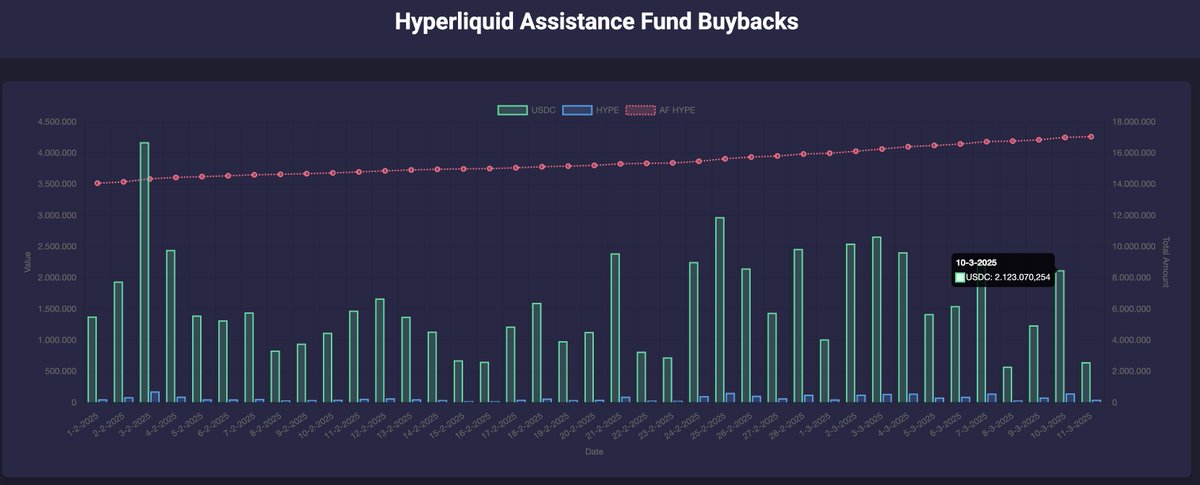
> Essentially all revenue directed to HYPE buyback ($7-17.5M per week)
> Largest revenue generating protocol outside of Stablecoin Issuers
> Expansion into a vibrant L1, spot markets and potentially equites and a native stablecoin
> Best bet on teams execution ability
> Zero supply hitting the market until Dec 25
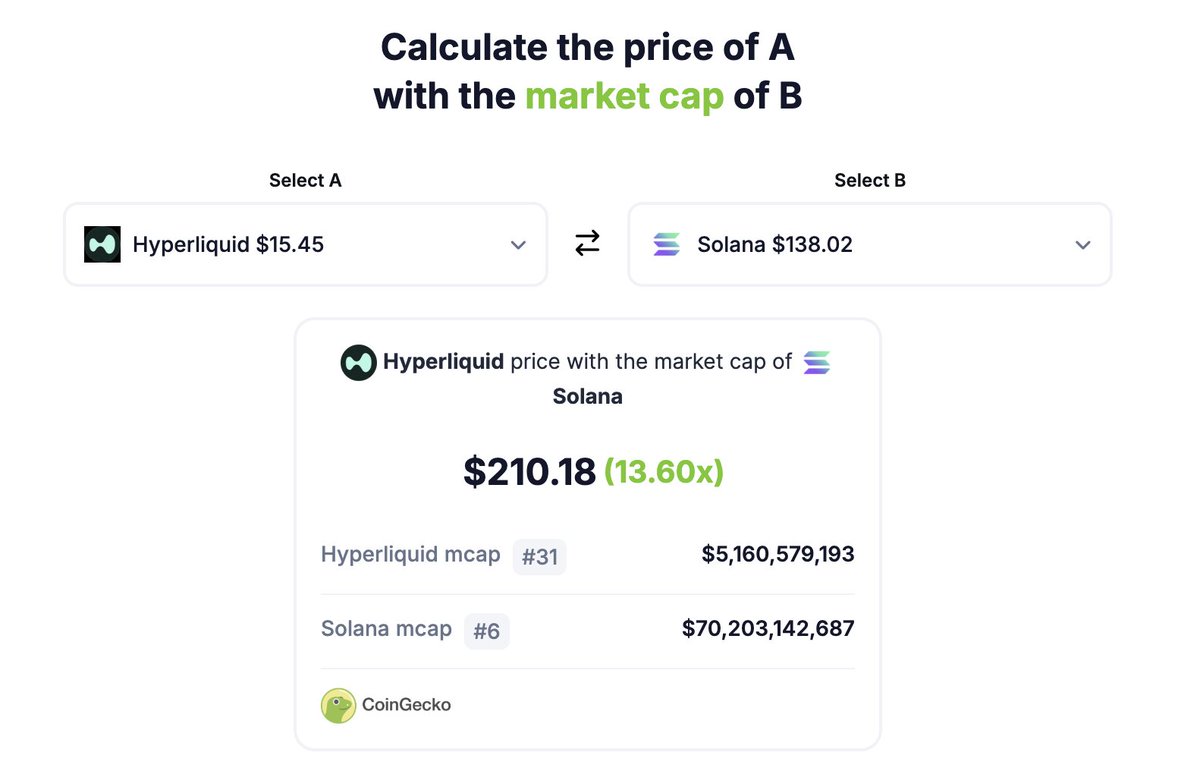
> Trading at much lower multiple than all L1s
Solana went to 70B market cap on it's first rally and would argue Hyperliquid is a much more superior product in it's initial stages and has the potential to earn multi-billions in revenue annually. If market conditions are conducive to risk then I don't see why in 12 months we cannot get to 30-50% of that.
Not financial advice for those who cannot stomach volatility.
Hyperliquid
$HYPE