East Coast/2nd Gen P.I.(ret)/Entrepreneur/Master Fabricator/Carpenter/Ex-Music Writer/Lifelong Occult & Esoteric Researcher/Raised by a Wizard & an Angel
@SurfThrash Friends of mine wanted to cover this song. He emailed and asked for permission and cost… They sent release and said they only wanted 5 copies so each member could hear what they inspired… cool mfers
https://t.co/ncsmJm8laS
@overclassifiedx If you talk to a physician they say you’re imbalanced
If you talk to a psychiatrist they say you are psychotic or schizophrenic
If you talk to a religious leader they say you’re possessed by demons
If you talk to most of the public, they do not believe you
Military: Havana
I found out why they are calcifying our pineal gland (neuroendocrine transducer) through food intake. It's not to prevent the opening of our “third eye” but it is to create an electromechanical biological transduction mechanism that they can use to exploit/inhibit the secreting of melatonin, which is responsible for the physiological carcadian rhythm control.
This will give direct access to our bodies master 24-hour internal clock that coordinates mental, behavioral, and physical processes. It is controlled by the suprachiasmatic nucleus (SCN)—a tiny cluster of nerve cells (20,000) in the brain's hypothalamus—which synchronizes with external cues like sunlight. The primary importance of controlling and maintaining this rhythm includes optimizing sleep-wake cycles, regulating metabolism and energy, supporting immune function, and enhancing cognitive and mental health.
LIGHT FROM ELECTRONIC DEVICES AT NIGHT CAN CONFUSE BIOLOGICAL CLOCKS!!
https://t.co/cvTjFascHY
Chronic circadian misalignment increases the risk of depression, anxiety, and neurodegenerative issues. CIRCADIAN RHYTHMS PENETRATE EVERY ASPECT OF LIFE!!
https://t.co/n6XJBz9gZh
NEW CRYSTAL IN THE PINEAL GLAND : characterization and potential role in electromechano-transduction
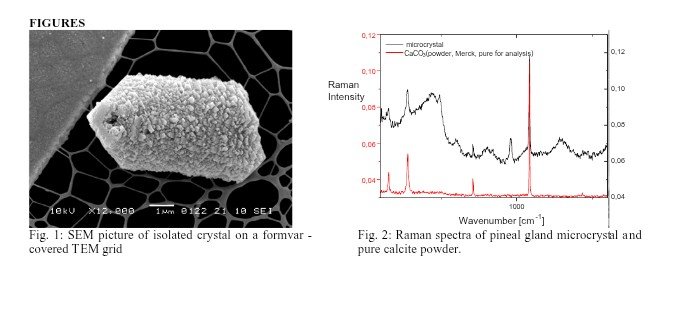
A new form of biomineralization has been studied in the human pineal gland. It consists of small crystals that are less than 20 µm in length. These crystals could be responsible for an electromechanical biological transduction mechanism in the pineal gland due to their structure and piezoelectric properties.
Using scanning electron microscopy (SEM) and energy dispersive spectroscopy (EDS), we identified crystals morphology and showed that they only contain calcium, carbon and oxygen elements. Furthermore, the selected-area electron diffraction (SAED) and near-infrared Raman spectroscopy established that the crystals are calcite.
The researchers explore whether external electromagnetic fields—such as radio-frequency (RF) fields from mobile communications (ranging roughly from 500 MHz to 2.5 GHz)—could induce tiny mechanical vibrations in the microcrystals. Such RF-induced mechanical stress could influence adjacent pinealocyte membranes or calcium channels, which might alter cellular coupling or impact melatonin synthesis and circadian rhythm regulation.
We report here the presence of a new form of mineral deposits in the pineal gland. The calcite microcrystals would have piezoelectric properties with excitability in the frequency range of mobile communications GSM (872-960MHz), DCS (1710-1875MHz), UMTS (1900-1920MHz, 2010-2025MHz), or BlueTooth(2400-2483,5MHz).
Their interaction with Global System for Mobile (GSM) waves could constitute a new mechanism of electromecano-transduction on the pinealocyte membrane, influencing by the fact the melatonin production. The RF-EMF electrical component interaction with the crystals could induce a morphological modification of the crystals, a vibration depending on the EMF frequency.
This morphological change, even tiny, could involve a modification of their cellular environment, by a localized modification of the cellular membrane of related cells. The membrane changes could alter the adrenergic suggested and/or calcium channel function.
https://t.co/YQU7fAeu2B
PDF DOWNLOAD
https://t.co/dkMuLwiUFJ
While ideal pure calcite is not normally piezoelectric, the complex, twinned structures of these specific pineal microcrystals can break local symmetry, giving them potential piezoelectric and second-harmonic generation (SHG) properties.
https://t.co/vXNPRpOQF7