@BubaHmm Não dá pra usar twitter de manhã. Eu scrollo e já vejo a opinião de uma vagabunda hipergâmica. Sempre as mesmas coisas. Ficam falando de altura, altura. Deviam dizer de uma vez que querem um macho que imponha respeito nela; que se quisesse estuprá-la, fizesse com facilidade.
Aqui onde moro, uma região uma vez bem ventilada, começou com processo de favelização normal brasileira quando fizeram casas primeiro andar e começaram a cortar árvores (essa semana cortaram um pé de manga que sei que será insubstituível). Nesse sentido sempre fui ecológico.
Odeio o termo "nordeste" e a designação "nordestino" fora do contexto geográfico, mas odeio ainda mais quem os usa pejorativamente, como se sua merda de bairro, cidade e região valesse alguma coisa e a própria pessoa não fosse uma parasita sub-humana
Remove marriage from the equation of your life, and you will realize that you don’t have any career pressure, pressure to buy a home at 30, or pressure to buy a car at 30. You will have your whole life to do whatever you want to do. It’s just marriage that puts us in a situation where we feel pressured to achieve all these things at an early age. That’s because we have been conditioned by society to believe that you need to achieve these things if you’re going to get married.
Entre todas as línguas do mundo, parece a inglesa a mais enganosa, posto que é aprendida com uma facilidade que falsifica totalmente a sua real dimensão. O turista que aprendeu a pedir um café no aeroporto crê dominá-la; mas se, por acaso, arrisca-se a ler um romance de Dickens, ou um poema de Milton, de Byron, de Chaucer, percebe em poucas linhas não saber nada da língua que aprendeu. E o curioso é que, sintaticamente, o inglês é sempre o mesmo: a estrutura dos períodos nunca complica demasiado a sua compreensão. Mas o inglês literário é um calabouço no qual o estrangeiro entra sempre sem lanterna. As palavras, as expressões infinitas, obscuras e intraduzíveis, são como assombrações. É preciso muita coragem para percebê-lo e encará-la enquanto escritor.
Enfim, só mais uma das minhas reflexões aleatórias sobre crianças. Tenho lido o Geração Ansiosa e indiretamente muitos dos comportamentos atuais e até biotipo são explicados nesse livro. E talvez porque estou ficando velho; e porque serei professor um dia, então...
Criança magra me causa uma repulsa muito grande. Eu mesmo sou magro, fui magro quando criança, mas falo aqui dos níveis de doente, subnutridos. Ao encostar, sinto que poderia ser desproporcional, quebrar-lhe um osso, dá agonia. Encosto com ponta dos dedos e é ainda pior.
Criança tem que ser gordinha, magreza nesse fase é problema, é doença, tem que ser investigado. Alguns pais não aceitam, vão deixar assim mesmo, "é ruim de comer", e lá deixa o moleque que corre o risco de ser sempre afetado pela falta de alimentação, ficando até retardado.
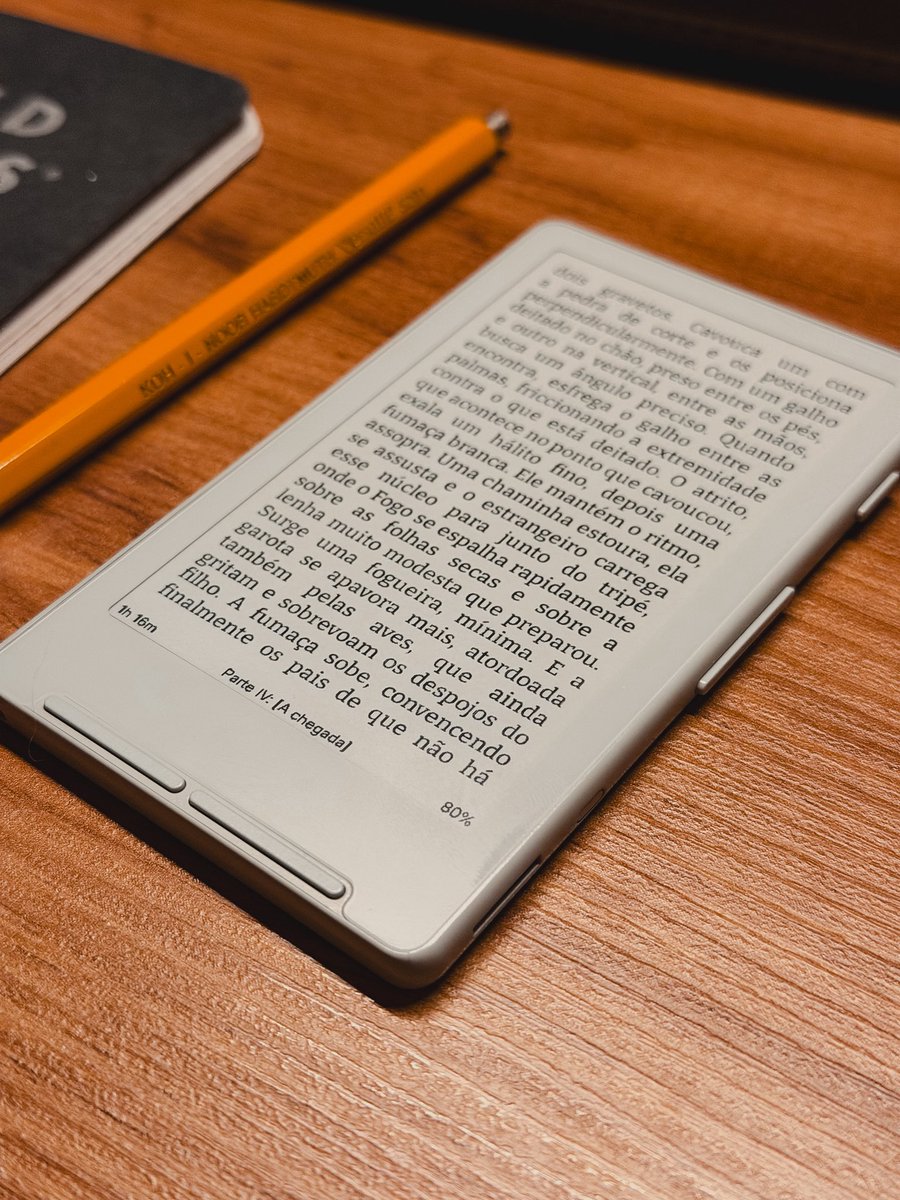
@4m3l1aMi@qunfraser Sobre marcação, perdi umas recentemente dum livro que estava lendo. Isso me aconteceu outra vez, busquei lá e não tinha nada. Não notei se tinha atualizado automático. Será que é isso mesmo?
Enfim, não pretendo fazer Jailbreak; meus ebook são azw3 e quero manter os dicionários.
Eu tenho que olhar pra isso sempre e me dizer que é tranqueira chinesa modinha, e que o kindle que tenho é simplesmente melhor, que isso aí não dura 1 ano de uso. Enfim, eu sei que não é pra eu comprar, por mais que fique esse diabinho.
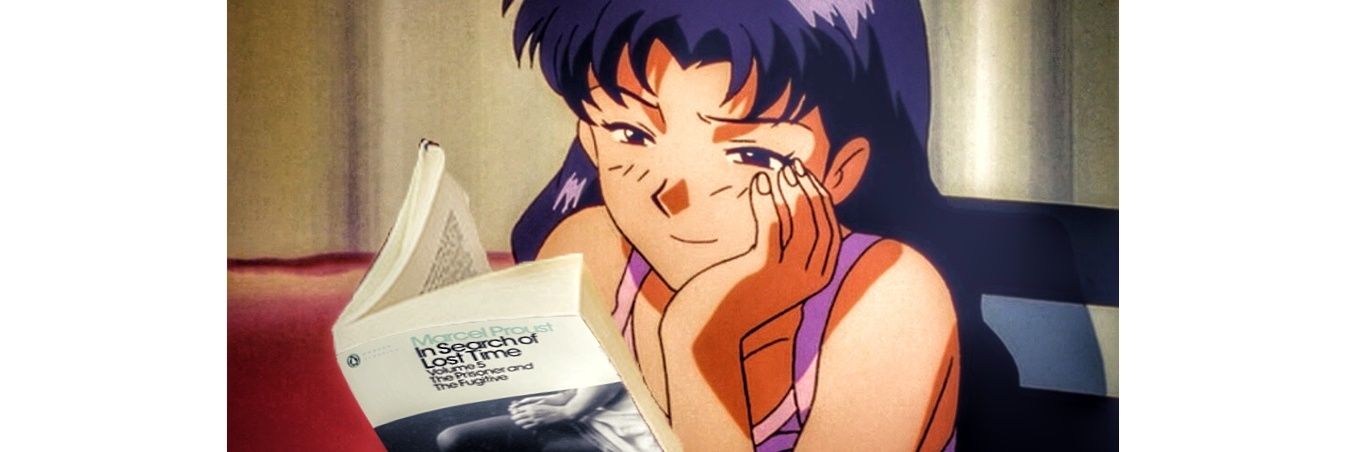
i read all of Proust over a 5-yr period, mostly on the subway
underlined and transcribed much of it
it's harder to understand than law because you can't predict what corner of the mind Proust's going to try to describe next but the motivation to grasp the payoff pulls you thro
improved my reading/writing ability more than law school and instilled me w a taste for art/the truth
my favorite passage is not the famous madeline that reminds him of childhood but is instead this attempt to describe de já vue:
I looked at the three trees; I could see them plainly, but my mind felt that they were concealing something which it could not grasp, as when an object is placed out of our reach, so that our fingers, stretched at arm's length, can only touch for a moment its outer surface, without managing to take hold of anything. Then we rest for a little while before thrusting out our arm with renewed momentum, and trying to reach an inch or two further. I recognized that kind of pleasure which requires a certain effort on the part of the mind, but in comparison with which the attractions of the indolence which inclines us to renounce that pleasure seem very slight. That pleasure, the object of which I could only dimly feel, which I must create for myself, I experienced only on rare occasions, but on each of these it seemed to me that the things that had happened in the meantime were of little importance, and that in attaching myself to the reality of that pleasure alone could I at length begin to lead a true life. I sat there thinking of nothing, then, my thoughts collected, compressed and strengthened I sprang further forward in the direction of the trees, or rather in that inner direction at the end of which I could see them inside myself. I felt again behind them the same object, known to me and yet vague, which I could not bring nearer. Where had I looked at them before? There was no place I could remember that was similar. Was I to suppose that they came from years already so remote in my life that the landscape which surrounded them had been entirely obliterated from my memory and that, like the pages which, with a sudden thrill, we recognize in a book that we imagined we had never read, they alone survived from the forgotten book of my earliest childhood? Or had I indeed never seen them before, and did they conceal beneath their surface a meaning as hard to grasp as the distant past, so that, whereas they were inviting me to probe a new thought I imagined that I had to identify an old memory? Or again, were they concealing no hidden thought, and was it simply visual fatigue that made me see them double in time as one sometimes sees double in space? I watched the trees gradually recede, seeming to say to me "What you fail to learn from us today you will never know, if you allow us to drop back into the hollow of this road [your mind], from which we sought to raise ourselves up to you, a whole part of yourself which we were bringing to you will vanish forever into thin air. I was never to know what they had been trying to give me and when she asked me what I was dreaming about, I was as wretched as if I had just lost a friend, had died to myself, had broken faith with the dead or repudiated a God.
Acho que a Minion fanática resumiu bastante coisa. Tenho o mesmo método de saber quem foi filtrado por lolita (os que têm necessidade de se identificar com o protagonista).
@giowriting no geral, eu gosto de saber o q a pessoa acha do livro "lolita". dependendo da opinião, eu já tenho uma BOA IDEIA da compreensão literária dela.
Isso aí simplesmente não é verdade. Mulheres como Anaïs Nin, Lou Andreas-Salomé, Madame de Staël etc tiveram inúmeras relações amorosas, mesmo quando estavam comprometidas.
Mas a moça do vídeo acha que a uspiana que leu quatro livrinhos de anarquismo é “potente e genial”.
Entendam que ter paciência com o Monark é dos melhores exercícios espirituais possíveis. Gostar dele apesar de todas as merdas que ele faz; acreditar no potencial, mesmo que desperdiçado, na inteligência latente. É análogo ao que Deus faz conosco. Só assim entendemos como.


![biglawbro's tweet photo. i read all of Proust over a 5-yr period, mostly on the subway
underlined and transcribed much of it
it's harder to understand than law because you can't predict what corner of the mind Proust's going to try to describe next but the motivation to grasp the payoff pulls you thro
improved my reading/writing ability more than law school and instilled me w a taste for art/the truth
my favorite passage is not the famous madeline that reminds him of childhood but is instead this attempt to describe de já vue:
I looked at the three trees; I could see them plainly, but my mind felt that they were concealing something which it could not grasp, as when an object is placed out of our reach, so that our fingers, stretched at arm's length, can only touch for a moment its outer surface, without managing to take hold of anything. Then we rest for a little while before thrusting out our arm with renewed momentum, and trying to reach an inch or two further. I recognized that kind of pleasure which requires a certain effort on the part of the mind, but in comparison with which the attractions of the indolence which inclines us to renounce that pleasure seem very slight. That pleasure, the object of which I could only dimly feel, which I must create for myself, I experienced only on rare occasions, but on each of these it seemed to me that the things that had happened in the meantime were of little importance, and that in attaching myself to the reality of that pleasure alone could I at length begin to lead a true life. I sat there thinking of nothing, then, my thoughts collected, compressed and strengthened I sprang further forward in the direction of the trees, or rather in that inner direction at the end of which I could see them inside myself. I felt again behind them the same object, known to me and yet vague, which I could not bring nearer. Where had I looked at them before? There was no place I could remember that was similar. Was I to suppose that they came from years already so remote in my life that the landscape which surrounded them had been entirely obliterated from my memory and that, like the pages which, with a sudden thrill, we recognize in a book that we imagined we had never read, they alone survived from the forgotten book of my earliest childhood? Or had I indeed never seen them before, and did they conceal beneath their surface a meaning as hard to grasp as the distant past, so that, whereas they were inviting me to probe a new thought I imagined that I had to identify an old memory? Or again, were they concealing no hidden thought, and was it simply visual fatigue that made me see them double in time as one sometimes sees double in space? I watched the trees gradually recede, seeming to say to me "What you fail to learn from us today you will never know, if you allow us to drop back into the hollow of this road [your mind], from which we sought to raise ourselves up to you, a whole part of yourself which we were bringing to you will vanish forever into thin air. I was never to know what they had been trying to give me and when she asked me what I was dreaming about, I was as wretched as if I had just lost a friend, had died to myself, had broken faith with the dead or repudiated a God.](https://pbs.twimg.com/media/HQOA5ZzWkAAejgQ.jpg)




![biglawbro's tweet photo. i read all of Proust over a 5-yr period, mostly on the subway
underlined and transcribed much of it
it's harder to understand than law because you can't predict what corner of the mind Proust's going to try to describe next but the motivation to grasp the payoff pulls you thro
improved my reading/writing ability more than law school and instilled me w a taste for art/the truth
my favorite passage is not the famous madeline that reminds him of childhood but is instead this attempt to describe de já vue:
I looked at the three trees; I could see them plainly, but my mind felt that they were concealing something which it could not grasp, as when an object is placed out of our reach, so that our fingers, stretched at arm's length, can only touch for a moment its outer surface, without managing to take hold of anything. Then we rest for a little while before thrusting out our arm with renewed momentum, and trying to reach an inch or two further. I recognized that kind of pleasure which requires a certain effort on the part of the mind, but in comparison with which the attractions of the indolence which inclines us to renounce that pleasure seem very slight. That pleasure, the object of which I could only dimly feel, which I must create for myself, I experienced only on rare occasions, but on each of these it seemed to me that the things that had happened in the meantime were of little importance, and that in attaching myself to the reality of that pleasure alone could I at length begin to lead a true life. I sat there thinking of nothing, then, my thoughts collected, compressed and strengthened I sprang further forward in the direction of the trees, or rather in that inner direction at the end of which I could see them inside myself. I felt again behind them the same object, known to me and yet vague, which I could not bring nearer. Where had I looked at them before? There was no place I could remember that was similar. Was I to suppose that they came from years already so remote in my life that the landscape which surrounded them had been entirely obliterated from my memory and that, like the pages which, with a sudden thrill, we recognize in a book that we imagined we had never read, they alone survived from the forgotten book of my earliest childhood? Or had I indeed never seen them before, and did they conceal beneath their surface a meaning as hard to grasp as the distant past, so that, whereas they were inviting me to probe a new thought I imagined that I had to identify an old memory? Or again, were they concealing no hidden thought, and was it simply visual fatigue that made me see them double in time as one sometimes sees double in space? I watched the trees gradually recede, seeming to say to me "What you fail to learn from us today you will never know, if you allow us to drop back into the hollow of this road [your mind], from which we sought to raise ourselves up to you, a whole part of yourself which we were bringing to you will vanish forever into thin air. I was never to know what they had been trying to give me and when she asked me what I was dreaming about, I was as wretched as if I had just lost a friend, had died to myself, had broken faith with the dead or repudiated a God.](https://pbs.twimg.com/media/HQOA5Z0WwAEOL2n.jpg)


