Quotes from the book "On the Digital Semiosphere: Culture, Media and Science for the Anthropocene" by John Hartley, Indrek Ibrus and Maarja Ojamaa (Bloomsbury)
Mushroom/world. Semiosphere is isomorphic. We animated Peeter Laurits' image "Atlas of Heavens 39" that is also on the book cover" #digitalsemiosphere
https://t.co/vLbtlLOELf
**Abstract deadline in 2 days** for a symposium on The Value of #Blockchain for the #MediaIndustries on 23–24 May at @TallinnUni to investigate existing visions and real-world practices of using blockchains in media and cultural industries. More info https://t.co/TRRs3G1Wz6
This: “While Russian opposition figures are often critical of the Putin regime, they are typically far less outspoken on the topic Russian colonialism, the root cause of the current genocidal Ukraine invasion.”
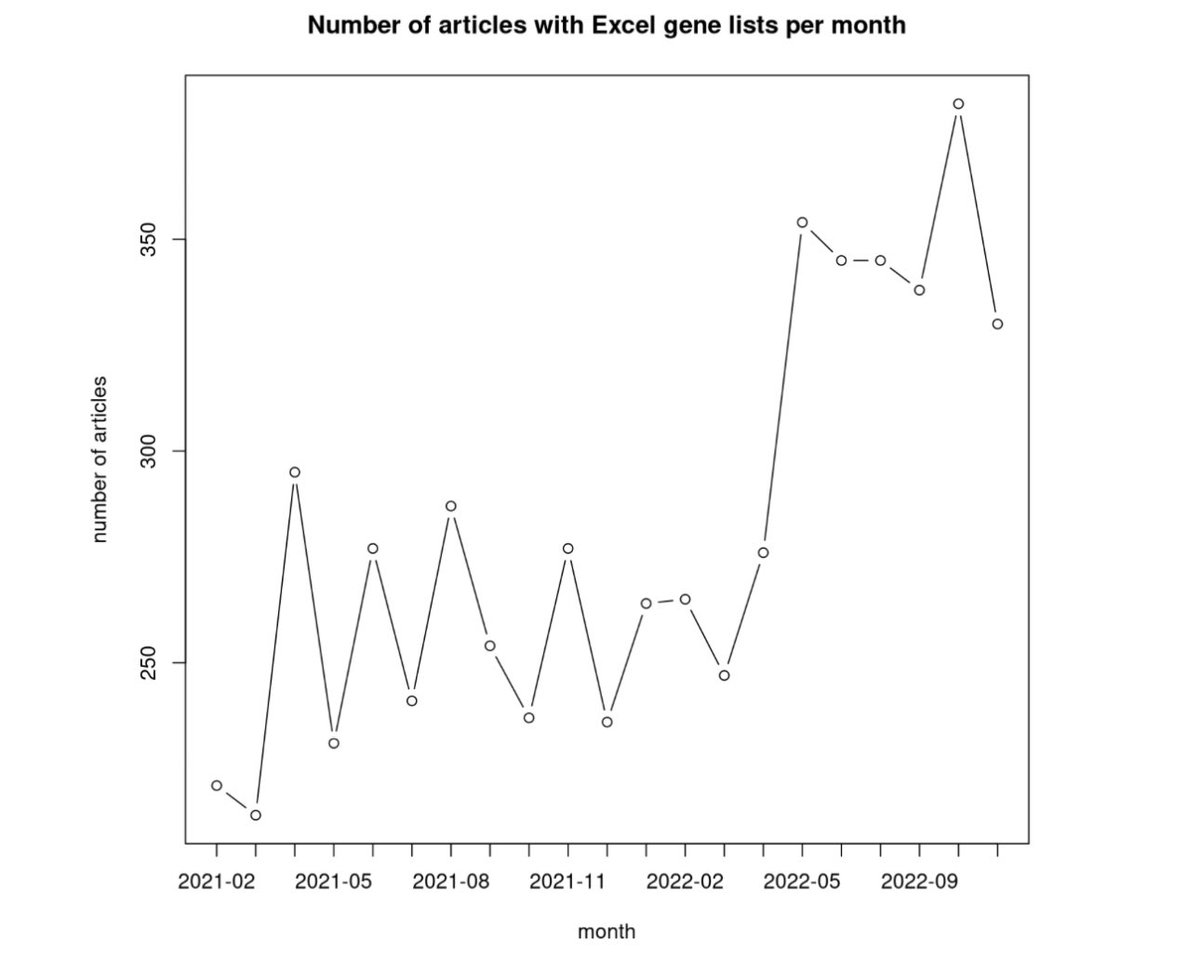
🤯Because of Excel, a THIRD of all genetics papers published in top journals have errors, as many genes have names like SEPT2 (the official name of Septin 2), which Excel automatically makes dates.
The issue was found in 2016, but still hasn’t improved! https://t.co/9E46yk82cd
This is really the worst. Just robbing children from their parents and their homes, and then trying to force them into a accepting new reality. Horrible. https://t.co/02xfDsonim
Hi friends, our bi-annual newsletter is here - https://t.co/oevVGEl4FV, check out what our researchers have been up to, what we've been writing, talking, exhibiting, performing and thinking about. @TallinnUni
We are very happy to announce our new Call for Papers: "Welcome to the Metaverse! (again?)". The special issue will be edited by Shenja van der Graaf (@shenjavdgraaf), Indrek Ibrus (@IndrekIbrus) and David Nieborg (@gamespacenl).
Please find the CFP here: https://t.co/0rUsSlIk7E
"[Our] case study of the evolution of the mobile web has demonstrated how media convergence tends to be complex and multilinear and involves both dialogic and autocommunicative communications as constituent forces."
"Cultural coherence among individuals and communities situated in different physical locations is increasing, while coherence between physically proximate communities is decreasing, and these textual tendencies have consequences in political, poetic and popular discourses."
"The reason why canonical literature cannot remain only literary texts, but become also audiovisual texts, is because culture is looking for ways to describe them as part of its current living culture, to make sense of them in accordance with contemporary meta-languages ..."
"...on the most general level, human culture appears not only as a vast collection of most diverse communicative acts but as one vast instance of autocommunication."
"In our collective memory of a well-documented historical period like the Second World War, visual versions influence the memorization of verbal or aural ones – we ‘recall’ the look more than the sound, but both may be supplied by later semiosis (e.g. documentary films, movies)."
"When a text is simultaneously interpreted by the codes of different systems in culture, for example a narrative is adapted into different media, various versions are memorized as a certain mnemonic collection, which is describable as a mental text (Torop, 2004: 327)."
"Culture’s continuity consists in a gleaming of its previous epochs through the overlay of contemporary texts and languages. The less complex a unit, for example a symbol, the more adaptable it is to new contexts." #semiosphere
"It is impossible to study a text in isolation from previous meanings stored in it or to study culture in isolation from its history. This is to condition the past /-/ to subject the past to the mechanisms of choice and complex re-coding. Memory is preserved to re-emerge..."
"As any new text is located within a semiosphere, which itself is the result of previous semiosis, it acquires memory in the cultural process, that is, a capacity to condense information on its complex intertextual contexts in a compressed form." #semiosphere#digitalculture
WEBSITE: "On the Digital Semiosphere: Culture, Media and Science for the Anthropocene" by John Hartley, Indrek Ibrus and Maarja Ojamaa (Bloomsbury 2021) has now also a *website*: https://t.co/Rxjvpt2Hal