GEN ROMEO S BRAWNER JR PA, Chief of Staff, Armed Forces of the Philippines, arrived at the Maritime Security Symposium (MSS) 2026, accompanied by the Flag Officer In Command, VADM Jose Ma Ambrosio Q Ezpeleta PN. #MSS2026#128thPNAnniversary@Philippine_Navy
The panel topics are also aligned with crosscutting issues on which the Philippines, as ASEAN Chair, is currently focusing, including “maritime cooperation, digital transformation, artificial intelligence, climate change, and disaster preparedness.” (3/3)
Welcome to the Maritime Security Symposium (MSS) 2026 with the theme, "Maritime Security in Southeast Asia: Navigating Continuity and Change through ASEAN.” This is the official Twitter Live Coverage of the event. #MSS2026#128thPNAnniversary@Philippine_Navy
Prof. Kraft then enumerated possible areas of cooperation such as the blue economy, climate change initiative, the code of conduct in the SCS, greater involvement of different stakeholders, and ASEAN institutions. #MSS2025
Prof. Herman Joseph S. Kraft, MA, Professor, Department of Political Science, University of the Philippines Diliman; Convenor of the Strategic Studies Program, UP Center for Integrative and Development Studies delivered his presentation titled... (1/2)
The second panel also serves as a foundational session and focuses on bridging the western and eastern frontiers of the Philippines. This panel redefines the Philippines' approaches in the West Philippine Sea concurrently addressing blindspots in the Eastern Seaboard
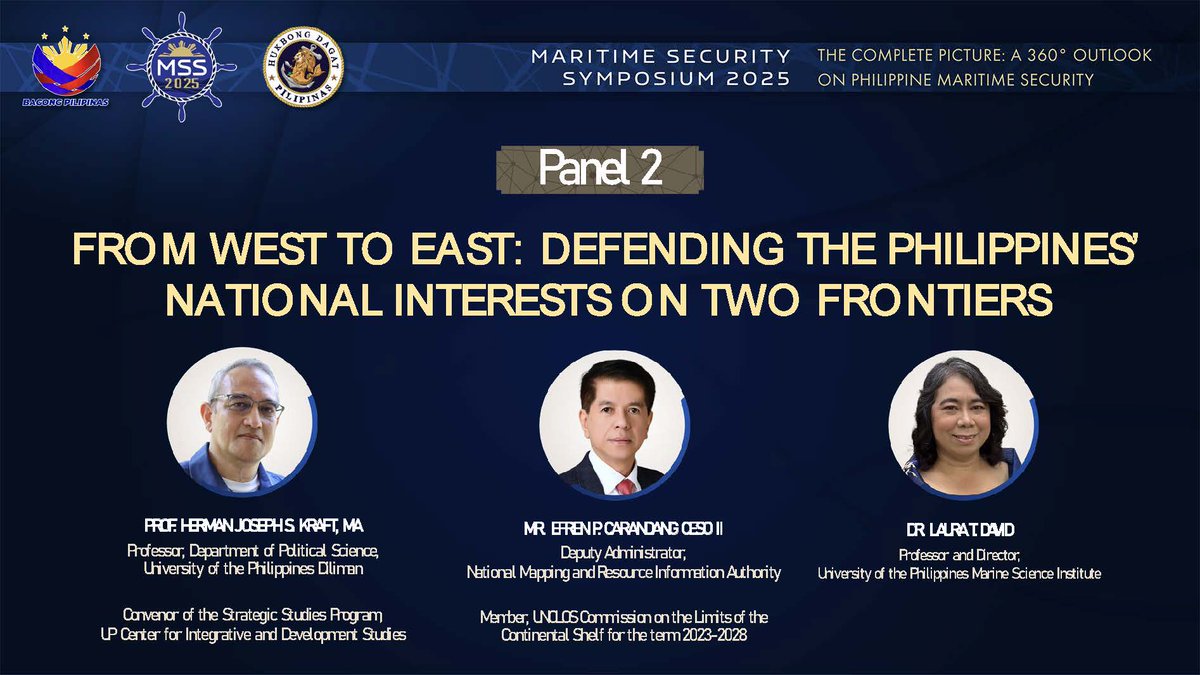
#MSS2025 Panel 2 on “From West to East: Defending the Philippines National Interests on Two Frontiers”, featuring Prof. Herman Joseph S. Kraft, MA, Professor, Department of Political Science, University of the Philippines Diliman, Convenor of the Strategic Studies Program.. (1/2)
UP Center for Integrative and Development Studies; Mr. Efren P. Carandang, CESO II, Deputy Administrator, National Mapping and Resource Information Authority; and Dr. Laura T. David, Professor and Director, UP Marine Science Institute
Atty. Santos then stated that in every team responsible for a crisis response, there needs to be: a national level leadership, coordinating agency, agency, leaders, field team leaders, support teams, and receiving teams.
Atty. Bertrand Theodor L. Santos, Senior Researcher, UP Institute for Maritime Affairs and Law of the Sea was the last presenter for Panel 1 and presented his discussion titled "Crisis Planning: Ensuring Access to our Northern and Southern Maritime Domain."
..and tornadoes; public emergencies such as infrastructure failures (e.g., dams), pandemic, and chemical, biological, and nuclear threats; civil unrest and conflicts such as local unrest, terrorist attacks, and wars; and extreme weather events. (2/2)