GOOD DAY, MR PRESIDENT: NIGERIANS DESERVE ACCOUNTABILITY
Good day, Mr President.
I congratulate you on spending a night in one of Nigeria’s states outside Lagos and Abuja. I hope you enjoyed the warmth, hospitality, and delicious cuisine of Akwa Ibom, which I am sure is even better than those of the destinations where you have spent over 260 days outside Nigeria since coming into office.
I sincerely hope this visit will inspire you to travel to the remaining 33 states of the federation, spend time with the people and, more importantly, explain what your administration has done with the ₦15.8 trillion saved from the removal of fuel subsidy, the over $100 billion you have borrowed, the increased revenues accruing to the government from taxing Nigerians, and the additional government revenues which your administration celebrated last year as having surpassed its target.
Nigerians deserve to know how many that were pulled out of poverty within this period, how many out-of-school children were returned to school, and how many functional primary healthcare centres you have built. They also deserve to know how much electricity supply has improved, especially given your promise that if you do not fix power, Nigerians should not vote for you. They deserve an explanation of how you have secured the country, which still ranks among the most terrorised countries in the world.
Mr President, Nigerians deserve answers. They deserve to know what has been done with the resources entrusted to your government.
The New Nigeria we want to build will be based on accountability, transparency, and the physical, measurable impact of our public resources on the lives of citizens.
A new Nigeria is POssible. -PO
That Nigeria’s unpopular president is not quaking in his suede loafers ahead of the next election says less about him and more about the country’s complicated electoral dynamics https://t.co/XYQ9LVOye3
I bought fuel yesterday in Toronto, Canada, at $1.7999 CAD per litre, and it cost about $98.95 CAD to fill up my tank. This should ideally last me about a week or more.
Now, the minimum wage in Canada is $17.95 CAD per hour, which means someone who works an average of 8 hours a day will earn $143.60 CAD before tax. A day's salary is enough to fuel his or her car for 2–3 weeks. This means that even one of the lowest earners in Canada can afford to own and drive a car daily without the cost of fuel becoming an overwhelming burden. Public education for children is also free and of high quality.
In Nigeria, fuel is about ₦1,300 per litre. It would cost about ₦88,000 to fill up a similar tank. The minimum wage in Nigeria is ₦70,000 per month. This means that an entire month's minimum wage cannot even fill the tank once.
A minimum-wage earner in Nigeria cannot realistically afford to own, fuel, and maintain a car. The same person still has to afford food, rent, children's education, healthcare, electricity, transportation, and other basic necessities. The list goes on.
In fact, even a bank manager in Nigeria earning ₦1 million monthly could still struggle to maintain a decent standard of living after covering these basic expenses.
This is one reason poverty is so widespread in Nigeria. The cost of basic living is simply too high relative to what the average person earns.
You don't just have an income problem in Nigeria. You have an affordability problem.
For millions of Nigerians, simply living a decent life has become too expensive and increasingly impossible.
My interview with Peter Obi a few days ago on Arise Prime Time focused largely on the Obi-Soludo debt row.
At the heart of it was a World Bank facility. It was not a commercial bank loan. It was a world bank multilateral development credit, offered to selected states, with a federal government sovereign guarantee.
The terms are long-term, near-zero interest, tied to specific reforms, such as budget transparency, fiscal sustainability, education, etc.
The crucial distinction is between approved vs draw down. Peter Obi's position is that he agreed to it but did not draw down. He did not access it.
Technically, that can be true. The loan facility is approved and signed at the federal executive council/world bank level, and the state signs a subsidiary agreement. But money only enters the state's account when it meets disbursement conditions and requests drawdown.
Obi says he left the money untouched in the pipeline and that he left savings, not debt on the books.
The Soludo camp's position is that he signed off on it. Also true. And this is where the fight is. Soludo's team argues approval is commitment - once signed, Anambra was on the hook, and that's why it shows up in the Debt Management Office records as inherited liability.
Obi's supporters say his successor chose to draw it. Obi showed discipline by not touching it. Obi approved it and signed Anambra onto it, but says he never drew down a kobo - his successor did.
So where does it go from here? Will both sides publish the DMO statements and drawdown dates, and let the documents settle who signed what, when it was drawn, and what it was spent on?
And with 2027 politics already in the air, will this row give the Nigerian people a clear audit of what was met, what was left, and what they still owe? Or just more politics and a sabre-rattling war of words?
Where Is Nigeria’s President?
The dynamic President of Ghana, John Dramani Mahama, delivered a remarkable address at the 81st United Nations General Assembly. The international community has commended his leadership and the substance of his address. It is a reminder of what leadership can produce when competence, capacity, compassion, commitment and character come together in the service of a nation.
Against this background, many are asking: Where is the President of Africa’s most populous nation, a country of more than 200 million people - more than Ghana - whose leader has been absent from the global stage for three consecutive UNGAs?
Nigeria’s President, who ought to be representing the country and providing leadership for Africa at the international level, has not attended any of these three global gatherings. Where is he, particularly at a time when the country faces significant challenges, both domestically and internationally?
Although our Vice President, Kashim Shettima, was present, the question remains: Where is the President? Let us continue to pray for his return and for his leadership in addressing the many challenges confronting the nation.
A new Nigeria is POssible. -PO
Check out this video, "ghana president at un" https://t.co/p4LsxEPiOq
Yesterday, I spoke with ARISE News on the Anambra debt question and other issues affecting our nation.
In the interview, I clarified the facts surrounding the multilateral development funds accessed by Anambra State, the financial position I left behind in 2014, and the urgent need to focus on the hardships confronting Nigerians rather than on political distractions. I am Sharing this interview to correct factual details, clear all doubts, and put the issues in their proper perspective.
A new Nigeria where leaders are proud of their past is POssible. -PO
https://t.co/kvURszM91q
ON THE ANAMBRA DEBT QUESTION
I have remained silent over the past few days because I have been grieving the loss of my very dear elder brother and friend, Chief Okey Ezeibe. However, the time has come for me to address some of the matters that have occupied public discussion in recent days.
I respectfully urge everyone to concentrate on the existential challenges confronting Nigeria and the hardships endured by its citizens, rather than on the needless distractions that have become widespread in our politics.
I wish to assure the public that I have no disagreement with my dear elder brother, Governor Soludo, or with any governor in Nigeria. I am not seeking the office of governor in any state, and I will not seek that position again, even if the Constitution is amended.
Accordingly, I appeal to governors to support whichever presidential candidate they choose while also permitting and assisting other presidential candidates and contenders for other offices to campaign freely and without interruption in their states. Ultimately, voters should be allowed to determine whom they wish to serve them.
Regarding the multilateral funding inaccurately described as “debt owed by Peter Obi” in Anambra State, I wish to state unequivocally:
As Governor of Anambra State, I did not approach any financial institution to borrow funds or issue a bond on behalf of the state. Indeed, at his farewell ceremony, the then Director-General of the DMO, Abraham Nwankwo, appointed me chairman and declared that, during his 10 years in office, I was the only state governor who had not approached him for a loan facility.
When I left office, the Anambra State Government owed no unpaid salaries, gratuities, or pensions. Neither did it owe any contractor or supplier who had completed work that the government had verified and certified.
Regarding development financing from the World Bank, these are concessionary development-support funds secured by the Federal Government for states selected by it to address specific needs. Repayment is spread over 25 to 30 years.
The Anambra State Government must therefore differentiate among three separate figures: the total amount approved for the multiyear development program; the amount Anambra State actually drew during my tenure; and the funding balance outstanding when I handed over on 17 March 2014.
The government has combined these distinct categories, added them together, and described the resulting US$123.77 million as “loans left by Peter Obi.” That is an incorrect application of public-sector accounting.
The eight facilities identified were primarily World Bank and IFAD development programs negotiated by the Federal Government, with participating states receiving access to the funds through subsidiary arrangements. They were not conventional commercial loans that I personally secured during my tenure.
This does not suggest that Anambra had no repayment responsibilities; rather, each facility must be examined in light of its approval, effectiveness, drawdown, and repayment record.
The clearest contradiction appears in the government’s own figures. It states that the original facilities amounted to approximately US$123.77 million and that US$92.35 million remained outstanding in June 2026. However, the DMO’s published records showed Anambra’s total external debt at approximately US$18 million when I began my tenure in March 2006, about US$30 million in March 2014, when I left office, and approximately US$45.15 million as of 31 December 2014, nine months after my departure.
The Anambra State Government must therefore clarify how a state whose recorded external debt was about US$30 million in March 2014 and US$45.15 million in December 2014 could supposedly have inherited US$123.77 million from Peter Obi, who left office in March of that same year.
Your favorite idiots here said doctors were on strike during Peter Obi’s time because he didn’t pay them.
Meanwhile, the man’s dedication towards the health sector was so laudable it became reference for the LSHA.
Bunch of filthy liars.
No Objection to Legitimate Scrutiny of My Certificates
My attention has been drawn to reports circulating on social media concerning a legal action by an individual or group seeking Certified True Copies (CTCs) of my Bachelor of Arts degree in Philosophy, awarded to me in 1984 by the University of Nigeria, Nsukka (UNN), as well as other academic records and credentials relating to my admission into the University.
I wish to state clearly that I have absolutely no objection to the release of these records.
I respectfully request that the University of Nigeria, Nsukka, within the limits permitted by law, make available, upon legitimate request, my academic certificates, records, and other official documents relating to my admission and studies at the University. I equally have no objection to other educational institutions, within and outside Nigeria, which I attended, making my academic records available in accordance with applicable laws and procedures.
I believe strongly in transparency and accountability, particularly for those who seek the privilege of public office. Public scrutiny must, however, be fair, lawful, and applied consistently to everyone who seeks to lead our nation.
As a presidential candidate seeking the trust of Nigerians to lead our country, I welcome legitimate public interest in my background, qualifications, and record. I am prepared to subject myself to the level of scrutiny that should reasonably be expected of anyone seeking the highest office in our country. Those who seek to lead must be willing to demonstrate, through both their words and actions, that they have nothing to conceal from the people they aspire to serve.
In that same spirit, I encourage every presidential candidate to make their educational qualifications and relevant records available for legitimate public scrutiny. Doing so should not be regarded as an inconvenience or an attack. Rather, it is an opportunity to strengthen public confidence, promote accountability, and rebuild the trust of Nigerians in those who seek to govern them.
Leadership must reflect the values we expect from the society we hope to build. If we desire a Nigeria founded on transparency, integrity, accountability, and respect for institutions, those values must begin with those who seek to lead it.
I therefore welcome the scrutiny of my academic background and remain committed to the principle that those who ask Nigerians for their trust must also be willing to earn that trust through openness and accountability.
A New Nigeria is POssible. -PO
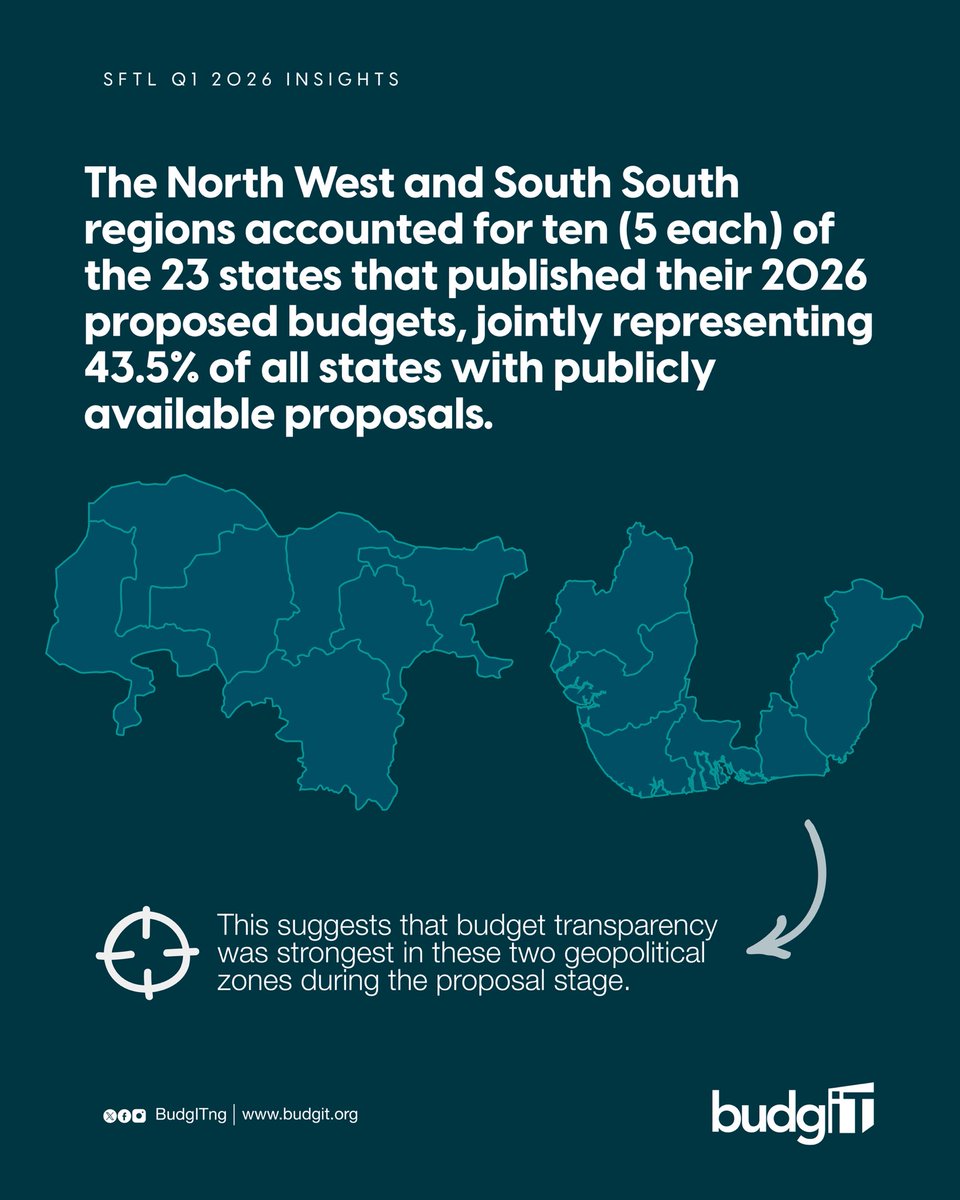
Every election, governments make promises. Every budget, they make allocations. But somewhere between the budget and the project, Nigerians are left in the dark.
Can you see who got the contract to build that road in your community? Has your state published its budget? Can you find procurement information without knowing someone in government?
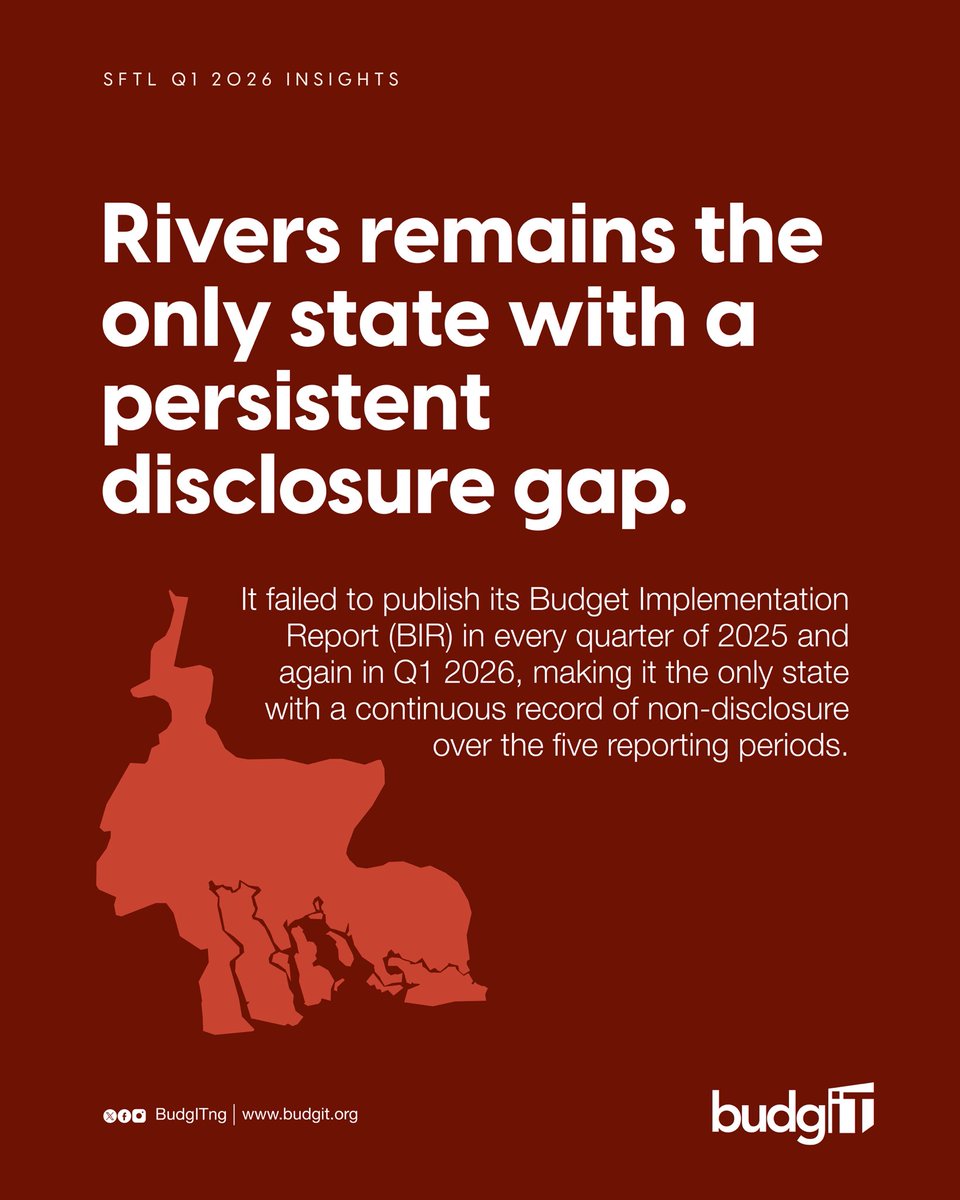
For the past three years, BudgIT has published the State Fiscal Transparency League (SFTL), an independent assessment of how transparent Nigeria's 36 states are with public finance information. The quarterly assessment examines budget transparency, procurement openness and access to key fiscal documents across all states.
🧵
#SFTL #FollowTheMoney #AskQuestions
Someone on your timeline needs to see this.
The Sir Dickson & Friends 2026/2027 Tech Scholarship & Laptop Support Initiative is still accepting applications.
Tag someone or share this with anyone looking to get into tech.
Apply here:
https://t.co/seJeCxkd3F