In a environment of constant volatility, the problem usually isn’t missing information.
It’s not seeing what’s really going on.
Who’s deciding. What they care about. What can’t change.
Once you see that, decisions get a lot clearer.
Clarity has a half-life.
Volatility shortens it.
In unstable environments, people update faster—they stop trusting old patterns.
Most orgs aren’t built for that.
They’re built for repeatability.
That’s why decisions lag reality. #risk#volatility
Leadership move in orgs facing volatility: Pick one early warning and map how it travels from the person who sees it first to you. If you can’t draw it, it doesn’t exist.
You can’t fix organizational stress & risk with inspirational messages. You fix it with a simple volatility-forward operating system: training, tools, & culture tuned for early detection, local problem‑solving, and fast, proportionate action when small issues show up in the work.
Most problems don’t start as crises.
They start as weak signals nobody owns.
By the time leadership sees it, the system is already paying for it.
The question isn’t “What happened?”
It’s “Why did we choose not to see it until now?”
We want teams that can handle #volatility, but we rarely train them for it.
This is the gap I care about closing.
In this video, I share the 10‑minute practice I use to turn every close call and tough week into resilience training for the next hit.
#Volatility doesn’t scare me. I ride black diamond trails for enjoyment. Here’s how mountain biking trained me to read the trail early, the same way I read unstable conditions at work to avoid going over the handlebars. #VUCA#resilience#systemsthinking
Working on how organizations deal w/ volatility. It doesn’t show up all at once.
It’s rarely the big problem that gets you.
It’s the small things explained away so many times. It sneaks in as small things easy to ignore… until they’re not.
By then, it’s usually expensive.
When volatility becomes normal, prediction stops being the differentiator. What matters is seeing early, deciding early, and adapting before the losses cascade. #volatility
POV: Your team is seeing problems early—but nothing happens.
Supplier slips. Customer behavior shifts. Workarounds become standard.
Everyone adjusts locally. No one connects it.
So signals stay isolated, decisions slow, and you react late.
That’s where you lose. #Volatility
You’re likely watching workarounds becoming standard practice across teams. That inefficiency is an early signal your system is under strain. #SystemsThinking#OperationalDrift#WeakSignals
Weak signals don’t disappear—they accumulate.
By the time they reach leadership, they’re no longer signals. They’re costs, delays, and damage.
The real edge isn’t reacting faster. It’s seeing earlier.
Reality Literacy is just asking “How do we know?” Minimum move this week: for every big claim in a meeting, ask “What’s that based on?” You’re training trust‑but‑verify so decisions rest on evidence, not confidence and gut.
#VUCA#volatility#resilience
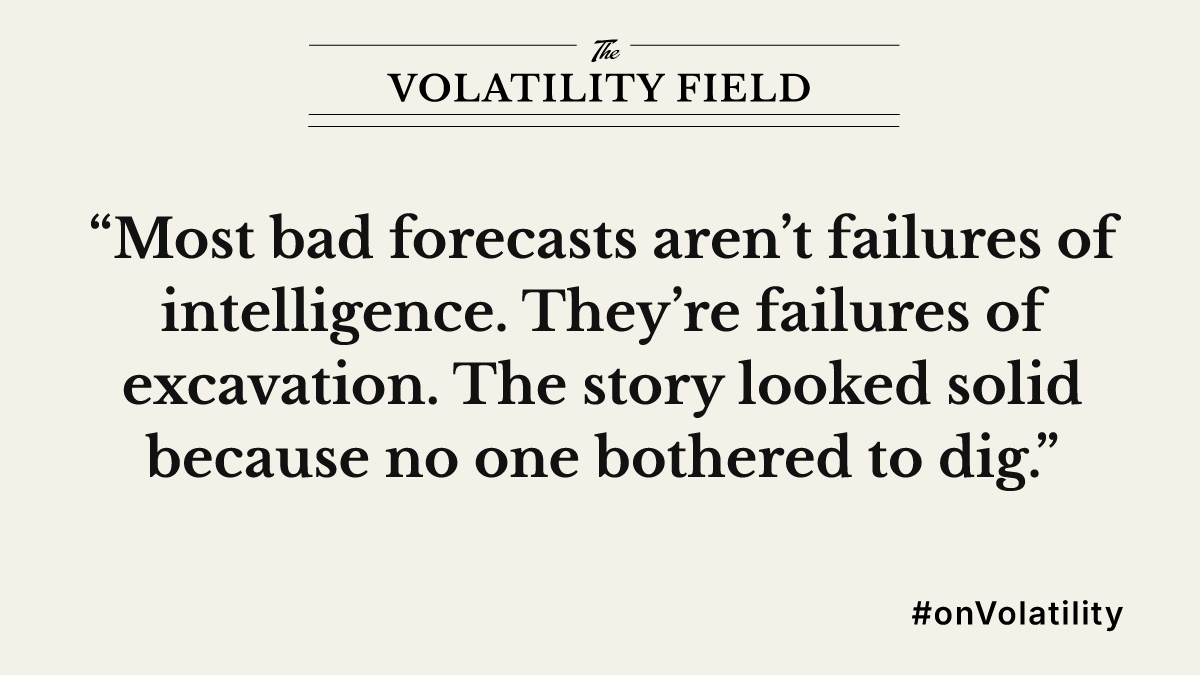
Forecasts rarely fail because the math was wrong. They fail because the model underneath never got questioned. In volatile systems, thinking isn’t prediction—it’s excavation. Dig past the narrative to find the real structure. (hard work)
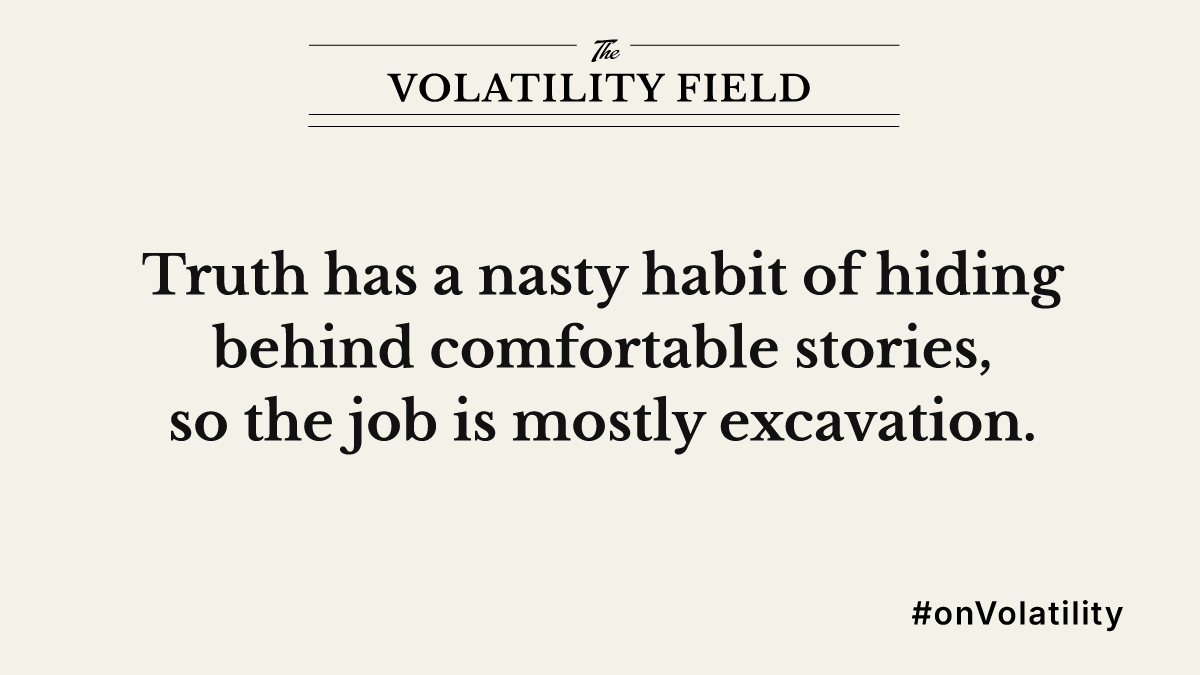
Humans are story-making machines. Our brains compress messy reality into narratives that feel stable. Useful, but dangerous. Over time the story replaces the signal. Good thinking is mostly excavation—digging until you hit bedrock again.
Colleges seem to be running the first large-scale volatility training experiment in society. Tuition, tech shifts, politics, job-market, & institutional drift all hitting the same population at once. That’s a very dense learning environment—even if no one designed it that way.
Forecasting assumes the future arrives on schedule. Volatility doesn’t behave that way. The useful signals show up early—quiet anomalies at the edges: tempo shifts, small breaks in routine. Prediction looks ahead; navigators learn to notice the faint signal already here.
@Heyitshassan Great description of volatility. For 85 yrs +/- the world was stable and only required us to put up with episodic crisis... turns out that time was atypical. now a huge number of reasons (individual to global) have ushered in the return of ecosystem volatility. #onvolatility