biotech is going vertical.
just this week:
• anthropic: six drug-development partnerships + its own rare-disease discovery programs
• generate + claude: a car-t genetic component ~70% shorter, with ~10x receptor expression in lab tests
• bighat + claude: ~1,010 antibody variants tested. the best bound their targets >10x more tightly
• parse + nomic: announced a 100-million-cell immune dataset linking rna and protein responses over time
• deepdelivery: 12 of 15 selected human proteins supported mrna delivery in an engineered lab system
predictions are being tested against actual biology.
clinical benefit is still the goal. these experimental results give us something concrete to build on.
could this approach extend to cancer diagnosis and treatment research?
as an initial experiment, we built a prototype from a published ovarian cancer trial: 36 tasks on extracting hla data, linking mutations to vaccine peptides, and interpreting TCR assays.
one task checks whether an agent notices that an initial assay was inconclusive because too few cells were tested. reading “na” as “negative” would miss that detail.
curious whether this could be useful alongside sequential diagnosis evals. we’d like to extend it to independent, unpublished patient records and see how well agents handle those cases.
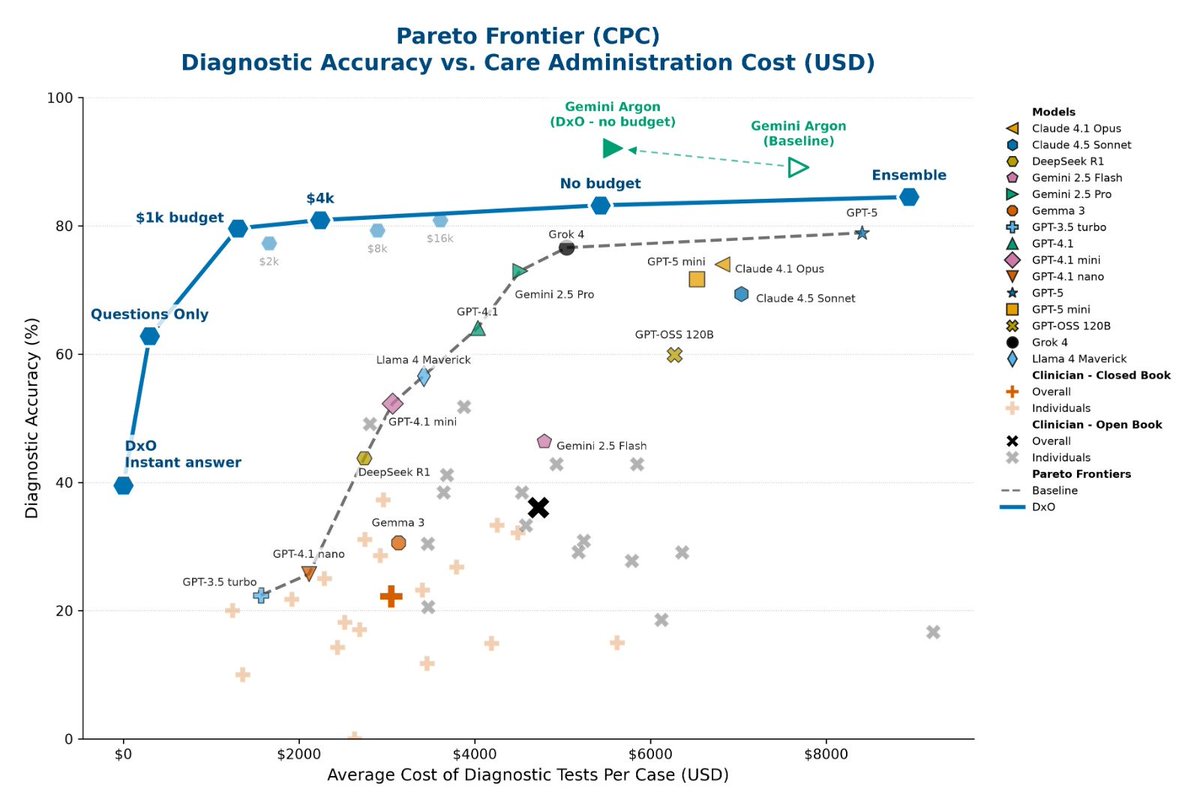
Our work on Diagnostic AI is now published in Science and open source!
While the paper was in peer review, new models came out, so I ran on the very latest frontier model release this morning :)
Gemini Argon is an excellent model, but still benefits from our orchestration!
we are currently linking pathology, treatment and outcomes over time, then turning those records into tasks medical AI can train on and be evaluated against.
starting with oncology and our cohort of 3-5k patients.
this is the direction we’re building toward >
we’re sourcing oncology cohorts with blood, h&e pathology and linked clinical data, exploring patient-matched multi omics and more
we also have our own patient cohort, with pre- and post-treatment data collection and longitudinal followup, subject to ethics approval and informed consent
the goal is to connect molecular measurements, pathology, treatment, and outcomes from the same patients over time.
oncology is our starting point
if you’re building medical ai, or interested in a research collaboration, let’s talk
If I were part of the Anthropic bio deal team, I would focus next on companies that have access to large amounts of diverse multi-omics patient data, ideally pre- and post-treatment, and beyond oncology (rare though!)