Dear Mr. Aliko Dangote @DangoteGroup,
Your Excellency President Yoweri Kaguta Museveni @KagutaMuseveni,
I write to you both with profound respect for your visionary leadership in shaping Africa’s energy future. Mr. Dangote, your pioneering refinery achievements have set a continental benchmark for self-reliance and scale. Your Excellency, your steadfast commitment to Uganda’s oil and gas sector continues to unlock transformative opportunities for the region.
Even with a world-class coastal refining footprint serving export markets, I believe Uganda’s Hoima refinery project represents not a competing venture but a compelling strategic complement – one that merits serious consideration as a high-return play within a unified East and Central African energy architecture, powerfully amplified by the East African Community (EAC) Customs Union.
At its core, the Ugandan refinery–planned at 60,000 barrels per day (bpd) with potential for phased expansion–sits directly atop proven crude reserves in the Albertine Graben.
It is embedded at the heart of the land-locked Great Lakes region, within a mature ecosystem: the Kabaale industrial park, modern road networks, an international airport, and seamless connectivity to one of the continent’s most dynamic but ready hinterland markets.
Uganda alone consumes approximately 40,000–45,000 bpd of refined petroleum products, currently met through imports costing the country roughly $2 billion annually in foreign exchange. Surrounding this are vibrant, fast-growing demand centers: Rwanda (approximately 10,000 bpd), eastern Democratic Republic of Congo (a substantial share of the national ~25,000 bpd), South Sudan (~12,000 bpd), western Kenya (part of Kenya’s total ~115,000 bpd consumption), and broader East African demand exceeding 416,000 bpd across the region.
Uganda’s investment framework further strengthens the case. Strategic projects such as this qualify for a 10-year corporate income tax holiday (especially within industrial parks or free zones), full exemptions from import duties and VAT on essential equipment, machinery, and inputs for oil and gas development, accelerated capital allowances, and other facilitative measures under the Investment Code and East African Community Customs Management Act.
These incentives, combined with government equity participation through the Uganda National Oil Company (up to 40% stake in the joint venture) and a supportive Host Government Agreement, significantly de-risk entry while accelerating returns.
Crucially, the EAC Customs Union–established in 2005 and now encompassing eight Partner States with a combined population of over 330 million and a rapidly expanding single market–unlocks seamless, duty-free access for refined products originating in Uganda across the entire bloc.
Under the Union, goods that meet rules of origin move tariff-free throughout Kenya, Tanzania, Rwanda, Burundi, South Sudan, the Democratic Republic of Congo, and Somalia, eliminating internal barriers and leveraging the Single Customs Territory to slash transit times and logistics costs.
At the same time, the Common External Tariff (CET) protects regional production by imposing duties (typically 10% or higher under the four-band structure for mineral fuels and related products) on refined petroleum imports from outside the EAC.
Harmonized petroleum product standards and policies further reduce non-tariff barriers, simplify operations, and create a predictable, investor-friendly environment that promotes cross-border supply chains and economies of scale.
The mutual benefits are substantial and quantifiable. For Uganda and its EAC neighbors, local refining under the Customs Union eliminates the expensive “last-mile” logistics burden from distant coastal ports–reducing transport, handling, and import-premium costs that currently inflate pump prices.
Conservative estimates suggest fuel prices could fall by 15–25% in inland markets through direct proximity to supply, while Uganda alone could conserve nearly its entire $2 billion annual forex outflow on refined products, strengthening the shilling, easing balance-of-payments pressure, and freeing resources for infrastructure and social spending.
The project is projected to create thousands of direct and indirect jobs during construction and operations, spur downstream industries (petrochemicals, fertilizers, power generation), and enhance regional energy security against global shocks–all while boosting intra-EAC trade, which has already grown 13%+ in recent years and now accounts for roughly 15% of the bloc’s total trade.
For you, Mr. Dangote, this represents a rare opportunity to anchor a strategic presence at the commercial heart of East and Central Africa. Rather than merely exporting crude or serving maritime flows from the coast, a stake here–backed by the full protections and market access of the EAC Customs Union–plants a flag in high-growth, under-served demand centers. It delivers refined products where people live and economies are expanding fastest, diversifies your refining portfolio across complementary vantage points, builds intimate market intelligence, and unlocks synergies in regional supply chains.
As Your Excellency has rightly emphasized, these are not rival bets but mutually reinforcing pillars of one integrated regional energy system: one at the water’s edge for scale and reach, the other embedded in the hinterland where demand is immediate and resilient.
In short, this is more than a refinery; it is a gateway–fortified by Uganda’s incentives and the EAC Customs Union–to accelerated industrialization, energy independence, and shared prosperity across East and Central Africa. The economics are compelling, the incentives investor-friendly, and the timing–amid rising regional consumption and your own demonstrated interest in East African energy infrastructure–ideal.
I offer these reflections as an admirer of your respective achievements, confident that strategic collaboration between your expertise and Uganda’s resources, under the enabling framework of the EAC Customs Union, could redefine the continent’s energy narrative for generations to come.
With the highest esteem and anticipation for the progress you will continue to drive together,
Respectfully,
Emmanuel Onyango
+256752722000/774722000
[email protected], [email protected]
4/4 Sixty percent of surplus stays with the Eco-River cooperatives. Women and youth hold the steward floor. Zero debt on the household plot. A 550-acre Tororo Climate SEZ buys the legal biomass. Your Excellency – the plume stops the day the bank is planted and the home is paid. #JustGreenLeap
@volcanaorg 1/ In 2015 a single overflight caught Eastern Uganda bleeding. Chocolate-brown plumes leaving the Malaba and the Elgon rivers, riding the Victoria Nile. That was not weather. That was soil, fish levy and unpaid tax leaving the country. #JustGreenLeap
3/4 Same bend, engineered future. Bamboo–vetiver–legume shield. Seven-layer food forest. Poultry tower set back from the water. Glass-clear flow. Sediment that once fled becomes soil carbon and taxable throughput. The Treasury already pays for the flood. Titles cost less.
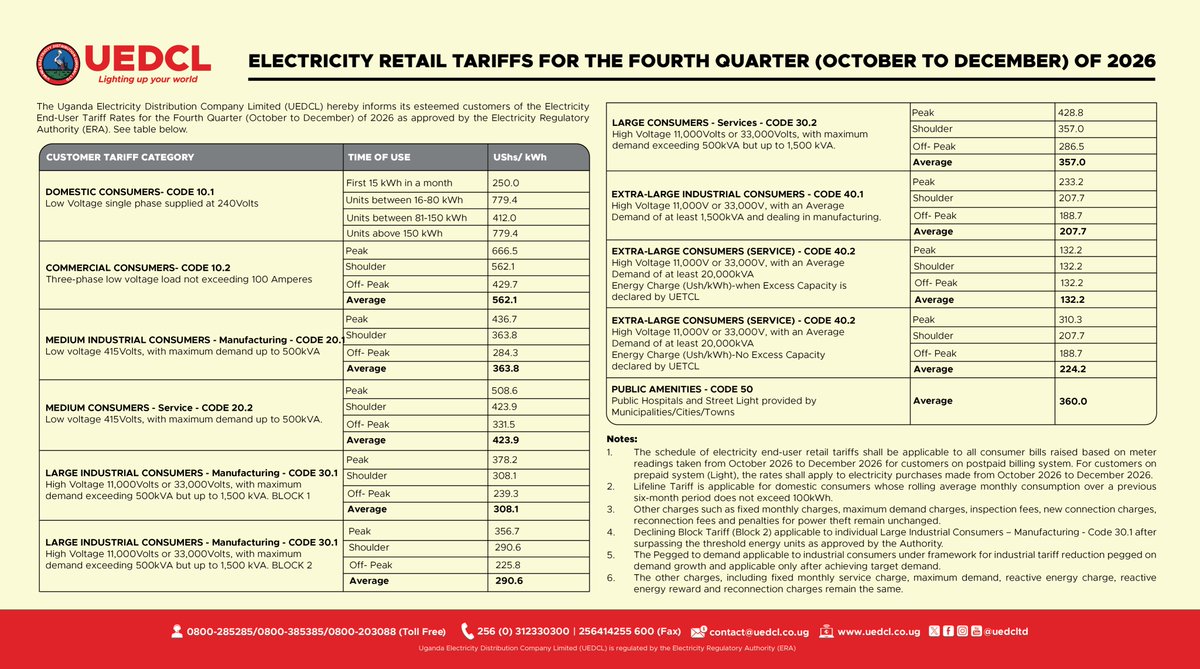
6/6 Cook inside the cheap window. Do not go past 150. And keep the power on. Otherwise the units rush out like they heard a rumour, and you are left ironing in the dark, negotiating with a torch.
1/6 UEDCL has published the Q4 postcard. Replies are from Gulu, Kisaasi, Kampala and Hoima Road, all asking why the lights are the ones on a lunch break. A tariff is a price for units. It is not a promise they will arrive.
We hereby inform our esteemed customers of the Electricity End-User Tariff Rates for the Fourth Quarter (October to December) of 2026 as approved by @ERA_Uganda.
#UEDCLinService#LightingUpYourWorld
5/6 Against last quarter this is a hold, not a cut: Q3 was the same 250 / 779.4 / 412 / 779.4. Against a flat old domestic rate, lifeline and the cooking band are the mercy; units 16–80 are the sting, which is why a Shs30,000 habit now feels like Shs50,000. Rwanda’s upper household band sits near this average. Kenya’s sticker is lower until the fixed charges join the chat.
6/6 Pass the Bill. Then make the tracks kiss. A Pearl with no gate is just a very round excuse. Tororo awake, Malaba open, rice on time. The ocean can wait its turn.
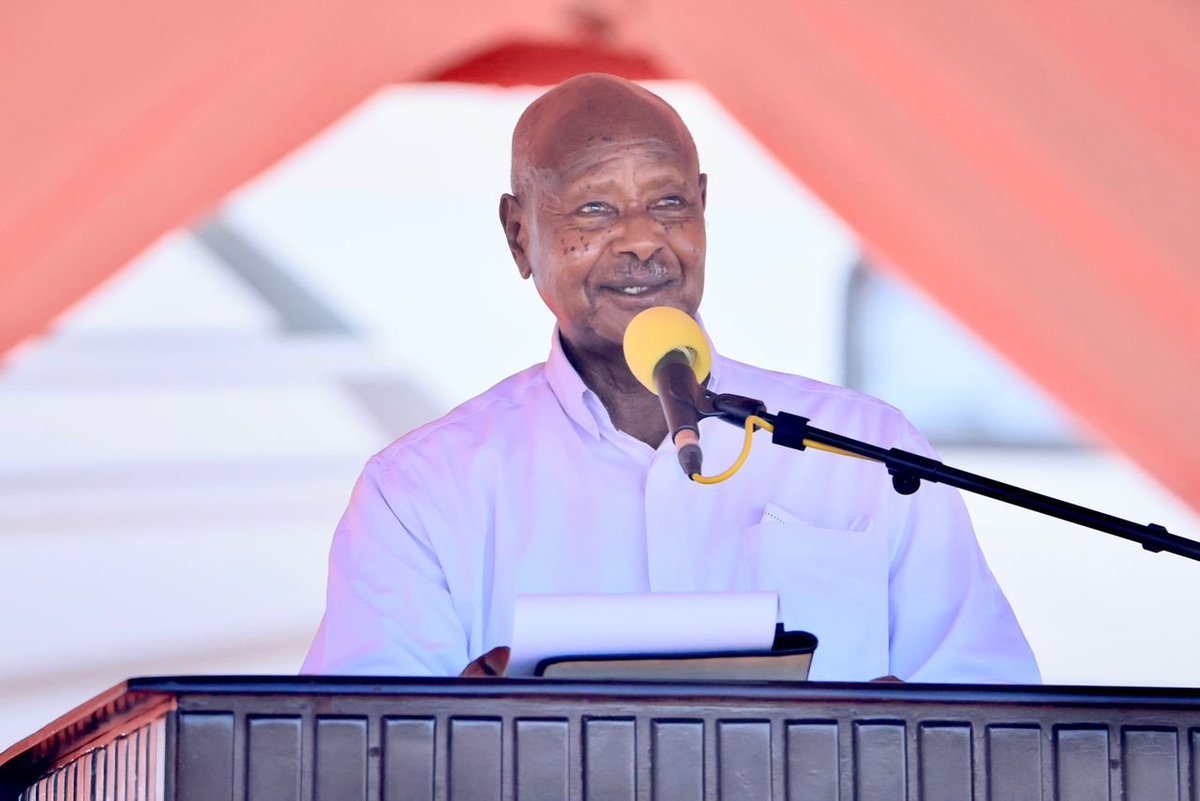
Kudos, President Museveni. Keep this, we want more A Thread:
1/6 Tororo has been sleeping through its own audition. Uganda just put the Railways Bill on the order paper, which is how a land-locked country stops writing love letters to the sea and starts charging rent on the doorway.
🇺🇬 President Yoweri Museveni said heavy cargo would move off roads and onto rail. The Uganda Railways Bill, 2026, included in the legislative programme attached to his address, is now listed for Government business on 6 to 8 October 2026.
Delivering his State of the Nation Address at Kololo on 4 June, Museveni said Government was revamping metre-gauge rail and building standard-gauge rail, alongside petroleum pipelines.
“That leaves the roads for only passengers and light cargo,” he said.
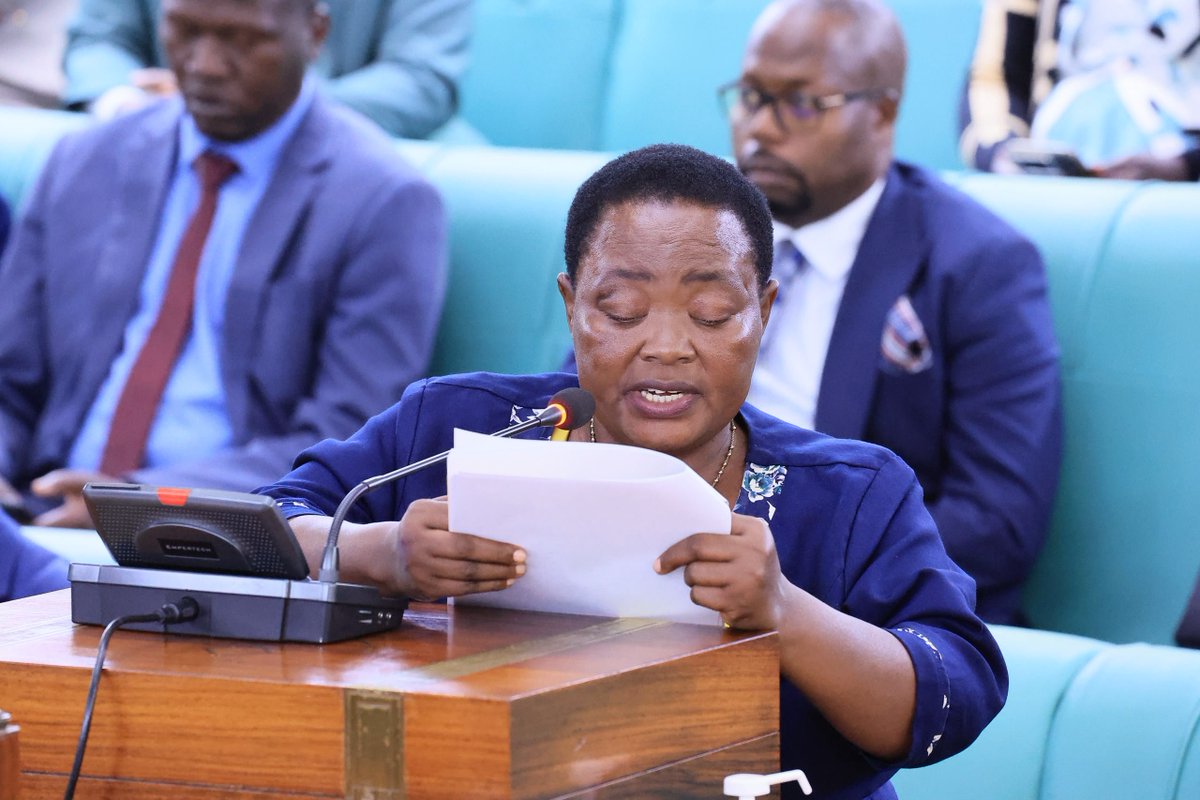
Annex 2 lists the Bill as item 16 under the Ministry of Works and Transport. Prime Minister Robinah Nabbanja listed it first in her statement to Parliament dated 1 October, announcing business for the succeeding week.
Photos: @Parliament_Ug
5/6 Benefits, in plain cloth: factories keep working capital, millers get maize on a timetable, steel leaves as product not dirt, and the weighbridge finally gets a lunch break. Macro version: a lower import bill, slower road decay, and a corridor that can look the Central route in the eye.
35 WEBSITES GOOGLE DOESN'T WANT YOU TO KNOW
1. Explee .com — sends cold emails on autopilot
https://t.co/938hHyWl9H
2. NoteGPT — turns docs into podcasts
https://t.co/d4iTHbTui1
3. Napkin AI — turns text into diagrams
https://t.co/HU2BrC710E
4. Ideogram — generates text in images perfectly
https://t.co/G4rgfXNHli
5. Suno — makes full songs from a prompt
https://t.co/fsPBTmmE9L
6. HeyGen — clones your face into videos
https://t.co/Ueb8wVmY3e
7. Kling AI — best AI video generation
https://t.co/A7TXfgV2rw
8. ElevenLabs — clone any voice instantly
https://t.co/oz3niCSYrX
9. Gamma — AI presentations in seconds
https://t.co/WkqTUtJV4r
10. Perplexity — AI search with real sources
https://t.co/g34FMgyorx
11. Pika — animate any image into video
https://t.co/7RqUnrYBF3
12. Runway — cinematic AI video generation
https://t.co/5jYeECXN3V
13. Cursor — AI code editor that builds for you
https://t.co/7a7dMg2eOa
14. v0 — generate UI components with AI
https://t.co/PIvFtpqhbs
15. Lovable — turn ideas into working apps
https://t.co/UYEVCrKQ2z
16. Descript — edit video by editing text
https://t.co/HW39psnniv
17. Opus Clip — auto cut long videos into shorts
https://t.co/hQRxTfQxG2
18. Krea AI — real time AI image generation
https://t.co/KUboS6td49
19. Magnific — upscale any image with AI
https://t.co/EgAbcDiECu
20. Viggle — make characters move realistically
https://t.co/XZfPqFkFH8
21. tl;dv — record and summarize any meeting
https://t.co/kBClntTwPH
22. Fireflies — AI meeting notes automatically
https://t.co/0Pt8ONmFPl
23. Castmagic — turn audio into content pieces
https://t.co/pV5JMwj5dE
24. Replit — code and deploy from browser
https://t.co/Dz6b7eFmKA
25. Leonardo AI — generate images for free
https://t.co/stKHFkGWX8
26. Synthesia — AI avatar videos no camera needed
https://t.co/8gAzQIzF2F
27. Fliki — turn text into videos with AI
https://t.co/fZ9Oqxvywv
28. Photoroom — AI product photography
https://t.co/78YBr42dhn
29. Invideo AI — turn prompts into full videos
https://t.co/2Est44wvIt
30. Consensus — search what science agrees on
https://t.co/Gep4QPHDTI
31. SciSpace — understand any research paper
https://t.co/9nFQwVFV6w
32. Tome — AI builds your pitch decks
https://t.co/4VnAZw1Hqw
33. Beautiful AI — smart presentation design
https://t.co/xHmicsqJvM
34. Meshy — turn text into 3D models
https://t.co/CjON3fzySV
35. Vizcom — turn sketches into renders
https://t.co/lBasUBSsMF
The AI revolution isn't coming.
It already happened and you missed half of it.
Follow
@triptitips
for more useful websites, AI tools & tech resources. 🚀
Top 30 Countries & Their Most Famous Scientists
🇩🇪 Germany — Albert Einstein
🇬🇧 UK — Isaac Newton
🇮🇹 Italy — Galileo Galilei
🇫🇷 France — Louis Pasteur
🇵🇱 Poland — Marie Curie
🇷🇸 Serbia — Nikola Tesla
🇺🇸 United States — Thomas Edison
🇬🇷 Greece — Archimedes
🇬🇧 United Kingdom — Charles Darwin
🇩🇰 Denmark — Niels Bohr
🇦🇹 Austria — Erwin Schrödinger
🇨🇭 Switzerland — Leonhard Euler
🇳🇱 Netherlands — Antonie van Leeuwenhoek
🇸🇪 Sweden — Carl Linnaeus
🇷🇺 Russia — Dmitri Mendeleev
🇯🇵 Japan — Hideki Yukawa
🇮🇳 India — C. V. Raman
🇵🇰 Pakistan — Abdus Salam
🇳🇿 New Zealand — Ernest Rutherford
🇧🇪 Belgium — Georges Lemaître
🇪🇸 Spain — Santiago Ramón y Cajal
🇨🇿 Czech Republic — Gregor Mendel
🇨🇦 Canada — Frederick Banting
🇮🇪 Ireland — William Rowan Hamilton
🇳🇴 Norway — Kristian Birkeland
🇦🇺 Australia — Howard Florey
🇵🇹 Portugal — António Egas Moniz
🇭🇺 Hungary — John von Neumann
🇧🇷 Brazil — César Lattes
🇿🇦 South Africa — Sydney Brenner
20+ AI tools that will save you hundreds of hours in 2026.
(Let me know what I missed!)
1. Claude — Solve any problem
2. Perplexity — Research anything
3. PortfolioTab — Create your portfolio
4. Kling AI — Create AI videos
5. Tripo AI — Create 3D models
6. Gemini — Perfect writing
7. CapCut — Edit videos
8. The AI Library — Discover useful AI tools
9. YouLearn — Summarize YouTube videos
10. Canva — Design graphics
11. ElevenLabs — Clone voices
12. Podcastle — Edit podcasts
13. ChatGPT — Brainstorm ideas
14. NotebookLM — Analyze documents
15. Lovable — Build web apps
16. Bolt new — Generate full-stack apps
17. Cursor — AI coding assistant
18. Windsurf — AI software development
19. Replit — Build apps in your browser
20. Gamma — Create presentations
21. HeyGen — Create AI avatar videos
22. Synthesia — Generate AI presenter videos
23. Midjourney — Generate AI art
24. Ideogram — Create images with text
25. Runway — AI video editing
26. Pika — Generate AI videos
27. Luma AI — Create cinematic AI videos
28. Leonardo AI — Create game assets & artwork
29. Figma AI — Design UI/UX
30. Framer AI — Build websites
31. Tally — Create smart forms
32. Otter ai — Transcribe meetings
33. Fireflies ai — AI meeting notes
34. Granola — AI meeting assistant
35. Wispr Flow — Voice-to-text
36. Zapier — Automate workflows
37. Make — Connect apps with automation
38. n8n — Open-source automation
39. Photoroom — Edit product photos
40. Remove bg — Remove image backgrounds
41. Suno — Generate AI music
42. Udio — Create original songs
43. DeepL — Translate accurately
44. Poe — Access multiple AI models
45. Grok — Real-time AI assistant
46. Genspark — AI super agent
47. Manus — Autonomous AI agent
48. Elicit — Research papers faster
49. SciSpace — Understand research papers
50. Notion AI — Write and organize notes
Share your list 👇🏿👇