Two years ago I thought the creator economy had a distribution problem.
Now I think it has a measurement problem.
Every platform can tell you how many views a post received. Very few can tell you whether that post changed someone's opinion, started a conversation, or built long term trust.
That's why so many creators end up optimizing for numbers that look impressive but don't necessarily mean much.
I've seen creators with huge reach struggle to build a real community. I've also seen smaller creators create stronger loyalty simply because people trusted their perspective.
The shift in my thinking happened after growing a 110k+ member Telegram community.
The posts that attracted the most attention weren't always the ones people remembered.
The posts that created discussion, disagreement, and repeat engagement were the ones that actually moved the community forward.
That's what I find interesting about @ClashoAI.
The Attention Games doesn't just reward activity. Missions require creators to explain their reasoning, share experiences, and take positions they can defend. The leaderboard rewards sustained contribution throughout the campaign rather than a single viral spike.
To me, that's closer to how creator value should be measured.
Not by how many people looked.
By how many people cared enough to come back.
What's one metric you think creator platforms focus on too much today?
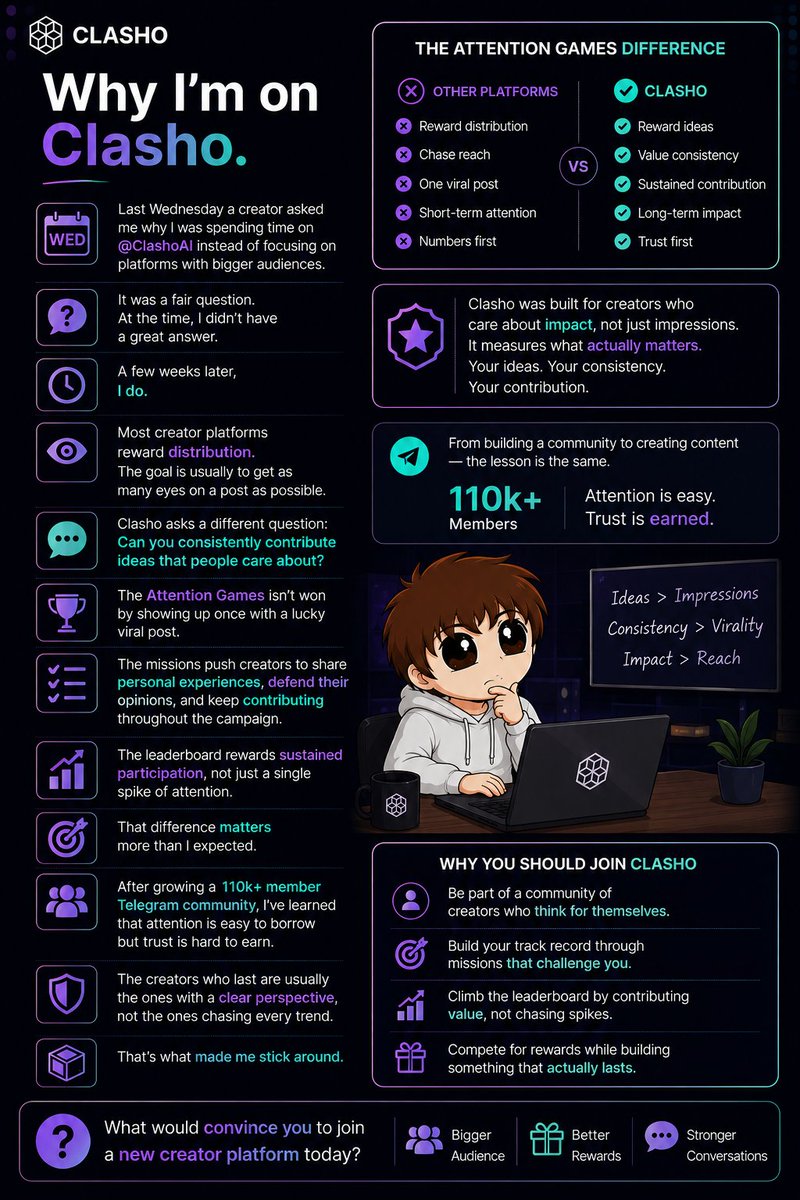
Last Wednesday a creator asked me why I was spending time on @ClashoAI instead of focusing on platforms with bigger audiences.
It was a fair question.
At the time, I didn't have a great answer.
A few weeks later, I do.
Most creator platforms reward distribution. The goal is usually to get as many eyes on a post as possible.
Clasho asks a different question:
Can you consistently contribute ideas that people care about?
The Attention Games isn't won by showing up once with a lucky viral post. The missions push creators to share personal experiences, defend their opinions, and keep contributing throughout the campaign. The leaderboard rewards sustained participation, not just a single spike of attention.
That difference matters more than I expected.
After growing a 110k+ member Telegram community, I've learned that attention is easy to borrow but trust is hard to earn. The creators who last are usually the ones with a clear perspective, not the ones chasing every trend.
That's what made me stick around.
If you're looking for a place where your thinking matters as much as your reach, Clasho is worth trying.
What would convince you to join a new creator platform today? A bigger audience, better rewards, or stronger conversations?
A brand I'd love to see launch on @ClashoAI next is Duolingo.
Not because of the owl.
Because it's one of the few major brands that already understands how to be part of internet culture without sounding like a corporate account trying too hard.
Last month I saw a Duolingo post generate thousands of replies where people were genuinely adding jokes, stories, and reactions. The engagement didn't feel forced. People actually wanted to participate.
That made me think about what would happen if a brand like that entered the Attention Games.
Most brand campaigns focus on maximizing reach. The problem is that reach disappears quickly. A post can get millions of views and still leave no lasting impression.
What interests me about @ClashoAI is that the missions reward creators for sharing original opinions and experiences over time. The leaderboard tracks sustained contribution throughout a campaign rather than rewarding one viral hit.
That creates a very different environment for brands.
Instead of asking creators to repeat a message, brands get to see how people naturally interpret, challenge, and build on an idea.
As someone with 7k+ followers on X, I've noticed that the most memorable brand interactions usually happen when a company is confident enough to let creators have their own perspective.
That's why I think Duolingo would fit surprisingly well here.
Which brand do you think would thrive in a creator ecosystem built around ideas rather than impressions?
Three weeks ago I almost ignored @ClashoAI.
At first glance it looked like another creator campaign with a leaderboard and rewards.
Then I started reading the missions.
The difference is that most creator programs reward activity. Clasho rewards thinking.
You can't climb very far by reposting popular opinions or copying what everyone else is saying. The missions push creators to share personal experiences, explain their reasoning, and take positions they can actually defend.
That changes the quality of the conversation.
Over the past few months I've seen plenty of campaigns where one viral post was enough to dominate the leaderboard. A week later nobody remembered who won.
The Attention Games works differently. Progress comes from contributing consistently throughout the campaign, which means creators build a track record instead of relying on a single spike of attention.
That realization changed how I viewed the platform.
As someone who manages a 110k+ member Telegram community, I've learned that the strongest communities are built around people with clear perspectives, not people chasing the biggest numbers.
If you're a creator who wants your ideas to matter more than your metrics, Clasho is one of the more interesting places to experiment with that.
What would make you join a creator platform today: bigger reach or better conversations?
@0xWassie@ZOOP Nice to see the real numbers. 80% revenue share is a huge incentive. I’m curious how the payout compares to other platforms definitely worth a test.
@ekinoks_26@NucleusCodes Reputation becoming an asset is a fascinating but complex path. The real challenge is making sure incentives reward genuine contribution instead of creating new ways to game the system.
@amiirshafii@EthraShip This vision of verifiable data is exactly how we transform legacy industries into something truly reliable. It is inspiring to see this level of innovation for the maritime sector.
@vyyker Apple upgrades are always a debate between innovation and incremental changes. The real question is whether the new features justify the premium price.
@michyexe@PerpGame Asset-backed models change the conversation from pure speculation to transparency and measurable value. Programmable treasuries could be an interesting direction for onchain markets.
@sheikhakash69@tryquantio Trading feels so much lighter when you stop staring at screens all day. Thanks for sharing this tip, it really changes the game for staying consistent and stress free.
@yalcn_tuncayy@0xMiden finally a blockchain that gets privacy right without forcing users to sacrifice usability or compliance. zero knowledge proofs are the way to go. mainnet in 2026 cant come soon enough
@Fraank9991 Health is connected, not siloed. Bringing sleep, nutrition, and activity together can lead to insights that actually help people make better decisions.
@0xBlue@sleepagotchi Nice to see a personalized approach to sleep. Linking habits like meal timing and screen exposure to recovery metrics could help people fine tune routines instead of generic advice.
@XNXX_EN@OriginalBlokyz king who let knowledge guide the realm rather than armies is a rare and powerful choice. Merging magic and science shows true vision; the Gilded Court’s legacy feels forward thinking, not reckless.
@0x_junnu@pudgypenguins@LBank_Exchange Strong IP always finds a way to break beyond its original space. The Pudgy Penguins brand expansion is a clear example of that
@one_spencerr Travel is not just about the destination, it’s about the memories created along the way. A trusted travel partner can turn plans into unforgettable experiences.
@AkiraRyukyu@BeldexCoin Absolutely. Interoperability is important, but it shouldn't come at the expense of user privacy. The future is about connected ecosystems that keep privacy as a core feature, not an afterthought.