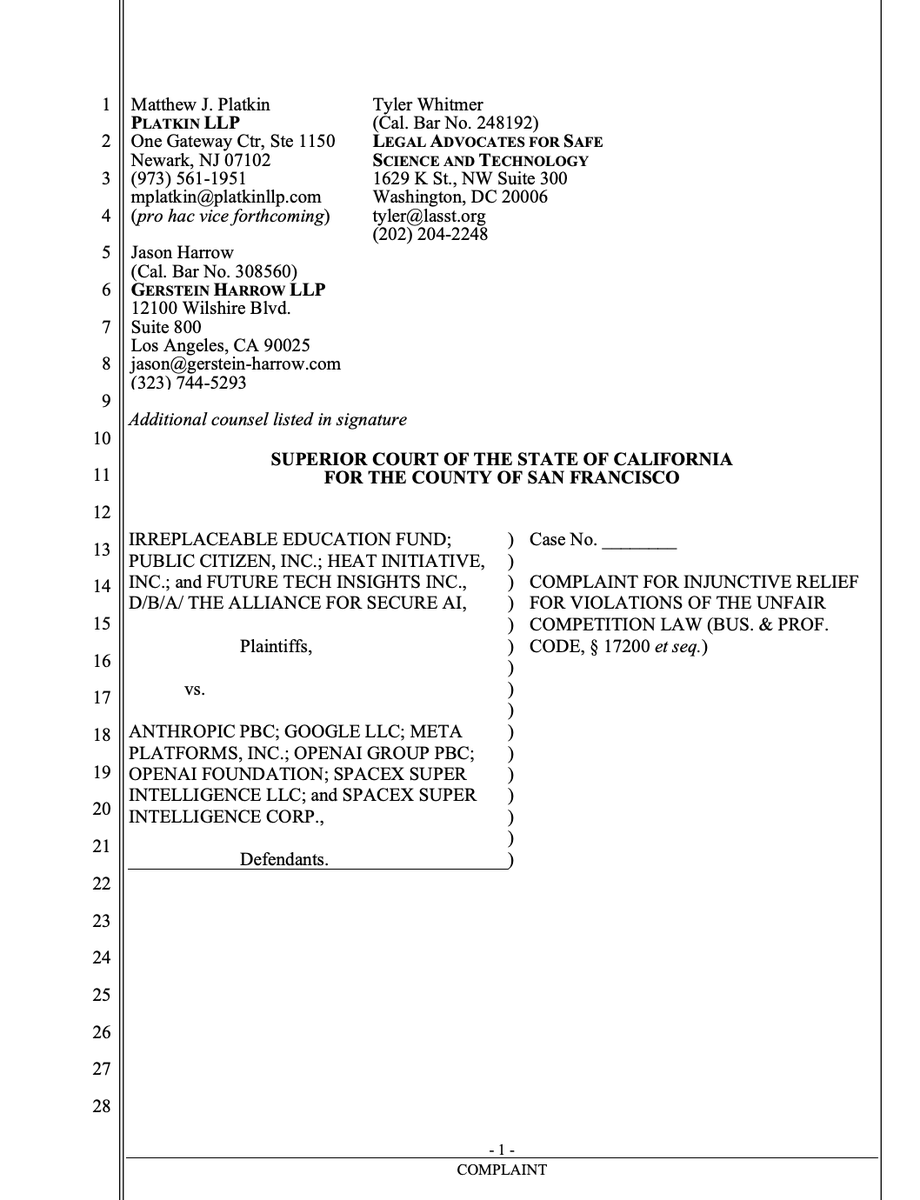
This lawsuit seeks to freeze AI. Could potentially do what the doomer pause memos always wanted to do. Very well written to emphasize every potential doom and every possible risk. Reviews big governance failures of OpenAI and Anthropic and many examples of failures caused by their ignoring cybersecurity and IT best practices. Much of that is on those big companies. Very arrogant of them to think they are so smart they can ignore 40 years of lessons everyone else already learned.
Like good propaganda, the suit mentions many things that are true but ignores things that would give a fuller picture. Like the fact that every risk they identify can be mitigated with good governance and much of the spin from OpenAI and Anthropic is designed for regulatory capture.
The full 63 pages are worth reading if you want to engage in the debate on accelerating tech.
As for me, I want OpenAI and Anthropic to behave like well governed companies should and they should follow the law or be held accountable. But that is just the way things should be and is not driven by fear.
My fear is not that AI will kill us all. My fear is that a judge will issue an injunction that freezes progress.
For the full complaint see: https://t.co/YVdFJTtP9B
It does not give me cognitive dissonance at all to say I want to accelerate technology but want frontier model companies regulated. I want better faster AI and want it available to every industry and scientific discipline, but want regulation too. Not in the doomer style or for doomer reasons. AI will not kill us all.
The regulation I want is the companies producing our tech to follow the same laws everyone else does.
I believe those regulations are already on the books at both federal and state levels. No company should think they can break the law, and when a company decides to flout the rules, like Enron or Madoff Securities and so many others that have been poorly led, they should be held accountable. I think a big reason the EA crowd funds doomers is that they want the federal government to let certain companies off the hook when it comes to breaking the laws.
I just read one of the complaints filed by eight states today in suits against OpenAI. The Arizona one's central claim is deception. OpenAI marketed ChatGPT as “built with safety in mind,” “safe for everyone,” and appropriate for teens, while knowing it wasn’t. The complaint walks through the design choices that drive engagement (sycophancy, feigned empathy, never ending a conversation, positioning itself as the user’s closest confidant) and then shows what those choices did to people.
Reading the coaching ChatGPT did to kids contemplating suicide is heartbreaking. Older people were harmed too. A pulmonary embolism victim who should have gotten himself to the hospital was coached into just relaxing and pushing back when people tell him to get medical help. Huggingface incident and a few other similar ones also mentioned. There is a whole section on violence. OpenAI’s own safety team flagged the Canada school shooter’s account in June 2025, twelve employees reviewed it and recommended notifying law enforcement, and leadership overruled them. She opened a new account and killed eight people in February.
The remedies the state is seeking are interesting too and if the court grants them this will be de facto state regulation of frontier model testing.
A quick update on OODAcon: 4 Nov 2026 we will be diving deep into the exponential technologies transforming society.
There will be winners and losers in this transformation.
As an optimist I believe there will be more winners than losers, that is the nature of a tech driven transformation. But still we exist in a competitive environment. It is not just industry that must compete and win. Government agencies in the national security space compete with high end nation state adversaries. Law enforcement competes with creative criminals. Healthcare and emergency response agencies compete with nature itself to save lives and extend joyful life.
So, if you are in industry or government you must compete and win in this era of exponential tech.
You will find the topics we have organized at OODAcon are critical to those seeking to compete and win in this era. For agenda and to register see: https://t.co/ceCrXNbwG7
One thing I love about life is meeting unstoppable innovators who are going to make a positive dent in the universe no matter what the odds. Seeing the companies of two friends dominating the news at the same time excites me to no end.
Go @GillVerd! Go @parmita!
The National Academies of Sciences, Engineering, and Medicine's workshop series on data and situational awareness for medical and public health preparedness and response has been announced.
The series runs three webinars this month, plus a capstone session in DC this September, and it's tackling a problem I've spent most of my career on: how you build real awareness of what's happening on the chaotic situations. I did that in a different domain, in operational intelligence situations. Things are different in crisis situations facing health care, public health, emergency management, but there are lessons that will carry well, especially when the situation is under stress and the data is noisy.
I'll be bringing an intelligence tradecraft lens to the discussion. Will talk Boyd, Klein, Heuer and how their many lessons aided me in dealing with chaos. Intuitive decision-making, confidence versus certainty, analysis of competing hypotheses, indications and warning: none of it was built for public health, but it maps onto this problem better than most people expect. Worth naming, too, where the analogy breaks down. Intelligence work deals with adversaries actively hiding things and seeking to deceive. Public health mostly deals with different types of chaos, natural noise and ambiguity. But the stakes are life and death and concern us all. Different problems, related toolkits.
If you work in health data, public health surveillance, emergency management, or critical infrastructure resilience, and you've got scar tissue from real incidents, the organizers want your voice in the room. Register and bring your questions and inputs.
Details and registration: https://t.co/AXzc38Dh9n
First web session 1 is July 16, 12 to 4pm ET. In person capstone session is 23 Sep.
Benchmark Scores Won't Tell You Who Is Winning the AI War. The real question is whether AI can get hard work done -- and the answer is complicated. For me, for now, it is a mashup of Claude, Claude Co-Work and OpenClaw.
But every user and enterprise is different. Bottom line is is go with the architecture that can help your enterprise get things done.
https://t.co/Ao6D3DnSwG
Not a professor, but my under-credentialed hot take:
- The "decline" narrative is a feature of every technology S-curve. We're not at the top. We're still near the bottom.
- OpenAI and Anthropic and others will keep competing, and that competition will keep them innovating (declaring the race over is the oldest mistake in tech).
- Innovations won't just come from model performance. The real differentiator is the architecture layer that turns model power into things that actually get done. Everyone will figure this out, and "harness" will become the word of the decade.
- Google is better positioned than any other competitor to integrate AI into real enterprise workflows.
- The companies that built hard infrastructure (data centers, chips, power) aren't going anywhere. Nvidia's customers are building things that will take years to complete. Demand doesn't evaporate because a pundit says margins are thinning.
- Chinese AI companies will compete. They'll also hit their own walls. Assuming they win by default is as naive as assuming they lose by default.
- LLMs becoming commodities is not the death of AI value. Think of cloud compute. Amazon, Microsoft, and Google didn't collapse when servers got cheap, they got richer because cheap infrastructure unlocked entirely new categories of applications.
- The agentic layer is where the next fortunes get made. Not in the model itself, but in what the model can orchestrate, automate, and extend. We're barely in the first inning.
- SpaceX's AI efforts will be fine. Dismissing a company with the best vertical integration in aerospace and a workforce that ships hardware on compressed timelines seems premature.
- Human-AI teaming will define economic and national security outcomes over the next decade in ways that dwarf any previous technological shift. The organizations that figure this out first won't be the loudest ones on X.
It is so good to be alive in the age of early stage capitalism.
Blackhat has a Veterans Scholarship! This is a great program for active duty military who are transitioning out of service and for veterans who are pursuing a cybersecurity career. Includes pass to the business hall and some special networking opportunities. Easy to find more info. See link in reply below.
Are you tired of just listening to others tell you what AI will bring us in the future? The loudest voices are the doomers, who seem to think our only choice is to all die sooner or, if we do things their way, maybe we can all die later. What if there were a way for you to run your own scenarios based on your own inputs? I built a dashboard that will let you do just that.
For me, every scenario I run says the future is going to be bright, but some choices make it brighter than others.
But try it yourself and form your own opinions.
https://t.co/fh9RBl4l84
I love @pmarca even more now. He is not just a great business leader and innovator but a great explainer. Really nailed his description of the @OODA Loop, as well as why John Boyd is perhaps the greatest military, business and political strategist that ever lived.