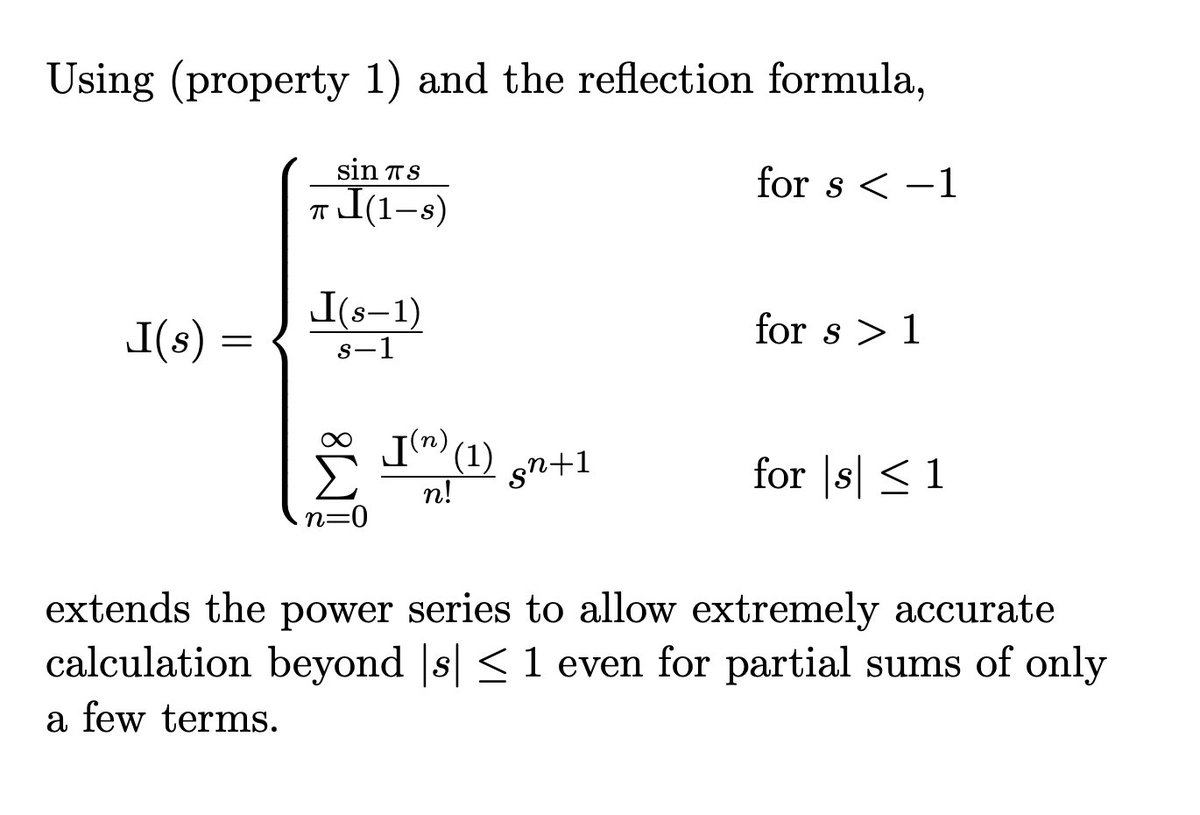
It can be computed to extremely incredible precision with just a few terms of the power series over a very wide range of inputs using the following trick:
While we can add, subtract, multiply, and exponentiate just fine, we cannot generally divide. For instance,
(1+h)(1-h) = 1 - h^2 = 0
which implies the existence of zero divisors and hence, it is not a field, unlike the complex numbers.
The algebra is quite cumbersome in the reals but drastically simplifies in the complex numbers.
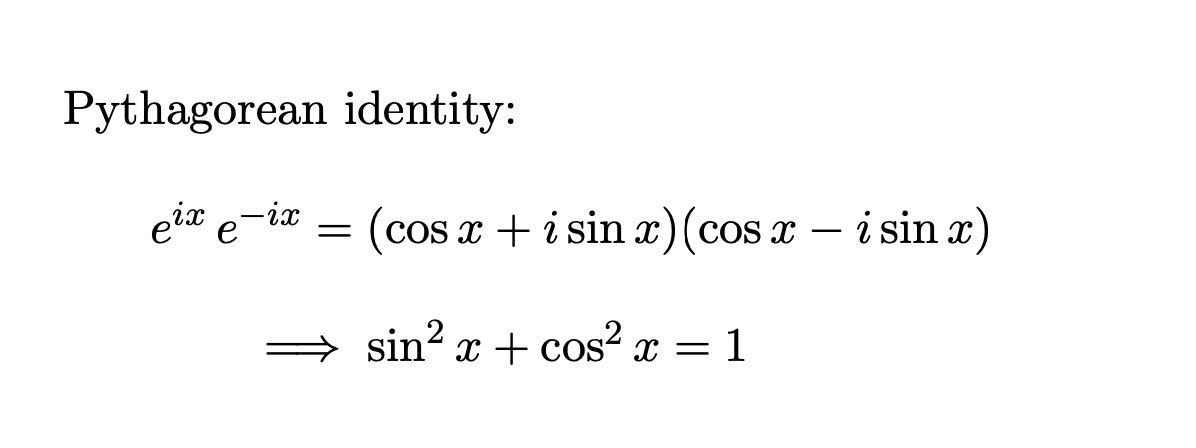
Algebraically, it is structurally far simpler to treat each pair of identities at once in one equation over C rather than splitting it up into two equations over R.
Once in a while I like to review basic but truly fundamental ideas in mathematics.
Here's a very short thread on how integral path independence leads to Cauchy which leads to power series:
⬇️
Cauchy's foundations for calculus using integral path-independence is more ontologically fundamental, but pedagogically it is also useful to approach this from the opposite direction using more elementary tools.
I compiled a short thread of some of the most important basics: ⬇️