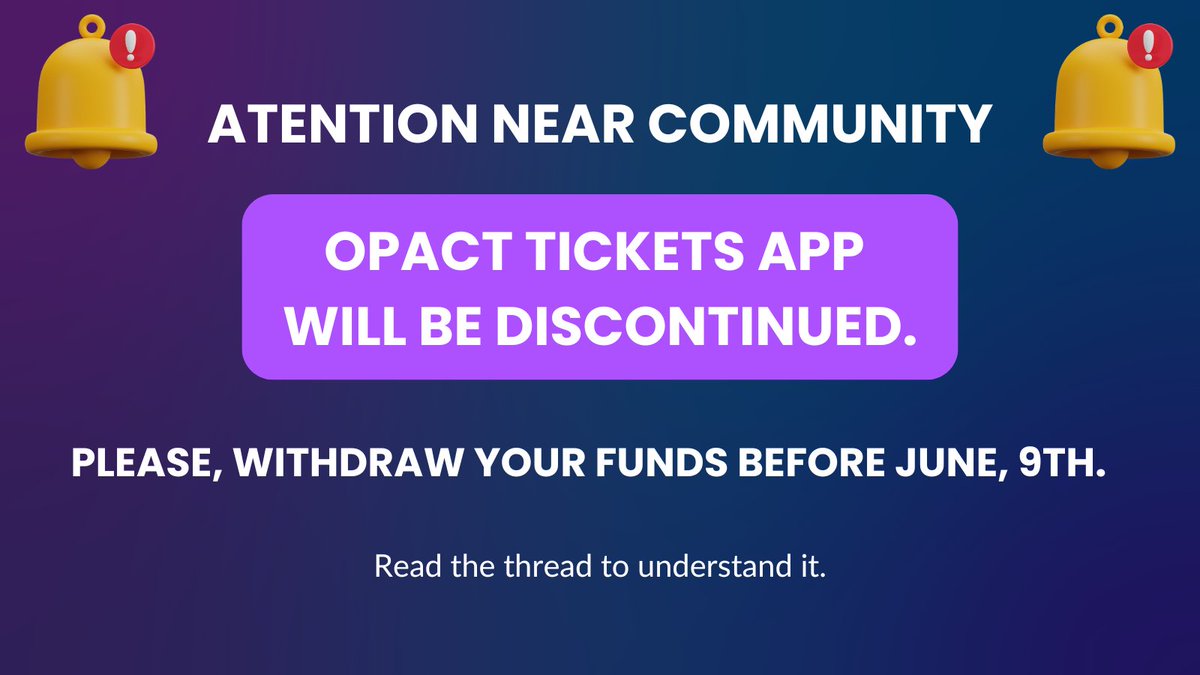
Dear @NearProtocol Community,
We’re discontinuing the Opact Tickets app interface & relayer system. You can still interact with the smart contract via Near’s CLI. The project remains open source for anyone to develop interfaces.
👇 Please read this important update.
Dear @NearProtocol Community,
We’re discontinuing the Opact Tickets app interface & relayer system. You can still interact with the smart contract via Near’s CLI. The project remains open source for anyone to develop interfaces.
👇 Please read this important update.
@chillingcatcash We're still figuring out what to do with Kadena, while our legal advisers study the case. The app is still running on testnet for now!
/6 Lastly, a heartfelt thank you to the Near Community, especially our users and supporters. Your efforts have pushed the envelope in privacy tech. We hope our contributions set a new standard for the future.
This special video from the #hack_a_pills series is split into two parts and logically explains when a system has privacy and when it does not.
Technical definition of privacy - Part 1
It’s important to differ from the moral intentions of a system, e.g., a specific website should not disclose that you have an account there, from the technical feasibility of the system, e.g., anyone can try to create an account with your email and check if you already have one.
A system is technically private whenever it’s not possible to extract information that should not be extracted, and vice-versa.
Check out the complete video: https://t.co/PSOisv6Dur
We’re exhaust to say that everything you do on-chain is visible for anyone to see since the blockchain is public. But what we are curious is: what scares you the most about it?
PS: your votes are anonymous!
What gets you the most excited about Opact Wallet? Is it the possibility of performing private transactions? The astonishing UI that our team has created to make it super easy to use? Or is it something else?
We’re excited to hear from you, tell us in the comments!
When using Opact Wallet, the only information effectively stored in the blockchain are the transactions depositing and withdrawing from smart contracts.
Due to zk proofs, however, it is impossible for an external observer to infer who is paying whom and the real owner of assets.
#HACK_A_PILLS
Privacy is not a single concept, but it does relate to the leakage of information that could lead to gains/losses, be it legally, morally, or economically. Let’s not get more confused!
Check out the complete video: https://t.co/SN5o4tYYOn
The key to making the protocol work is the zero-knowledge circuit.
The circuit is a mathematical proof that allows the SM to verify that a user is allowed to withdraw funds from Opact Wallet without revealing any information about the user's balance or the source of the funds.
#Hack_a_Pills
In economic terms, privacy relates to information asymmetry that leads to financial gains or losses.
If I have inside trading information, I could move the market for my own benefit, even though the information should be kept private.
In the context of blockchain, this arises especially with MEV, but different data leakages lead to economic gains and losses in the ecosystem.
You can check the full video at: https://t.co/tY2G1CLF1g
#Hack_a_Pills - Moral Concept of Privacy
Privacy can be seen through different lens. In the legal context, privacy relates to what should and what should not be private according to the law.
Tornado Cash is a notorious case in which a private system was not legally accepted - and this is not a moral conclusion, just a legal one.
Check out the whole video: https://t.co/sOLnyhUM7R
Opact Protocol works as a smart contract (SM) in the Kadena Blockchain that carries a ZK circuit within it.
It is a single SM that receives funds from all users that use it.
The SM is responsible for keeping track of the balance of each user, and for allowing users to withdraw.
We have decided, for Opact’s initial implementation, to not enforce any particular AML protocol at the smart contract level. The security is instead being enforced on the frontend level.
This allows for a more flexible implementation and for multiple AML providers to coexist.
Opact Protocol was designed to be 100% agnostic with different AML rules and providers.
We do not block any transaction at the protocol level, leaving the blocking choices for the frontend developer.