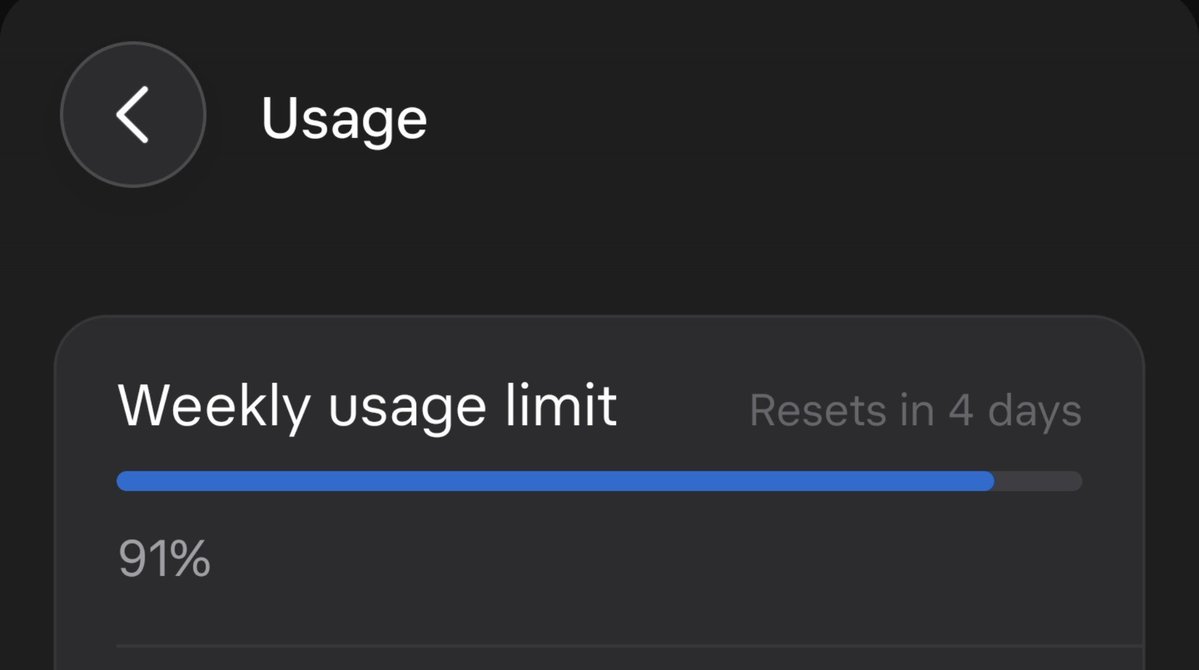
@IamEmily2050@_mohansolo Mano, num é assim.. o de 200 tem que ter limites maiores. Tenha responsabilidade já que eles te ouvem/vêem. Os limites deles está UMA grande merda!
@larsencc@SamSokolin Irmão, com todos sinceridade do mundo, não vi nada disso aqui.. continua tudo ruim. Estou evitando até abrir meu Grok bot. Péssimo (sou assinante ultra). Limites ruins, trabalhos ruins.. mano, vocês precisam arrumar isso.
@alecwilcock Irmão, Grok bot é outra merda (assinante ultra falando). Mesmo coisa do intinct: funciona no começo e até impressiona.. mas depois fica uma merda.. acaba sendo pior porque você paga bem caro e os limites também são uma merda, infelizmente. Muito decepcionante.
@chrismaconi Mano, você nunca deve ter usado o Claude code ou Codex.. num é possível.. tirando o acesso nativo ao X, de resto, vejo só péssimos trabalhos.. demorados, limites de merda (tenho o plano ultra).
@aicodeking Irmão, concordo plenamente. Estou na plano ultra e os limites vão igual água e com um péssimo trabalho. Não estou querendo mais nem abrir o Grok bot. @poteto@mattyp
Always test the result with the AI switched off, not only with it on. Alpha School charges up to $75,000 a year, and about half of its students missed the math goal.
I was reading the report by Muskaan Arshad, a Fortune reporter, and I opened the full story, not the headline.
I read the numbers slowly, one by one.
The promise is learning twice as much in two hours of class a day, with an AI tutoring app.
About half of the K-8 students at the private campuses missed the goal of learning math twice as fast, and about one in five missed the reading goal.
Among students who started behind, only 37% hit the 2x growth goal by winter.
But the number that bothered me most came from another part of the same story.
A study of 26,811 students in China saw homework scores rise 18% after AI use, and closed-book exam scores fall 20%.
I think the problem is where we look: the result with the tool on almost always looks great.
To be fair, the story itself has the other side.
Fortune notes that how students use AI matters as much as whether they use it: moderate users did about the same as non-users.
So the first step is simple: set aside a sample and measure the result without the AI, the way an exam does.
Because measuring only the homework means finding out too late that nobody learned.
Source: https://t.co/Tka1G7VikE
@iamdemetrius_ Discordo totalmente. Já foi, mas não é mais. Estou no plano ultra e é tudo uma bosta. 80% do limite em 2 dias. E não me venham com use menos.. não faz sentido nenhum. Sou mais o @hark_labs agora.
Measure today how many days your team takes from a bug report to the patch going live. Google's Project Zero will shorten its disclosure deadline through 2028, and the stated reason is AI.
I was reading the piece by Natalie Silvanovich, a Project Zero researcher, and I opened the original in full, not the headline.
Since 2021 the policy gave vendors 90 days to fix, plus a month of soak time for the patch to reach users.
Now the soak time is gone: the bug is disclosed 90 days after the report, period.
In February 2027 the deadline drops to 60 days, and in January 2028 it drops to 30.
The reason is in the text: LLMs speed up finding and exploiting bugs, and they now find several a week where they used to find a few a year.
But the line that bothered me most was a different one.
They treat the time between patch and exploit as close to zero.
I think this changes the math for anyone building: fixing fast stopped being polish and became a deadline with a date.
To be fair, the source cites the other side: vendors asked for a gradual cut, afraid of rushed fixes making the bug worse.
That is why the cut comes in steps, and there are exceptions: bugs already exploited, already public, or disclosed at the vendor's request.
The first step is simple: write down the report date and the patch date, and look at the gap.
Because finding out your gap only when the deadline drops is finding out too late.
Source: https://t.co/JMFXL18Ewe
E é exatamente isso que venho criticando há semanas sobre o Grok Bot.
O problema não é só a qualidade das respostas, que já caiu bastante. São os limites cada vez mais baixos, inclusive para quem paga pelos planos mais caros.
Eu mesmo tinha duas contas Ultra, cancelei uma e estou considerando cancelar a outra.
De que adianta vender uma assinatura com 50x de uso se, na prática, a experiência parece ser de 5x?
O pior é que a concorrência está avançando muito rápido. Aos poucos, tenho migrado boa parte do meu uso para o Hark Pro.
A xAI precisa entender que não basta ter um modelo poderoso. O produto precisa funcionar bem, ter limites coerentes e entregar valor para quem paga.
E, sinceramente, a cada dia fica mais difícil justificar essa assinatura.
Turns out Grok Bot $20 plan has pretty low limits. I like the quality of life features it provides, but not enough to justify going above $20/mo with my casual usage. Is anyone else facing the same issue as well?
Test your MCP server from the outside, with real calls, before you open it to the public. The official MCP spec lists 4 obligations for every server: validate inputs, control access, rate limit calls and sanitize outputs, and mine passed 20 of 20 in the public test.
Yesterday I put a remote MCP server online, and this is the story of that test. MCP is the standard that connects tools and data to AI assistants, and its spec, published in July 2026, is still the current version today.
There's a detail in the security of these servers that I think a lot of people still aren't paying attention to: testing only from your own computer proves nothing.
Mine is read-only and serves a library of texts about AI that I wrote.
So I ran the test from the outside, over the internet, the way a stranger would.
What came back:
no token, blocked,
wrong token, blocked,
unknown origin, blocked,
a request for a private file with "../", refused,
too many calls, cut off at call 48.
But the part that gave me the most relief was something else.
Before it starts, a gate scans the library for emails, phone numbers, CPF (Brazil's tax ID) and token patterns. If it finds anything, the server simply doesn't start.
If a formatter fails, that's one kind of impact. If a security check fails silently, the impact is completely different.
A control that fails silently is not a control we can trust.
The real caveat: that gate is still a list. A name that isn't on it would get through. And that bothers me a lot.
That's why the list of allowed files comes first, and I review every release.
The spec itself also asks for a human who can deny a tool call. It doesn't put everything on the server.
I use AI every day to build things like this. But in my view, the outside test is the part you can't skip.
My suggestion for anyone shipping an MCP server is simple: also test what happens when a stranger calls it the wrong way.
Because working on your computer says nothing about what a stranger can pull out of it.
Source: https://t.co/3F6auxDtrB
A cada dia que passa, tenho menos vontade de abrir o Grok @bot .
Problemas de qualidade, limites de uso, performance muito abaixo do esperado... E olha que pago o Ultra.
O pior é que o bot performa tão mal que acaba torrando minha assinatura tentando resolver coisas que outros agentes fazem tranquilamente.
Eu tinha duas contas Ultra. Já cancelei uma e estou considerando seriamente cancelar a outra.
Que assinatura é essa de 50x que, na prática, parece 5x?
Sem contar o atraso do Grok 4.8, que talvez pudesse melhorar boa parte desses problemas.
E acho que a xAI está subestimando uma coisa: enquanto eles não resolvem isso, outros produtos estão chegando, entregando tão bem quanto ou até melhor, e conquistando esse espaço.
Eu mesmo, aos poucos, estou migrando praticamente tudo para o @hark_labs (e, por favor, não me decepcionem nesse negócio de limites.)
E o mais preocupante para eles é justamente isso: chega uma hora em que você simplesmente perde a vontade de voltar.
@mattyp@poteto
@_lopopolo@brandon_galang@artichokeruby Estou com o Brandon, irmão. Acho meio que uma besteira, para ser sincero, isso de vários e vários modelos. Vejo até uma questão de "aparência" na comunidade também. Mas enfim..
Measure the contrast of every piece of text in both themes before you ship a screen built with AI. The W3C, which sets the web's accessibility standard, asks for at least 4.5:1 between text and background, and a report I built hit 1.66:1 in light mode.
This one is on me: it happened this week, with two web-page reports I built with AI.
In dark mode, everything looked great.
In light mode, this is what showed up:
big card numbers washed out,
timeline labels fading away,
times almost invisible,
all of it in a fixed accent color on a gray panel.
But here's the thing: nobody had opened light mode before shipping.
The W3C rule is very objective, and the number is a hard threshold: almost there doesn't pass. Brand colors don't get you out of it either.
And it exists for a very concrete reason: a lot of people lose contrast sensitivity with age, and faint text simply disappears for them.
Generating a pretty screen is one thing. Shipping a mature, stable, reliable product is another.
My advice for anyone building with AI is simple: test what happens in the other theme too.
So I set up a check that runs before delivery: it opens the page in both themes, measures every piece of text against the real background, and fails anything below the minimum.
Then I forced a failure on purpose and watched whether the check caught it. It did.
I think a lot of people generating screens with AI only look at the theme they work in.
AI is making execution cheaper and cheaper. But checking is still on us.
Because a screen can pass perfectly in your eyes and still fail in the eyes of the person who has to read it.
Source: https://t.co/UJMMsWppIo
Mas se eu criei a porra da rotina, é porque preciso dela, certo?
Aí a dica pra conseguir usar o serviço é… cortar as rotinas? Eu pago US$ 200 pra ficar pensando em como usar o mínimo possível?
Mano, vocês são loucos. Hahahahaha
Pro tip from @poteto: ask your bot where your usage is going, then cut the routines down. I did exactly that this week and went from 79.8% of my plan to 37.5%. h/t @mattyp