El CEO de Anthropic viendo como China lanza un nuevo modelo de IA que supera a Claude Opus 4.8 en TODO, iguala a Fable 5 costando 8 VECES MENOS, que encima es 100% Open source y no puede hacer nada al respecto
HORMUZ TRAFFIC HOLDS FIRM
Traffic through the Strait of Hormuz remains steady despite renewed attacks on commercial ships and rising Middle East tensions.
Ship-tracking firm Kpler recorded 36 vessel crossings on Monday and 41 on Tuesday—roughly in line with last week's daily average of about 40 crossings.
Bitcoin traders’ unrealized profit margins hit 17.7%, the highest since June 2025.
The last time margins reached these levels while Bitcoin tested the 200-day MA was March 2022, just before the downtrend resumed.
Jose explains why agent harnesses may become the new battleground for software.
“The products that are most successful are the ones that are built for agents... The agent harness is what defines what model it wants to use, what services it wants to use, and that is pretty valuable.”
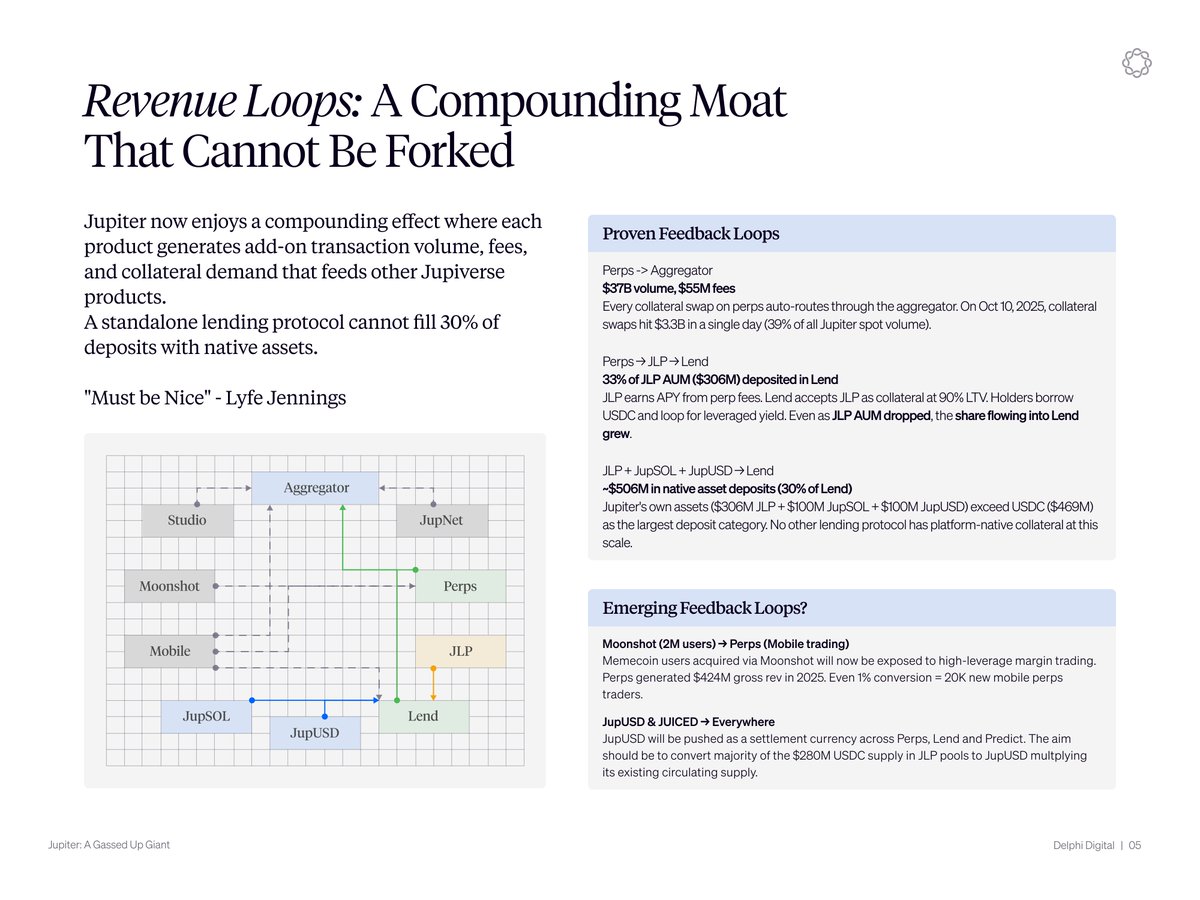
Our new report "Jupiter: A Gassed Up Giant" is Live and Free to read!
@JupiterExchange did $184M in protocol revenue in 2025 with no venture funding and a near-zero capital base.
JUP now trades at roughly 9x annualized revenue while Aave trades at 20x.
The disconnect comes down to categorization. The market sees a cyclical DEX aggregator, but the team has spent the last 18 months shipping 10+ new product lines while defending 80% of Solana spot aggregation.
What makes this durable is the product flywheel underneath it. Perps auto-route collateral swaps through the aggregator, generating billions in spot volume as a byproduct. JLP earns yield from perp fees and a third of its AUM flows into Jupiter Lend as collateral.
Jupiter ranks as the third-largest perp earner behind only Hyperliquid and EdgeX. When JupNet goes live and GUM opens access to equities, commodities, and forex, every new asset class feeds volume across the entire stack.
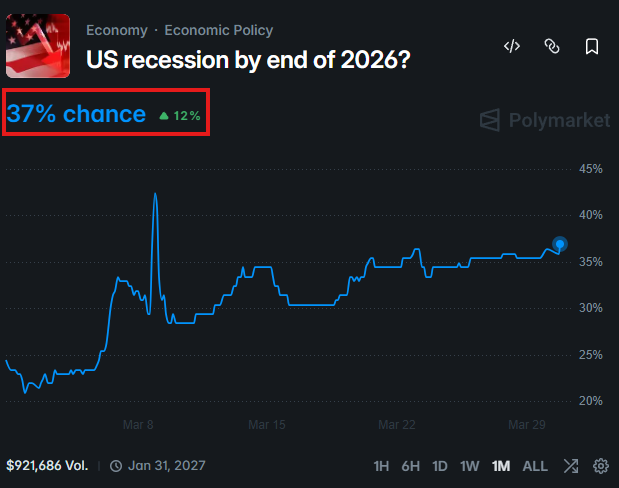
BREAKING: There is now a 37% chance that the US economy enters a recession by the end of 2026, per Polymarket.
US oil prices are officially up +$50/barrel from their December 2025 low.
I re-built the Fear & Greed index.
Wanted something deeper and actually accurate.
So I completely re-engineered it from scratch.
10+ inputs:
- volatility (VIX level + term structure)
- options positioning (put/call ratios, skew)
- trend (SPX vs 20d / 50d / 200d)
- market breadth (advancers vs decliners)
- new highs vs new lows
- momentum (sector leaders vs laggards)
- % of stocks above key ma's
- credit spreads (risk-on vs risk-off)
- flows (etf + fund inflows/outflows)
- sentiment (social + positioning data)
It's ludicrous that we are ~6% off ATHs in $SPY, and CNN's Fear & Greed Index is reading "extreme fear" at 16 (!!!).
My Fear & Greed Index 2.0 is reading 38.7
Definitely gives a better representation of where we currently are + potential room lower (or higher).
Made with @perplexity_ai's Computer again...will update reading daily.
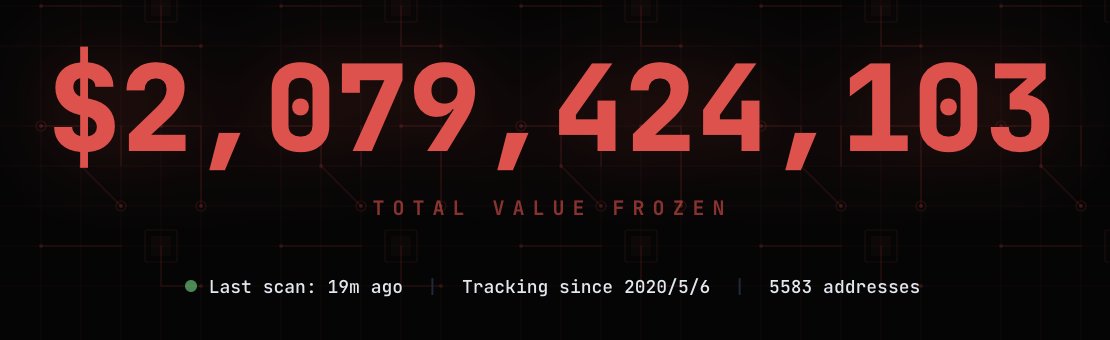
You don't own your stablecoins. Circle and Tether do. And they have a remote kill switch.
Introducing ➡️ https://t.co/7IulaUkdoW
I built a real-time tracker for every single blacklist event on Ethereum and TRON. The data is brutal: thousands of addresses frozen, billions of dollars locked.
No trial. No appeals. No recourse.
What’s under the hood:
- Auto-syncs from Etherscan & TronGrid every 30 mins
- Cumulative charts & monthly freeze breakdowns
- Top censored wallets & a live address checker
Built on the same .rip matrix architecture: open, zero tracking, no signup.
If you hold $USDC or $USDT, you need to see this. Welcome to the transparent fiat prison. 🏴☠️
Now, the quantum resistance roadmap.
Today, four things in Ethereum are quantum-vulnerable:
* consensus-layer BLS signatures
* data availability (KZG commitments+proofs)
* EOA signatures (ECDSA)
* Application-layer ZK proofs (KZG or groth16)
We can tackle these step by step:
## Consensus-layer signatures
Lean consensus includes fully replacing BLS signatures with hash-based signatures (some variant of Winternitz), and using STARKs to do aggregation.
Before lean finality, we stand a good chance of getting the Lean available chain. This also involves hash-based signatures, but there are much fewer signatures (eg. 256-1024 per slot), so we do not need STARKs for aggregation.
One important thing upstream of this is choosing the hash function. This may be "Ethereum's last hash function", so it's important to choose wisely. Conventional hashes are too slow, and the most aggressive forms of Poseidon have taken hits on their security analysis recently. Likely options are:
* Poseidon2 plus extra rounds, potentially non-arithmetic layers (eg. Monolith) mixed in
* Poseidon1 (the older version of Poseidon, not vulnerable to any of the recent attacks on Poseidon2, but 2x slower)
* BLAKE3 or similar (take the most efficient conventional hash we know)
## Data availability
Today, we rely pretty heavily on KZG for erasure coding. We could move to STARKs, but this has two problems:
1. If we want to do 2D DAS, then our current setup for this relies on the "linearity" property of KZG commitments; with STARKs we don't have that. However, our current thinking is that it should be sufficient given our scale targets to just max out 1D DAS (ie. PeerDAS). Ethereum is taking a more conservative posture, it's not trying to be a high-scale data layer for the world.
2. We need proofs that erasure coded blobs are correctly constructed. KZG does this "for free". STARKs can substitute, but a STARK is ... bigger than a blob. So you need recursive starks (though there's also alternative techniques, that have their own tradeoffs). This is okay, but the logistics of this get harder if you want to support distributed blob selection.
Summary: it's manageable, but there's a lot of engineering work to do.
## EOA signatures
Here, the answer is clear: we add native AA (see https://t.co/YD9nIpsxcC ), so that we get first-class accounts that can use any signature algorithm.
However, to make this work, we also need quantum-resistant signature algorithms to actually be viable. ECDSA signature verification costs 3000 gas. Quantum-resistant signatures are ... much much larger and heavier to verify.
We know of quantum-resistant hash-based signatures that are in the ~200k gas range to verify.
We also know of lattice-based quantum-resistant signatures. Today, these are extremely inefficient to verify. However, there is work on vectorized math precompiles, that let you perform operations (+, *, %, dot product, also NTT / butterfly permutations) that are at the core of lattice math, and also STARKs. This could greatly reduce the gas cost of lattice-based signatures to a similar range, and potentially go even lower.
The long-term fix is protocol-layer recursive signature and proof aggregation, which could reduce these gas overheads to near-zero.
## Proofs
Today, a ZK-SNARK costs ~300-500k gas. A quantum-resistant STARK is more like 10m gas. The latter is unacceptable for privacy protocols, L2s, and other users of proofs.
The solution again is protocol-layer recursive signature and proof aggregation. So let's talk about what this is.
In EIP-8141, transactions have the ability to include a "validation frame", during which signature verifications and similar operations are supposed to happen. Validation frames cannot access the outside world, they can only look at their calldata and return a value, and nothing else can look at their calldata. This is designed so that it's possible to replace any validation frame (and its calldata) with a STARK that verifies it (potentially a single STARK for all the validation frames in a block).
This way, a block could "contain" a thousand validation frames, each of which contains either a 3 kB signature or even a 256 kB proof, but that 3-256 MB (and the computation needed to verify it) would never come onchain. Instead, it would all get replaced by a proof verifying that the computation is correct.
Potentially, this proving does not even need to be done by the block builder. Instead, I envision that it happens at mempool layer: every 500ms, each node could pass along the new valid transactions that it has seen, along with a proof verifying that they are all valid (including having validation frames that match their stated effects). The overhead is static: only one proof per 500ms. Here's a post where I talk about this:
https://t.co/rAUSJjW7WL
https://t.co/EtXpkaDll5
@PrimordialAA@PrimordialAA If you claim the token unlock data is incorrect, why don't you fix it? I don't believe you lack the resources to do this. Posts in X don't have that much power. You could change your mind tomorrow and delete it.
BlackRock’s BUIDL, the world’s largest tokenized RWA, is now accepted as off-exchange collateral for trading on #Binance
This milestone reflects our dedication to enabling institutions to access digital assets with control, yield, security, and capital efficiency.
👉 https://t.co/lngav16D6m